Category Archives: Triple-Bottom Line Articles

Etsko Schuitema on Intent, and the Care & Growth Model (An Interview)

At the core of the crises humanity is facing is the spectacular failure of controls and policies – be that in food management, financial sectors, international relations, governance systems, or even inter-personal relationships.

In a world that is becoming fragmented and franchised, more controls are impossible to implement. Yet there is a need of collective decision-making by people: an engaged citizenry.

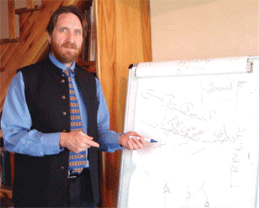
Etsko Schuitema, a transformation consultant, is the managing member of Schuitema – a consultancy about business transformation through business growth, based in South Africa, Pakistan, Europe and other parts of the world. In his work, Etsko has explored Intent as the core of being human, and developed the Care & Growth Model of Leadership – derived primarily from his research in the African mining sector. This is a brief interview, taken in 2008, and featured in Triple Bottomline Magazine, Karachi, Pakistan.

1. Why do people matter?

People are the bottom line. An organization is built to serve its chosen customers by adding value; as long as it genuinely does that, it survives.

Organizational leaders care for and grow the employees. If the organization does not concern itself with the benefit of people, it will not prosper as people grow wary of the relationship.

2. Yet, “people” are not the priority on most organizations’ plans.

That happens. There are two opposite models of leadership: The Pharaoh Model, and The Moses Model.

In the first model, the leader is the end, and people are the means. The society’s efforts are harnessed to glorify the leader and build grand structures of no value to the society. Pharaohs enslaved people to build pyramids.

The way of Moses is the complete opposite. People are the end, and the leader is the means to serve their best interest – which of course could sometimes require hard but fair measures by the leader. A true leader sacrifices to achieve the society’s fair aspirations.
The first kind of leadership does not thrive because it is not based on contribution to the society. It takes, it does not give. Only that which is generous, survives.

3. But all organizations serve customers. Where is the difference?

The issue is of where attention is given first. Is customer the primary concern, or profit? Profit follows happy customers. It’s not the other way round.

Then, who is the actual customer? In a school, for instance, it’s the students – not the parents, the management, or the society. The purpose of a school is to serve the students’ best interest. If that fails, everything else fails.

4. What is the essence of your Care & Growth Model of Organizational Leadership?

That an employer is a leader by virtue of empowering the people – by caring for and growing them; not by virtue of being able to ‘buy labor’.

Transactions occur between two equals.

The legitimate power structure is only where the leader provides unconditional care and fair and honest growth. The result of it is that employees are loyal to the leader.

Care refers to the ‘soft’ element: such as listening, empathy, genuine concern in the welfare of the employee, making provisions. Growth is the “hard” or control element: it means fairness and honesty, establishing accountability. Together, they serve the best interest of the people.

5. How does empowerment work?

People and things are not defined by boundaries, but by transcending their boundaries.

True leaders concern themselves with removing limitations to the realization of people’s potential. This is achieved by giving employees the means and the ability to perform their jobs, without which they are not truly accountable. Over time, the leader removes controls and creates conditions for growth, much like a gardener does not “grow” the plants, but creates the right environment. Ultimately, leadership is about gradually surrendering control.

But for this, the leader needs to have the big picture in mind.

6. What is meant by the (incremental) surrender of control, as described in the model?

Organizations are like living organisms, composed of structures and systems. First, this means the flow of work and addition of value from input to output. Secondly, it entails the policies and procedures that govern the flow.

Living organisms change, so must organizations. The process of change is a gentle, incremental suspension of control. In little bites, the structure flattens over time. And the system shortens as it shifts from procedure-driven to policy-driven.

7. How does Intent function? How does it transform the organization’s relationship with the society?

Intent is a process of maturation – it’s a shift of attention from “I am here to get” to “I get to give/ I give to get” to finally “I am here to give.” From malevolent intent to benevolent.

The first stage of this maturation journey is an infantile attention; it’s selfish and based on own needs. Its primary concern is greed.

The second is the adolescent concern with fear; which leads to hostility and aggression. Its organizational equivalent is a focus on competitiveness. In later adolescence there is a shift towards bargaining: service is conditional on getting back.

The third intention is mature. Organizations at this stage are concerned with generosity, which means good (corporate) citizenship. The focus is on leaving something to the community and social engagement.

This journey of maturation is not necessarily bound by specific time, but it occurs over these stages.

Intent defines the framework and seeps down to the operational level. It’s not enough to have benevolent intent; the best organization measures itself by it.

8. How do organizations ensure sustainability?

Sustainability by extending more controls is not achievable – it should not even be the goal. Death is the most certain of all things, and we all die alone. Showing courage in the face of death is the measure of one’s preparedness. Organizations don’t die like people do, by age, but they do if they don’t concern themselves with generosity and ultimately courage.

What courage means is that there comes a stage where there are issues larger than the collective – the interests of society. Groups mean the individual participant has to surrender some value at some point to the collective. Courage is to walk the path alone. To look beyond one’s interest, and even the demands of the society. To do the right and the appropriate, even if no one approves.


NOTES:

This article is part of a series of articles Ramala Hubb’Allah wrote (with her then name) during 2008-11 for Pakistan-based publication, Triple Bottomline Magazine, published by Asiatic Public Relations. The publication’s focus was Corporate Social Responsibility, Climate, Environment, and Developmental themes. This is the second article in the series, published in May 2008. Original version in print; web version on the TBL site here.

This article is lightly edited for clarity for republication on the Hubb’Allah website. Any changes in the works and ideas of the interviewee are not noted here, please research on your own for latest updates. This article is reproduced to present the collected body of Ramala’s works on the Triple Bottomline Magazine.
The People-Centered Model of Business (PC-MoB—aka The Salaam Matrix)

“Our way is not of feats of action, but feats of perception.”

Etsko Schuitema, author of Intent & Leadership
Teacher of the Care & Growth Model

The Dilemma

Sometimes, we refuse to change not because we don’t want to, but because we don’t know how to – and what to change to. Consider the dilemma of contemporary corporations within which kind souls wish to create a better world through business – but are caught in a worldview where business is equated with “not doing good.” Business is based on economics, and that, at its crude core is based on price and quantity. No wonder businesses only factor in Profits – not People and Planet.

What if we had a model that looked at the bigger picture?

PC-MoB: See The Big Picture

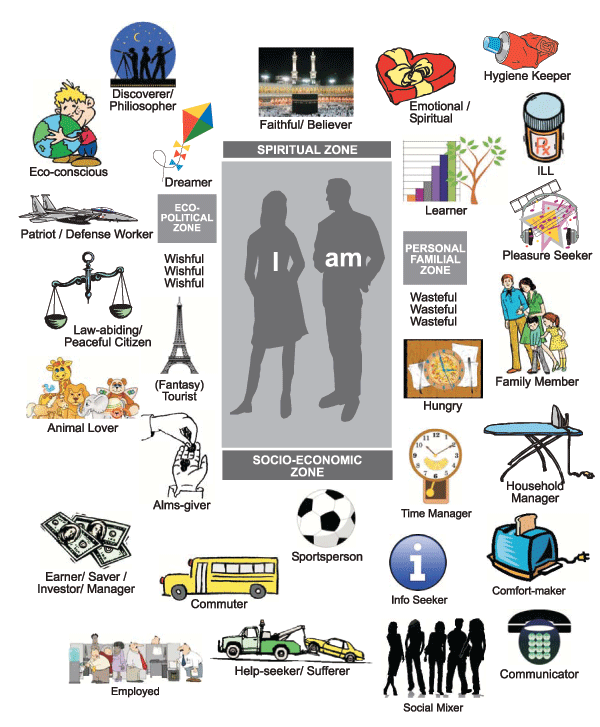
The People-Centered Model of Business (PC-MoB) is a practical tool through which organizations (businesses and others) examine the reality of their markets by focusing on human activity. It has multiple application modules including: Market Insight, Trend-Forecasting, Entrepreneurship, Creativity, Organizational Leadership, and Social Business – the last is detailed in this article.

The Four Life Zones

1. Spiritual (S) Zone

This Life Zone deals with people’s beliefs, ideologies, and life outlook – or the lack of them. Closely related to the faith system of individuals is their heart, their intellectual mind and free will. To understand a person or culture, it is important to understand their belief and spiritual system. A belief can be true, false, completely wrong, or absent. S zone is the primary PC-MoB zone, as it determines a person’s behavior in the respective life zones.

2. Personal-Familial (PF) Zone

The family is the basic unit of society. A person will always be an individual, in the context of their family – whether it’s joint, nuclear, or dysfunctional. Personal beliefs shape family dynamics and families shape society. In Maslow’s terms, the PF zone is where a person seeks emotional and physical security and stability. This determines the level and quality of peace in society, and its creative energy.

3. Socio-Economic (SE) Zone

A person interacts with the larger community for economic and social purposes. This is where a transaction occurs between personal-familial values of individuals and household units as they begin to interact with one another. A shared vision that governs these social contracts is created out of those dynamics. These in turn determine society’s collective behavior.

In the SE zone, a person rises above the self-development and family care needs to communicate with society at large. Help is given and taken. A person is both an employer and an employee in the economic system. Information is traded; people earn, save and build; and money becomes a medium of exchange. Technology emerges to facilitate the speed and beauty of transactions between people and resources.

A person chooses their SE zone behavior in line with how they have developed in the S and PF zones. Societies that have accessible information and open communication, where transactions are facilitated, and social contracts are honored become creative – and foster open opportunity. Else, they are unfair and transgressive. The latter are marked by confusion, resentment, violence and warped employment dynamics – as the case of Pakistan could be interpreted.

4. Ecological-Political (EP) Zone

Finally, a balanced human being, or society, progresses enough to participate in the larger universe – of law, politics, ecology, and cosmic philosophy. “Balanced” describes experiencing, learning, and evolving from the previous three zones. Some groups try to short-cut the first three zones, and jump into the universal zone perhaps as a means to avoid their duties and establishment of rights in the S, PF, and SE zones. That results in a perpetual futile conflict between these wishful idealists and society, which rightfully needs able persons.

In mature societies, the EP zone represents universal love, art, entertainment, travel, and discovery. Media is the child and the lifeblood of this zone – because by definition, media is media between the real products and people who already exist. A media that exists out of harmony with its own society heralds its own disabling through frustration. The institutions of charity, establishment of good and prevention of evil, collective prayer, the judicial system, defense, foreign affairs, and struggle are in the EP zone. These are higher level societal institutions that cannot be imposed on/by immature people.

The Cyclic Relationship of the Four Life Zones

The Four Life Zones are not strictly separate. Some roles overlap boundaries, others can fit into other zones. In a way, the four Life Zones are connected in a cycle: “The Circle of Life”. When each zone reinforces the other, it’s a progressive cycle. When each zone leads to spillover, ill effects on the next, it’s a vicious cycle.

Business = Busy-ness

Picture the Four Life Zones in movement. Where an ill person is being treated, a household manager is preparing food, one is building homes, or requires safety, travel, or learning – it is “the busy-ness of life.” Since these actions require a deep web of “helpers” who are paid in money, business is created. Business is thus a part of the society, if it is based on the real needs and understanding of the society. Whoever was trying to sell refrigerators to Eskimos was a true conman, and died unpopular.

The key is that our businesses cannot prosper without adding true value to their own consumers: an issue that is easily skirted -and hard to tackle- in a society as oft-ill-informed as Pakistan’s.

PC-MoB: The Social Business Module

“Social-izing business” is one of the most profound emerging global trends of the 21st century. This concept has various meanings, one referring to businesses whose primary aim is to serve social needs profitably. Business thinker C K Prahalad has built a case for doing profitable business for “bottom of the pyramid (BOP) markets” – which are the over 4 billion consumers of the world with modest but real spending powers. They represent a largely untapped market which can be served – and profitably so. Using PC-MoB to study the lives of the BOP market would reveal a multitude of niches that can be filled by small local businesses and create tremendous employment opportunities. This role has been typically relegated to NGOs and charities. We need a new construct that balances people + planet + profits; the imbalance of one shakes another

Application Scenarios

In Pakistan, food stock fluctuations can be better managed by improved warehousing and transport – leading to decrease waste in produce, and hence market prices. [SE-zone]

Tele-medicine services have seen an opportunity in sending mobile medical teams to otherwise inaccessible areas. [SE-zone]

In India, Unilever has a program called “Shakti” – literally meaning “power” – that empowers poor women by turning them into Unilever sales representatives – which in turn gives the women better lifestyles and expands the company’s reach. [PF-zone]

Note:  See the dedicated website The Salaam Matrix for new application scenarios of this model, developed 2024 onwards. 

Business Realizes Human Potential

Business is not a cancer. It is an integral, legitimate part of a healthy social organism. The condition is that the business is empathetic to the society/societies it operates in and helps legitimate “busy-ness”. The entrepreneur affects change when s/he accepts the society as is, and does not create products and markets for a make-belief group. Then the entrepreneur is in a very powerful position to mobilize change. A business cannot effectively live in denial of the society and environment around it. Understanding this fine point will save many businesses a lot of heartache and headache.

The PC-MoB makes it simpler to understand the fabric of society – and hence the dynamics within which all organizations function. It also establishes the social context of the business so that unnecessary conflict is avoided. In fact, business becomes a pleasure – both for the markets being served, and for the entrepreneur who can use their innate potential for issues that are relevant to their own environment.

Characteristics of the PC-MoB

Questions, Not Answers

The PC-MoB is a template. These roles are questions, not answers. The role of “ill,” for instance, asks the studier: what ailment does this group of people suffer from? For instance, poor people suffer lesser from heart disease (often the result of overindulgence), more from infection (the product of filth). Thus, North American markets need obesity control as Africa or Pakistan might need disinfectants.

Realistic, Not Fictional

The PC-MoB demands reality, not fiction or desire. Facts lead to insight. How will we know the answers to these questions? With research. With unstoppable curiosity and fact-finding. With determination to really know the people we market to. To envision their needs, so needed solutions can be served and waste is prevented. That’s the higher purpose of business.

Empathetic

Empathy is elicited as a reader identifies the truth of the people being studied. It also gives perspective to consumer study and consumer insight.

Accommodates Diversity

There is a strong implication that one consumer group’s life profile cannot be projected reasonably onto another’s – owing to the variety of human nature and culture.

Drawing up a PC-MoB profile for each group of markets will lead to rich insights about their unique lives, tastes, aspirations.

Welcome Back Home!

The PC-MoB is an integral tool; it puts things together into the “big picture,” where one thing is related to another – as is the case in our daily lives. This is the reality of life that traditional single-disciplinary models could not perceive nor incorporate. The simple PC-MoB liberates organizations from the guilt of feeling “external” to the human life by weaving them back into the social fabric where they are active, healthy participants in human activity. This ends the fictional divide between “the good” and the necessity of “just doing my job/ business.” This, in short, is the beginning of the end of secluded, incomplete thinking patterns which is the root of why modern businesses compulsively act solely profit-centered as if there’s no other way.


NOTES:

PC-MoB: Originally Self-Published in 2006, Self-Published; this abridged version published in March 2008, details as follows.

This article is part of a series of articles Ramala Hubb’Allah wrote (with her then name) during 2008-11 for Pakistan-based publication, Triple Bottomline Magazine (TBL), published by Asiatic Public Relations. The publication’s focus was Corporate Social Responsibility, Climate, Environment, and Developmental themes. This is the first article, published in March 2008. The magazine’s version has been duplicated on the Hubb’Allah site as it is, with only a change in the title. Original TBL article in print; web version here.

The People-Centered Model of Business has been renamed to The Salaam Matrix in 2023-24, and has a website of its own: The Salaam Matrix. The visuals and applications of the model have been updated in most parts, and are under further upgrade and review.