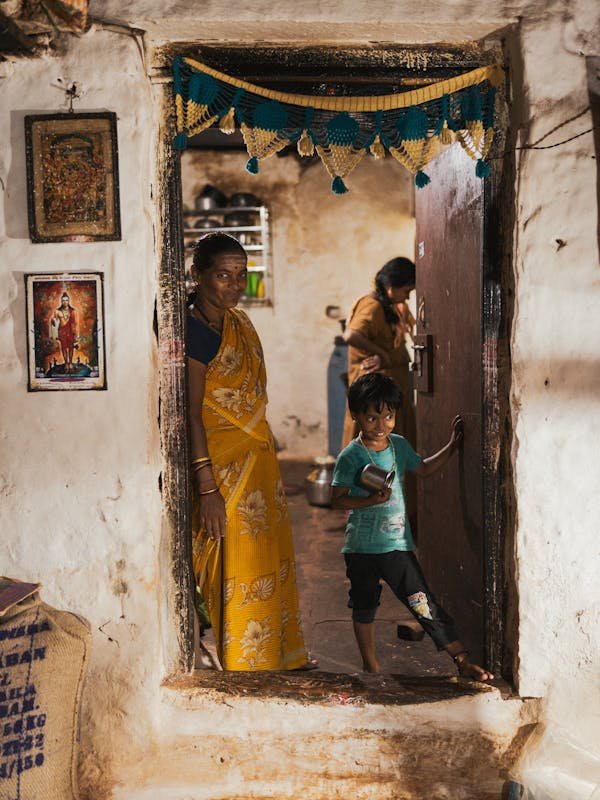
Image is representational image of a modest family home, the kinds of places the author has later seen during travels, and sometimes wanted to serve or connect to the larger grid of social activity and giving and service, where there is need as felt by the author and affirmed by the stakeholders.
I went to visit the doctor two days ago. At the clinic, I was given a waiting number. Now this clinic is a bit of a run-down operation, but I trust the doctor for his accurate diagnostic skills and the ability to treat a patient with more kindness and less medicine. He also chooses to run a clinical practice in a less-privileged area. When asked why, he once said, “This is where I am needed.”
So, I sat with the square little cardboard paper card that bore my patient-calling number. I noticed, during the ample idle time, this card. It had been fashioned out of medicinal packaging ‘repurposed’, so to speak with the number ’23’ written with a blue ballpoint pen. Highly unimaginative, this piece announced, “You are sick!” in subtle ways.
My mind wandered at this sight, and I thought: “Why, in all my years of visiting this clinic run by a rather selfless man who could have earned millions healing people in a ‘better’ facility, have I not thought of contributing anything to this clinic?”
I looked around and saw many flu-ridden children amongst the patients. I noticed that the bookrack had books that were wilting due to overuse. There were some nice posters on the wall masked advertisements of pharmaceutical companies. All in all, the clinic could use a paint job, some fresh art on the walls, and new books and magazines in the racks. It could use something to engage the children in waiting, something better than the ancient TV overhead. It could use some engagement for the men and women, seated in separate quarters, who sometimes spend more than an hour waiting for their turn. Precious productive time was idled away at this clinic.
Finally, the clinic could certainly use more imaginative and perhaps enduring – not to mention hygienic cards or chips with waiting numbers.
I imagined:
What if I go home and make artistic cards for them with a beautiful, heartening picture and perhaps some uplifting words? What if I bring some art for the walls? What if I bring some of my magazines and books?
Then I ploughed a bit deeper with my question:
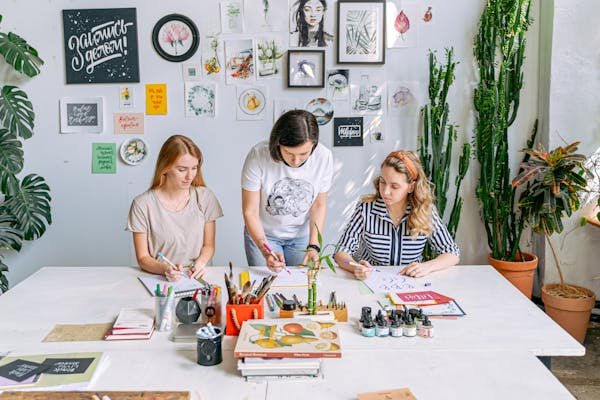
Image is representative of a generic art class. An appropriate image of ‘discarded art’, as was often the case during the years of the writer’s own schooling where art and murals were locked and forgotten in stores, is not shared here.
Art classes. There are so many art classes in so many schools in this city. And they create ‘stuff’ only to relegate most of it to the dark, fungal cupboards of the class. Some schools do not let the children take their projects home – especially if those are examination assignments – and most of the productions simply end up as piles of junk.
In school, we often made art no one eventually cared for. Most children created with half a heart because they could not ‘see’ the end purpose of this enterprise. “What’s the use of all this?” is a common complaint in classrooms and campuses.
Yet here, in this city, there are clinics and homes and bus stands that could use more art, more beauty.
Why is There a Gap Between the Two?
In this gap, one is forever needy, and the other is forever producing unappreciated, unused junk. There is a break in what ought to be a cycle of giving and receiving.
I recalled that some years ago, I became familiar with the idea of ‘service learning’ – that is, learning in academic settings through real service projects. For instance, a student of architecture would actually implement a working solution for a (needy) community in order to obtain a pass in the subject. Real service projects are carried out under this paradigm. What an idea! Academia does not waste years of knowledge that children acquire, asking them to wait till they grow up to become functionally useful (as traditional education does). One serves and learns as one goes – and (almost) everything that is produced is utilized.
Service. That was the key theme that I was digging for. Business, academia, communities, individuals – if they act to serve, not only will there be many needs fulfilled and bonds created but so, too, will there be less physical junk in the world.
Service. Service keeps our relationships cyclic, in action – service keeps us connected as people and as organized groups.
Service. This is what makes a human of whichever station or status useful and therefore connected to other humans.
Service. This is going to make life (more) sustainable – for sustainability is nothing more than ‘elements of life in an effortless perpetual cycle’, a definition I proposed in my article ‘Why We’re Failing to Sustain – and How Can We Succeed, Right Now’ published in tbl in July 2009.
It all made sense to me. I looked down at the little crumbling cardboard slip in my hand. It was made out of the cover of a package which must have contained a cough syrup bottle within. The negligible little card had educated me about the scheme of things. It also showed me the way to begin.
Archive image featured with the article, featuring the items selected by the writer for donation. Even old books are great for children who cannot read, but enjoy images.
Bridging the Gap
On my next trip to the clinic, I am taking along with me some posters and books and magazines that I have tried to give away in the past. Mysteriously, they have refused to go away and ended up with me again. They know better; that there is a just-right place in the world for them; they refuse to be sold away to a paper junk dealer (one who thought they are ‘too good’ to be taken away) or to be taken up by visiting friends (“Too heavy! I shall take them next time!”).
I shall donate those to the clinic. My junk will become treasure through service.
Perhaps such discards can be salvaged for donations to needy communities, in a zero waste, circular society
NOTES:
This article is part of a series of articles Ramala Hubb’Allah wrote (with her then name) during 2008-11 for Pakistan-based publication, Triple Bottomline Magazine, published by Asiatic Public Relations. The publication’s focus was Corporate Social Responsibility, Climate, Environment, and Developmental themes. This is the seventh article in the series, published in March 2010. Original version in print; web version on the TBL site here.
I just had an Aha! moment about what’s the problem with sustainability. Consequently, I saw how that “problem” can be fixed instantly. Because that problem does not lie in nature. The ‘problem’ is how we define sustainability.
This is the current (2009) Wikipedia definition and by design, it’s the current definition of the collective humanity:
“Sustainability, in a broad sense, is the capacity to endure. In ecology, the word describes how biological systems remain diverse and productive over time. For humans it is the potential for long-term maintenance of wellbeing, which in turn depends on the wellbeing of the natural world and the responsible use of natural resources.” (Wikipedia)
Additionally, this is a widely popular theory in business schools:
“When applied to business, [sustainability] refers to the ability of an organization to stay profitable over a long period.”
“Everything on this planet is part of a cycle of birth-death-regeneration. There is a water cycle, a carbon cycle, a consumption cycle. Money, too, revolves. It is spent-earned-spent. A cycle is a complete loop. The very definition of “un-sustainability” is an incomplete loop – a cycle broken by excess (accumulation) or by withholding (depletion).
Simply defined: Sustainability is “the act of elements revolving in an effortless cycle.”
(Ramala Hubb’Allah’s definition)
The Problem? TIME!
Comparing the aforementioned definitions, the problem with popular definitions of sustainability stands up like a prickly cactus thorn to attention: The problem with popular definitions of sustainability is that they are time-based.
‘Forever’ is not what sustainability is. Sustainability has nothing to do with time. Sustainability has to do with the “ability to sustain”.
The Two Tyrannies of Time
There are two natural, contrary outcomes of time-based definitions, both of which justify my suggestion of giving up the notion of relating sustainability with time:
1. Short-Term Gratification
The justification of short-term behavior. Because that would be the rational thing to do for those who sincerely cannot perceive what 10, 100, or a 1,000 years mean. Short-term behavior makes sense. Greed and fear are the consequences of a focus on “time”.
2. Long-Term Tradition
The preservation of tradition for the generations to come. This is the opposite of short-term behavior. In this scenario, people take a “higher path” – apostrophes intended – and decide to create a way for how their children, grandchildren, and their generations will live henceforth. They attempt to create a perfect system. In remote geographic locations, they can – because newcomers do not visit them. In accessible geographic locations, they become adamant traditionalists. “Our ancestors perfected a way of living,” the subsequent generations will say, “and it cannot be changed. It is the way of life.”
All “ways” of life have an expiration date, after which they become extinct, or they evolve. Only ‘life’ itself sustains, not one way or another. Life is the phenomenon of the change of ways, and yet the continuation of existence.
In sum, this concern with longevity and perennial ways and “the forever” leads to oppression. Because oppression is the only way that an outdated way can be granted life beyond its natural time.
Whether it’s the short term, or the long term – both are tyrannical, fundamentally harmful at any given time, and inappropriate. More importantly, they take attention away from what the purpose, mission and outcome of sustainability is: Giving.
Giving forth, yielding, nourishing, handing over to the Other. Sustaining the Other (and the Other reciprocates).
What Does It Mean “to Sustain”?
This is the definition of the word ‘sustain’ found in the Merriam-Webster online dictionary:
To give support or relief to
To supply with sustenance: nourish
Keep up, prolong
To support the weight of
To buoy up. For example, sustained by hope
To bear up suffer, undergo
To support as true, legal, or to allow or admit as valid
To support by adequate proof: confirm
Of these eight definitions, only the third definition has to do with the notion of time. Other online dictionaries have additional definitions. For instance, the Free Dictionary adds:
“To support the spirits, vitality, or resolution of; encourage.”
Dictionary.com has a definition that elaborates upon this in a way that the concept of ‘time’ is removed:
“To keep up or keep going, as an action or process: for example, to sustain a conversation.”
Another interesting definition is:
“To support the spirits, vitality, or resolution of; encourage.”
Hence, since the 13th century, the word ‘sustain’ has centered on the single concept of giving.
Sustain-ability is enabling a system to be continuously, cyclically giving.
This improves, also, upon the way I understood sustainability earlier. Sustainability is still “the act of elements revolving in an effortless cycle”. “Enabling continuous giving” only looks at it from another angle. Which is, “What can we do to make this happen?” In other words, it grants humans (observers) will, power, and autonomy.
We need to answer this question because we ask this question. We ask this question because we are humans. We are sentient. And we want to do something.
Experiencing Sustainability: Two Somatic Exercises
Sustainability is not ‘linear’ and it is not time-based. It is ‘cyclic’, it is right now. The best way to understand it may be to visualize it. Stand in a space, literally or mentally, and imagine these two scenarios:
1. You are standing in the middle of a long, wide road. Visualize yourself as a spot somewhere on this line, which represents a road. You are a spot traveling down the long road, having already traveled a long distance which is now behind you.
2. You are standing in a field. Extend both your hands outwards, spin, and imagine the whole, wide world around you. Right now. A big, round circle, radiating outwards from you. Feel free to imagine yourself to be the queen or king of the world.
.
.
.
How do these two opposing scenarios make you feel?
It is when we experience that whole, big, circular nature of the elements of life, of the whole world, in one instant – as in the second imagery – that we begin to understand the nature of sustainability. When you perceive the world in this way, you will want the entire world to do well, because it will be your world.
This still requires work. It requires giving and contribution. It requires personal character and benevolence to live in such a world. It requires the ability to truly accept responsibility. It is also about experiencing the abundance of life, in the now. To think of ourselves is not to think of ourselves in terms of taking from others, but in terms of giving.
Sustainability is Harmony
If a major trouble with the world today is due to errant human behavior, then this implies that corrected human behavior shall prevent, stop, and in instances even reverse the damage. Indeed, we can look forward to a harmonious coexistence.
When we get out of obstructing the cycles of nature, eliminate our time-based fears and thereby let go of our greed and fear, let things be and learn to live with the vast, thriving, abundant planet – then we shall be able to hold it up. To nurture ourselves and our fellow elements on the planet. To partake in supporting the weight of existence as animals, plants and mountains and rivers have been doing far before humans first appeared on the planet.
To, in short, sustain the other and thus sustain our selves.
NOTES:
This article is part of a series of articles Ramala Hubb’Allah wrote (with her then name) during 2008-11 for Pakistan-based publication, Triple Bottomline Magazine, published by Asiatic Public Relations. The publication’s focus was Corporate Social Responsibility, Climate, Environment, and Developmental themes. This is the sixth article in the series, published in July 2009. Original version in print; web version on the TBL site here.
This article is lightly edited (reformatted, definitions cleared up) for clarity for republication on the Hubb’Allah website. It is reproduced to present the collected body of Ramala’s works on the Triple Bottomline Magazine.
By the time this article is being written (February 2009), it is clear: those who warned against the unsustainability of greed (getting more than one deserves) and fear (contributing less than one’s potential) are vindicated. No matter what the consultants advocate, the truth is that the old way of working is over. Now that we have damaged the planet sufficiently, and as a result hurt the population that rests upon it – is it any surprise that neither the planet nor the people can afford the ways profit is made?
The lesson is clear: No Planet, No People. No People, No Profit.
This is a mantra that needs no other proof than the current state of affairs. No matter the details of the collapse, there is a single concept that sums the situation and its possible remedy: ‘Sustainability’.
Sustainability: a Simple Definition
Everything on this planet is part of a cycle of birth death regeneration. There is a water cycle, a carbon cycle, a consumption cycle. Money, too, revolves. It is spent-earned-spent. Each cycle has a starting point and that point is ‘contribution’. It starts when Entity A chooses to contribute to the ‘Whole’/System (Entity B). Then Entity B pays it forward, until the contribution returns to Entity A in a new form. Entity B can be one person, or it can be many. For example, if I work as a guard in a TV channel, I contribute by letting in the right person (who has the potential to become a talented actor) through the door and keeping the gatecrashers out. Overtime the actor clears audition and performs in a play. The play is aired and earns the channel its income. I get my salary. This is a cycle – this is ‘Wholeness’. It is true for all systems of the entire world; the only difference is the level of complexity.
Given that the start of a cycle is at contribution; the life cycle starts at birth, the water cycle at rain, the money cycle initiates at spending, and the cycle of business starts at enterprising talent.
But there can be no continued contribution unless there is graceful reception on the other side. So in totality we can see a cycle as ‘an act of cooperation, a continued collaboration’. The giver is also a receiver – always. We receive with realization and give with choice.
Simply defined: Sustainability is “the act of elements revolving in an effortless cycle.”
A cycle is a complete loop. The very definition of unsustainability is an incomplete loop – a cycle broken by excess (accumulation) or by withholding (depletion).
The Giant Collapse of 2008
If material stuff is produced, but not recycled back into the system, we will end up with pollution: blocked drains, toxic landfills, and smoke-filled air. If there is money earned such as through big business, but not spent back such as through fair wage, we will end up with vast populations unable to afford business any longer – and at a tipping point, the whole system will suddenly collapse. That tipping point was reached in 2008 – when all unsustainable cycles from the natural to the economic collapsed together.
The Solution: Enable Sustainability Through Collaboration
When bad times hit, do what the poor do: help one another. Create sustaining relationships, keeping in mind the definition above: sustainability is a cycle when it is in smooth motion. This also means that when it is time for a certain cycle to end, such as in the case of an end to an entire industry, everyone in the cycle can sense the closure at once and get prepared to move on. It is more difficult to move on to bigger and better things when one is either too empowered or too weakened by a dysfunctional cycle. The first one has a vested interest in keeping things as they are, and the second one has no willpower.
It is tragicomic that in spite of the 2008 catastrophic wipeouts, most organizations are still pursuing the aim of meeting their old projected profits and other objectives using the same methods that often directly brought about this breakdown.
It is clear by now that the game and the rules have changed. But how do we move on? The real issue at this time may be a sense of insecurity and high uncertainty – the end of greed and the beginning of fear.
In my view, this is exactly the current challenge. We are no longer oblivious of the fact that the planet is in peril, and people are severely endangered from our own actions and the backlash of nature. It is also apparent by now that we have at once the responsibility, and (some say perhaps) the power to do something.
Interestingly, at this point in human history, we happen to have a technology for every need. We have also tested almost every social, political, and economic system great human minds could envision. In other words, the “hard” and the “soft” elements are present. What, then, do we need?
Answer: Collaboration
Wikipedia defines collaboration as: “A recursive process where two or more [entities] work together towards an intersection of common goals. For example, an intellectual endeavour that is creative in nature – by sharing knowledge, learning and building consensus.”
Precisely because we have all the requisite technology and ideology at our disposal, our next task is to put things together in a way that benefits the wholeness of our systems. The systems are already whole (cyclic) by their nature and definition. Our real task is to develop a method that facilitates the motion of cycles. And that method is a value: working together. Collaboration.
Collaboration is a means to an end: the end is sustainability – enabling the cycle of life.
The Principle of Collaboration
There are several processes, behaviours and conversations that relate to collaboration. They are too many to remember intellectually. Another approach is to understand the fundamental principle, and then apply it to individual situations. The basic principle is: Collaboration is to facilitate the motion of a cycle. The two aspects of the cycling principle are:
Increase/facilitate flow.
Reduce blocks.
The first aspect is about being creative. The second aspect is about removing obstacles to creativity. Essentially both achieve the same result, but are needed together. In my view, it is the second aspect that is the real need of the time.
Easy Guidelines for Situational Collaboration
It has been assumed for a while now, especially in the business and political world, that relationships can be ‘created’. There exist fundamental principles of relation between the large and small, giver and taker, weak and powerful, etc. The task of collaborative practices, then, is to honor that which exists and to orchestrate that to use – not to attempt to forge something beyond the system.
Based on this understanding, situational collaboration can be developed.
1. Work With What Is
Resource utilization is a critical contemporary issue. Though often we are concerned with “over-utilization,” the sustainability principle suggests that in each instance something is over-utilized, there is another thing that is being under-utilized – because it is ignored or sacrificed.
The solution is to ‘work with what is’ – evaluate one’s assets, and contribute. Rather than want more resources than are already given, work with what is already given. It is far better to adjust one’s ambitions and ideas than to stretch or waste one’s resources.
If the utilization of a person’s energy under our supervision is to help them grow, what precedes this is taking care to get to know the innate potential of that person.
There is an inborn quality in each person. That quality shapes their contribution. It is the task of the system as a whole and a leader in specific to see that quality and co-create work around it. Schuitema suggests that work is a means to engage the individuals in a relationship. This brings delight back into relationships, even in the work arena.
An implied application is to use experiential experts’ help. Receive the knowledge that others have to offer. Often we refuse to work with talent that is available, in order to pursue imaginative goals. In Pakistan’s context as well as of other developing nations, this non-acceptance of our unique abilities and offerings is leading to the belief that there is a dearth of talent. If that were the case, none of the developing nations would be able to destroy as much as they do, for destruction suggests the presence of energy not utilized.
Competition has long been a virtue, and it had its rightful place in the evolution of human endeavor as we strove to push the boundaries of our potential and existence. I think there is less blame to be assigned to competition itself – rather the need is to realize that the time to compete has simply passed.
In this age, we must intentionally lower “competitive think” and replace it with “collaborative think”. In my work with a beauty products client, for instance, we have chosen to see household-based women entrepreneurs as friends and partners rather than as threats to our business. There is an acceptance that there will increasingly be small entrepreneurs who will test their own mettle. Traditionally the Big Business attempts to drown them out. My client took the approach of changing their business model to a modular one that suits the variable nature of workers in the fragmented marketplace for today. The immediate benefit is that energy is now reserved to co-create joyful solutions, and to do the real task of carrying the product to consumers to enhance their life – rather than being consumed by the anxiety of overcoming beyond control “competition.” (Note: We used homebased bloggers as beauty influencers in 2008, before it was a thing!)
4. Minimize Legislation, Maximize Relation
Legislation is oft invisible but often the most powerful of blocks in the way of human endeavor and relationship. The problem is very simple: we have come to believe that legislation exhausts the list of all possibilities.
Therefore, there must be a law for every DON’T and a description of every DO. This is a fallacy. Law is a limitation, and its only function is to mark boundaries and off-limit areas in a relationship. The off limits are those where, by definition, the relationship ends if one or all partners venture there.
Legislation is not the fullness of a relationship. It is the boundary of a relationship.
The best constitutions of the world, therefore, are short or non-existent. A constitution as exacting as that of Pakistan, for instance, anticipates being violated as relationships and their needs evolve and as boundaries – which are not fixed – are re-marked.
Part of this practice in business is to create projects based on mutually ‘engaging’ rather than ‘acceptable’ terms. When we engage another on the basis of their fulfillment and joy they would co-create happily with us, while we can also create a beneficial ethic amongst ourselves, which helps the whole system.
The Technology
There are two broad types of technology: one is soft (conceptual), the other hard (quasi-physical/physical). The best kind the first technology is described already: it is relationships – amongst people, and then people and every living and non-living thing.
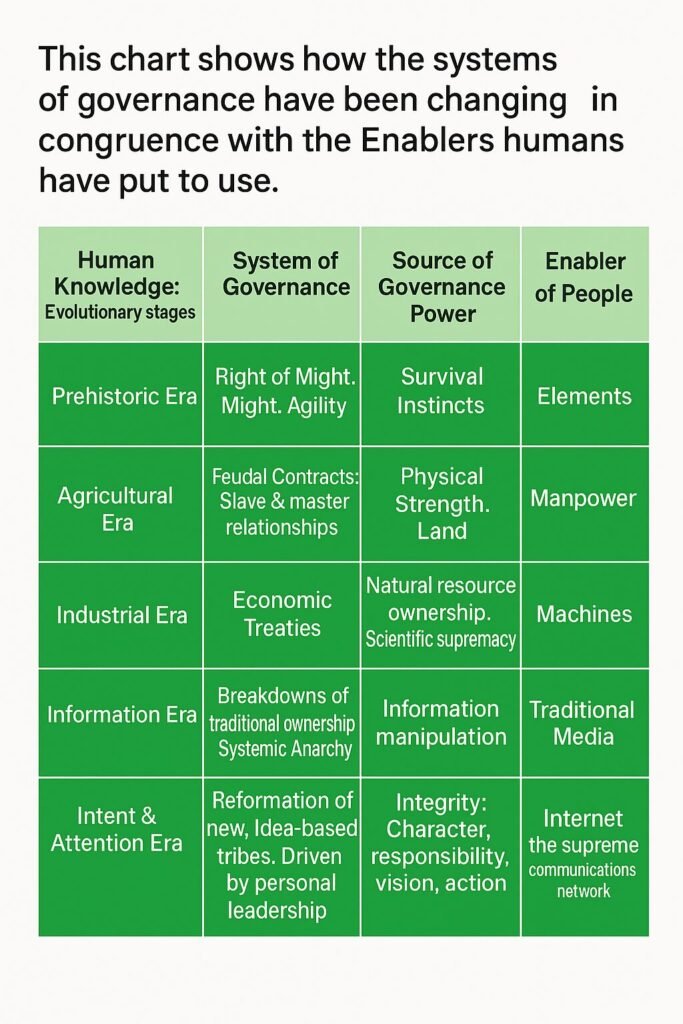
The best of the second type of technology is the Internet, identified as “the supreme communication network” and the “enabler of people” [the first and the vastly more important element in collaboration] in this Intent and Attention Era.
Outcome: Benefits of Collaboration
One would like to round off a solid case for collaboration by listing a set of definite outcomes. This, however, is not a great idea because ‘definite’ also means ‘limited’ – and limitation is resisted by human nature. Indeed it is a block in the cycle of growth. The truth is that the outcome of collaboration depends upon the clarity of understanding what it truly means to work together, to contribute, and the sincerity and intelligence with which this way is made a practice.
Despite this, the very technology of collaboration – such as shared workspaces – immediately yield certain benefits, such as:
1. Reduced Activity Footprint
Using fewer things means lesser material is being churned out on the planet and there is less pressure on the already exhausted systems. Carbon is a fundamental measure for “activity.” Eliminating the non-essential and sharing resources implies reduced activity and therefore reduced carbon footprint.
2. Reduced Cost: Competition is Cost
Primarily because it takes attention away from creative opportunities and the right application of one’s talent. Often an entity competes with one that is different from it. I have seen media enterprises in Pakistan who ditched their niche to chase the rival’s territory (such as entertainment) – and hence led to the decline of both. Competition is a cultural phenomenon that has led to megalomania-driven growth, and decline. Henceforth, our growth should be based on service to the whole system, not competing with elements.
3. Healthy Interdependence
This is a state where all elements in a cycle support and rely on each other and are clearly aware that mutual benefit is the real benefit. This is most practical at a local level where community members work with each other and support others’ enterprises.
It is my belief that the issue that we face is not of meltdowns and painfully wrenched bailouts. It is the issue of bringing values back to the way we work. The values, in turn, are employed so we can experience the joy of being alive. That joy, I believe, is the real aim and must become a part of the world of business – and the business of the world. Collaboration, when practiced faithfully, is that joy in itself.
NOTES:
This article is part of a series of articles Ramala Hubb’Allah wrote (with her then name) during 2008-11 for Pakistan-based publication, Triple Bottomline Magazine, published by Asiatic Public Relations. The publication’s focus was Corporate Social Responsibility, Climate, Environment, and Developmental themes. This is the fifth article in the series, published in Feb 2009. Original version in print; web version on the TBL site here.
This article is lightly edited for clarity for republication on the Hubb’Allah website. It is reproduced to present the collected body of Ramala’s works on the Triple Bottomline Magazine.
I had a sudden realization: I am beyond borders and regulations on the Internet. Certainly, the regulations and norms of the “real world” no longer applied to the virtual interactions of hundreds of millions of people.
From chatting to creating social networking communities like Orkut and Facebook; from writing emails to sussing out the real from the fraudulent on MySpace, and taking citizen action through blogs, using our networked computers as our media centers – we are semi-consciously creating a new space with its own rules and codes of conducts.
It struck me that the Internet had indeed become my de facto government.
It was then that I proposed this at the NEXT> blog:
June 2, 2006:
If “government” means the “act of exercising authority,” then I must report that I believe my official government may not be my official government. In its broadest sense, ‘govern’ means ”the power to administrate, whether over an area of land, a set group of people, or an association”.
If this is really what government is – a body of influence, whose rules and laws I form, obey and own – my government is now The Internet.
The Internet is the government of the commons, which has leveled social, and class and racial and other barriers.
I think for the first time in history, humans across the globe have created a government that is truly a government of the people, by the people, for the people.
A reader at the blog questioned: “You’re sure? Internet is only the medium–it is neither the message nor the messenger. What thrives here is the open and accessible communication between far-flung human beings.”
My response: Exactly. What is government but a facilitator of the activities of human [societies]–a servant that administrates the complex function? That is why we say, “like people, like government.” By itself, the government is nothing.
Traditional non-participatory governments do not represent the people – rather they shape the minds of the people.
The (social) Internet does not exist to rule. It does not exist to create absurd laws. It is a collaborative space. It is inclusive, responsive, self-organizing, and evolving. It is a powerful source towards which the modern human is turning to share and to listen.
In fact, in my opinion, never before in the history of humankind has the democratic, human-centric definition of government been seen in practice. The Internet is not just any people’s government; it is the first truly human government.
The Power of Conversations
Here is the reason why the details of this exchange are shared. If we step back and look at the content of conversation and how it develops, we notice that:
One person (I), using their territory (the blog) declared allegiance to a new kind of government. This declaration draws authority from another virtual territory – Wikipedia – which has a self-governing system. That territory is able to overcome differences of race, class, geography, language, sexual orientation, faith, etc. to create a thriving system.
This declaration is willful and emergent — it emerges organically as the outcome of a process of thinking and practice.
Another person challenges.
And the first responds – demarcating their “law”.
If the challenger agrees, this law is established between at least two people. There are also silent readers who are to be counted.
Within this conversation, an evolution of governance has taken place that is hard to emulate in the physical world in speed and authority. The power of such conversations in creating change is not to be underestimated, especially where the virtual community is strong and led ably. Conversations change people. People change spaces.
The Formation of a Government
One of the most powerful constitutions in the world is that of the United States of America. It was the result of the conversations between the founding fathers of that nation. The outcomes of their thoughts were published in The Federalist Papers – 85 essays outlining how the new government would operate and why that type of government was the best choice for the USA. Back in the days of print, the Federalist Papers meant to persuade New York voters to ratify the proposed constitution.
Internet: How It’s Changing the Territory
The process of writing a constitution is germinated in conversations and willingness. Internet is changing the way conversations take place. Humans are in a free space communicating with each other. The once slow and costly services have been replaced with fast, agile, free, and universal services.
Let’s step back in history and examine how countries came to be marked. In the most primitive times, it was oceans, rivers, mountains, forests, walls, wild animals, and other natural phenomenon that marked distances and differences. Soon enough, humans began marking fields, building walls, setting up colonies, and creating tribes.
Over time, ideological boundaries led to the birth of countries. What separates the two sides of a no-man’s land but the differences in political constitutions and social contracts? Passports, visas, restrictions, treaties are the products of more recent times with respect to the human history.
This development has run parallel to an evolution in human knowledge.
November 2008: Generation-O has Chosen a Government
There are many people who still believe that Internet has no reach, it is a waste of time, and above all – it’s an elite medium. Media are relevant. Let’s make it simple: which of the following seems the most inclusive?
Print: Few write, many read.
Radio/TV: Literate and groomed produce, many are audience.
Internet: Many produce, many engage.
As a Pakistani, which of these media can I use to send a message to an official in Barack Obama’s transition team? To the world via CNN (iReport)?
More than 2 years after I first postulated the idea, a relatively unknown, young, multi-ethnic black man has been elected the President of the United States. Barack Obama’s campaign machine made unprecedented use of the Internet by forming community organizations, linked through their leaders who networked online.
Not everybody has to be online, only their community leaders. The argument about the Internet being elitist and non-effective has little merit. At any rate, Internet is growing to become more inclusive, not less. Obama’s victory is an affirmation to all believers in the power of Internet to create a true people’s government.
Making Sense of the Global Governance Breakdown
Governance, in its widest sense, is not just a political-national institution. From households to corporations, even down to the Self, the rules of governance apply.
What we are witnessing in this world as “breakdowns” – from financial meltdowns of USA, Europe and Asia to people’s resistance movements in Pakistan, Burma, Thailand – are often the signs of territories changing. Obama’s victory is the first but not the last time in human history when the networked structure of the Internet became a map for real-life organization – and change of government. It is a benevolent change – one that is brought about by acceptance, inclusion, and the will of the peaceful citizens working together to create a more positive world. (That is the intent.)
A Matter of Choice
Internet is not just a tool for passing time. It is at once the product of and the herald of a new era in human consciousness, and therefore systems of governance that are inclusive, self-reflective, transparent and swift.
The choice is up to humanity to accept the power of this enabler, and use it now to create benevolent governance from corporations to communities to nations. Or, as it happens at times of all evolutionary shifts, be left behind and perish.
NOTES:
This article is part of a series of articles Ramala Hubb’Allah wrote (with her then name) during 2008-11 for Pakistan-based publication, Triple Bottomline Magazine, published by Asiatic Public Relations. The publication’s focus was Corporate Social Responsibility, Climate, Environment, and Developmental themes. This is the fourth article in the series, published in Dec 2008. Original version in print; web version on the TBL site here.
This article is lightly edited for clarity for republication on the Hubb’Allah website. It is reproduced to present the collected body of Ramala’s works on the Triple Bottomline Magazine. This article was first published as a blog on Ramala’s then blog, NEXT> by Ramla here and here
An update of this article’s premise, as well as the original version with commentary, is under works.
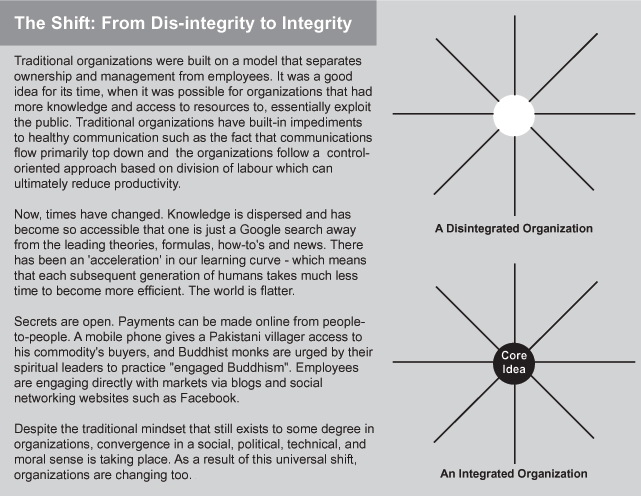
The emerging organization is breaking down the traditional divides between owner, manager, and employee in corporations: now, all roles are assumed by one person or an aligned group.
Generally, it all starts with an idea around which a group of free agents or entrepreneurs gather willingly. They are highly skilled individuals who have a common interest and divide the task among themselves according to their individual skills. The work is project-based, and legal relationships are ‘open’. Contracts are not enslaving, and group members may have other project engagements. In other words, they self-organize around an idea and a mission or purpose.
Self-Organizing Ends Forced Structures
Free will and the strength of the group’s relationship and integrity determine their sticking power. Because they are accountable to themselves, internal regulations and self-scrutiny allows them to stay competitive. Corrections are made as performance or capability gaps arise.
An organization based on such a model is vulnerable to shift because “managers” cannot exploit “employees” or fib about their performance to “shareholders.” Therefore, it constantly scrutinizes the external scenario to study opportunities or threats. Because such an organization is basically an idea “hub” around which skills have gathered as ”spokes” to get things rolling, it is knowledgeable on its own design and area of expertise.
Change, to the members of an intelligent organization, is a matter of perceiving things accurately and swiftly. As well as they perceive change, they can modify their own selves; they are not required to convince a separate entity (an owner, manager, employee). Hence, they evolve to suit the new circumstances. This is called “self-organization.” (Not very different from how the very intelligent “virus” works!)
Why Traditional Dis-integrity No Longer Works
Most of the troubles harrowing today’s organizations are rooted in their disintegrated structure, which pits one part against another. It is a bit like the heart of a body taking a disliking to the stomach. The results are not nice!
Employee care and growth is seen as a cost. Because the home is not the office manager’s problem, there is a divide between work and life, with one competitive to another. This has led to high emotional and healthcare costs globally, followed by turnover.
Curiously, this set-up perceives the world as hostile. It is geared to exploit more than just the competitors. With the increased awareness of the downsides of this approach has come around a doubt about the workability of this model. The truth is that this structure will not cut it any longer in a world where people are joining hands to save the planet and themselves, and walls are being torn down.
How Integrated Organizations are Better
These organizations cut through layers of expensive hierarchy and the ensuing resentment. Collaboration is not just a new tool. It is a characteristic of such organizations. Decision-making is transparent, speedy, and agile. This subtle shift translates into a dramatic reduction in litigation.
Diversity emerges as the group automatically senses its “gaps” and fills them. There is no arbitrary third-party (second party?) policy to bow to especially when such a policy flying in the face of common sense of the organization. People set rules, not vice versa.
Work is based on passion – a requirement as today’s work requires high levels of knowledge, agility, and personal insight. Being passionate about your work is important as this fosters inspiration, creativity and innovation. The possibilities for the emergence of a satisfied and creative person’s contributions are limitless!
Through their very design, such an organization is both geared to and restricted to contribute to society (instead of exploit) or else it will disintegrate, as no policy, external funding or lies can protect it from constant external scrutiny. The final measure of the goodness of such an organization is its contribution to the larger community, as judged by the community!
Three special cases of contribution possibilities:
Case 1: Innate Corporate Social Responsibility
Whose responsibility is the community anyway, when the elements of an organization itself don’t get together? The issue of an irresponsible organization could be closely related to its elements being competitive to each other. They are designed not to collaborate. Is it not surprising that as children we sincerely want to make the world a better place, and as adults, we derive our earnings from exploiting it? This personal-professional ethical dissonance is based in a lack of ownership.
The essence of Al Gore’s environmental campaign is that: “You cannot teach a man something if his salary depends on not understanding it.” If salary is tied to performance, which is measured as reduced (internal) cost at any (external) cost, it is easy to see that this math puts the business interest as inverse to the community’s.
When a person owns a small business, it is likely to be close to their home, or in their home. That is also true for an entrepreneurs’ group. Their children, family, friends, and lungs are breathing in that environment. Peace and security affect them. Social bonds exist within that area. This exerts not just an invisible social pressure, but more importantly, it creates an internal urge for responsibility. The entrepreneurs are directly answerable to themselves and to their families. They can now manage their work and life, and are aware that others in the group have similar priorities.
The group members do not see each other as ‘bits’ of contract or policy, but genuine human beings with whom they have a personal relationship. This creates an entirely new ethic.
Case 2: A Faster Company Built on Trust
I recently lunched with a group of bloggers headed by a team that proposed a code of ethics – which turned out to be a result of their own past ‘worst practices’. Everyone laughed and the larger group decided this code is not in the spirit of blogging; but can be turned into guidelines on how to have a more interactive or professional blog. Business opportunities were swapped and deals were closed; all at the speed of a lunch. Such fast organization was made possible by the trust that a blogger is ethically responsible to other bloggers not just by a sense of community, but also by a fear of earning a nasty blog entry in case of defection!
Case 3: Entrepreneurship Without Cubicle Borders
‘The Hub’ is an idea for a collaborative space for change agents. It started in London and has spread to other cities. Shared space is rented by hours, and free agents sit in an open space designed for communication and collaboration. Typically, the projects are social or civic in nature. Multidisciplinary teams form and gather in the physical space, and the culture is self-evolving. Projects include women’s art businesses to technology camps and films. Start-ups are born here. This is the new shape of the collaborative enterprise.
NOTES:
This article is part of a series of articles Ramala Hubb’Allah wrote (with her then name) during 2008-11 for Pakistan-based publication, Triple Bottomline Magazine, published by Asiatic Public Relations. The publication’s focus was Corporate Social Responsibility, Climate, Environment, and Developmental themes. This is the third article in the series, published in July 2008. Original version in print; web version on the TBL site here.
This article is lightly edited for clarity for republication on the Hubb’Allah website. It is reproduced to present the collected body of Ramala’s works on the Triple Bottomline Magazine.