This part of the Salaam Matrix Codex is for Advanced Reading.
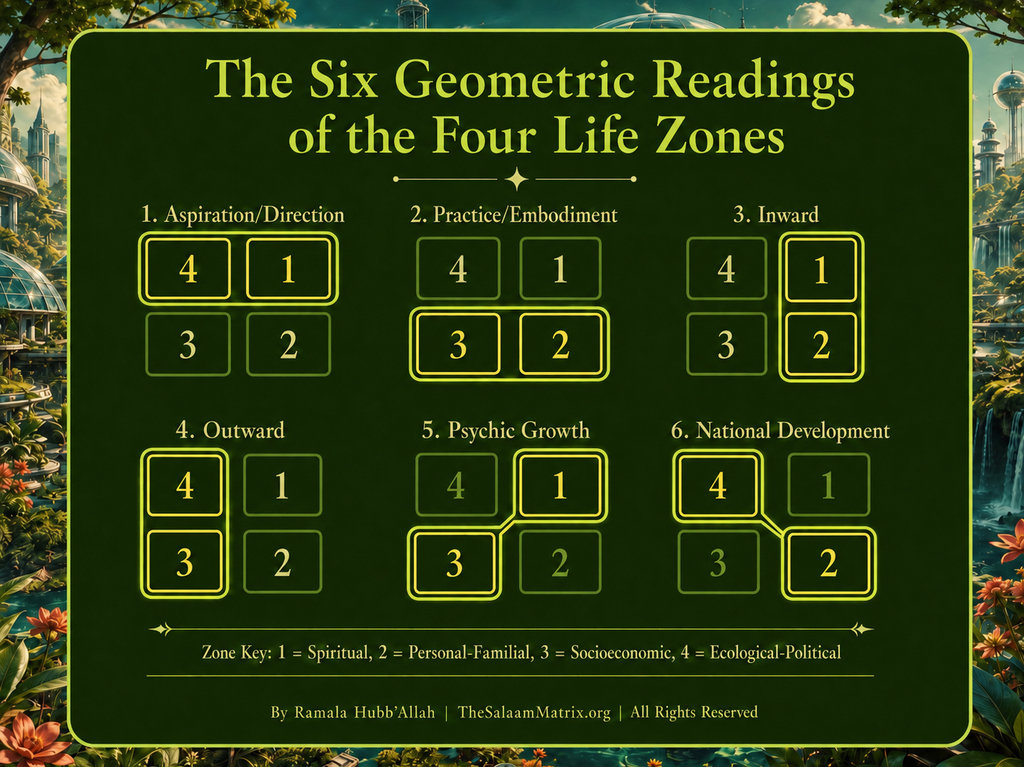
The Four Zones in the Salaam Matrix — Spiritual, Personal-Familial, Socioeconomic, Ecological-Political — are arranged in a specific order within the standard 4-quadrant diagram of the Salaam Matrix:
The Spatial Arrangement of The Four Life Zones
Zone 1, Spiritual: Top-Right
Zone 2, Personal-Familial: Bottom-Right
Zone 3, Socioeconomic: Bottom-Left
Zone 4, Ecological-Political: Top-Left
When drawing the Matrix, we start from the top right quadrant and move clockwise to finish. This formation has allowed for an arrangement of the Four Life Zones that allows for further and deeper examination of the nature and impact of these zones.
We offer Six Geometric Readings as the core readings of Four Life Zones’ schema and placement in the Matrix, before permutations and combinations generate further, case-based readings for situational use.
⁜
Six Geometric Readings: The Process
⁜
THE PROCESS
The Six Geometric Readings are produced by isolating pairs of Zones across Horizontal, Vertical, and Diagonal Axes. This renders six unique geometric formations which are then “read” or described in terms of what they represent and their characteristics.
Each Reading describes a key conflict, which asks: “What if only the chosen zones were operative or dominant at the cost of others?” The Key Conflict is summed up at the end of each reading, producing a total of six conflicts, two for each axis.
Then, those Six Conflicts are reconciled, axis by axis. The two Conflicts of each axis, when reconciled, become a Harmony for that axis. We obtain Three Harmonies, one for each axis. A “Harmony” basically asks: “What happens when the two sides of this axis (horizontal, vertical, diagonal) worked together instead of in opposition?” The Three Harmonies are the result of zones along each axis working in cooperation, mutually reinforcing one another.
The Three Harmonies are finally reconciled in One Integration: The outcome of all zones working together and optimizing for the greater good, cooperating rhythmically, creating a fluent symphony of sorts. This is Salaam in action—a dynamic equilibrium, a constant integration of parts and opposites that create Synergy rather that Discord and Conflict. What you give in one area is harvested in another arena of your life, as long as you remain put together and centered.
Six Conflicts –> Three Harmonies –> One Integration
Note: This process is currently not adapted for The Shadow Matrix and the Ghost Matrix.
THE SIX READINGS
Two Horizontal Readings:
Aspiration/Direction
Practice/Embodiment
Two Vertical Readings:
Inward
Outward
Two Diagonal Readings:
The Spirit-Economy Relationship: Psychic Growth Axis
The Government-Family Relationship: National Development Axis
✽
⁜
A.
TWO READINGS ON THE HORIZONTAL AXIS:
Design vs. Embodiment
The Horizontal Axis separates the Spiritual & Ecological-Political Zones on the top, from the Personal-Familial and Socioeconomic Zones below. It is noticeable that the top two zones are more abstract and inspirational, and the work that is done there is about design, choosing and assigning values, and setting limitations as well as, paradoxically, exploring greater horizons within and without. The top two zones are both expansive and yet deal with setting down a path and values. The real living and doing happens in the bottom two zones, for the safety, sanctity and regulation of which it is vital that values, journeys, paths and planning in the above two zones are correct. Meanwhile, if the lower two zones do not deliver stability and healthy output, the designing in the two zones is wasted as well as there are no able persons to take inner journeys or make good governance in the above to zones. The relationship is reciprocal and mutually reinforcing. Neither zone is “better” than the other, however, the top zones are formative of the stability and containment of the two zones below, which have to do their own work or else the entirety collapses regardless.
First Reading
The TOP Two Zones:
Spiritual + Ecological-Political
Aspiration, Direction
Placed the farthest apart on the growth ladder of The Salaam Matrix, the top two zones have a similarity: these are zones of expansion and aspiration. The Spiritual Zone expands in the inner realm, and the Ecological-Political Zone expands in the outer world. Both zones offer a sense of detachment from the mundane and are also zones where values are established. In the Spiritual Zone, the values and beliefs are more internal and abstract, and in the Ecological-Political Zone, they take the form of both policy and of promise. The determinations made in these zones shape how humans live our lives.
An excessive abidance in these zones may produce dissociation and poor attachment to the rest of the Matrix.
THE FIRST CONFLICT
↑ without ↓
Abstraction, idealism, policy/theology without embodiment.
⁜
Second Reading
The BOTTOM Two Zones:
Personal-Familial + Socioeconomic
Practice, Embodiment
Unlike the top two zones, these are the zones of immense practicality, and living an enacting a grounded life. This is where ‘the rubber hits the road’ and creativity becomes manifest and concrete. The decisions and directions of the top two zones determine whether humans live in peace or in discord in these zones. Safety and regulation are vital for these zones, life hits a grind as it must, for humanity to stay in motion and to utilize its potential. These zones are also where humans need to be safe and to thrive so that the other two zones can be entered into with peace and to work on human dreaming, aspiration and fulfilment.
An excessive abidance in these zones makes the society stuck in a rut, with little revision, progress, and alleviation. To audit, examine and alter what happens in the bottom two zones and why, we need to look in the zones above.
THE SECOND CONFLICT
↓ without ↑
Immediacy, routine and survival without sufficient orientation or horizon.
THE FIRST HARMONY:
When the dreamer and planner aspect of the top two zones works in alignment with the practical and embodied aspect of the bottom two zones, the user feels that they are achieving the goals that they are setting and living in alignment with their values. The practical and the embodiment zones both live out the dreams and directions set in the upper two zones, as well as provide stability for the upper two zones, since shrinkage or distortion in the lower zones leads to tension and compression in the planning and dreaming zones. When the two sides are harmonized, the dreams are lived in the practice zones, and the practice zones provide comfort and space for further creative dreaming.
⁜
B.
TWO READINGS ON THE VERTICAL AXIS:
Inner vs. Outer
The Vertical Axis separates the two more inward and private dimensions (Spiritual; Personal-Familial) of the lives of citizens from the two outer dimensions (Socioeconomic; Ecological-Political) where they are tested, trialed, and exposed. It is imported to understand the quality of each, so we know where the more nurturing work of Guardianship is more relevant (Inwards), vs. where does control and Governance become more dominant (outwards). This is vital in order to understand and audit a society and identify correct interventions. This also helps map the behavior and cultures of nations, among other uses. Note that no placement is “better” than the other, each has their own use, and one without the other can be in need of the other. The Inner, however, is formative and primary, but an intervention may not always belong in the inner dimension, depending on who is using the Salaam Matrix. A governor, for example, will need to create an environment in which the inner dimensions remain safe. An economic planner will need to allocate human talents to tasks. A therapist and healer will focus on the inner as the root even is malady occurs in the outer dimensions.
Third Reading
The RIGHT Two Zones:
Spiritual + Personal-Familial
Inward
On the vertical axis, the Matrix divides into the Right Zones, and Left Zones. The two right zones are the more inner and private zones pertaining to the Psyche, where individuality and the autonomy of persons and the individuation of families as units matter. Public scrutiny is off, and introspection, bonding, intimacy and personality development are the main activity and the product of this zone. This is the going of “going inwards”, comfort, and nurturing and cultivation. This is the zone where seeds of growth as sown in the psychic formation of humans. The implications are this that when people display personal strength or flaw, these are the zones that have either done the work right or wrong. These are the zones to which the Guardianship part of the Codex matters more. This is where nurturing, care, investment into the person matters relatively more.
An excessive abidance in the two Inner Zones can make the practitioner hermit-like and parochial, with agoraphobia. It may also make society primitive and scattered as ecological-political unity fails to develop.
THE THIRD CONFLICT
→ without ←
Privatized/interior life—potentially hermitage, insularity, excessive self/family enclosure.
⁜
Fourth Reading
The LEFT Two Zones:
Socioeconomic + Ecological-Political
Outward
One the left of the vertical axis lie the two outward-facing, world-centric zones. This is where persons and families step out of the comfort of absolute or relative privacy and engage with the larger world. Economic transactions and viability of form matter here. Governance is the dominant part of the Codex that relates to these zones, and it’s not fruitful but rather risky to not hold persons and groups to account, lest they run over one another. This is a zone of interaction between groups that may have disparate values, conflict resolution is vital here. These a also a more competitive and testing zones for the outward form of a person or group. These are the zones where one should expect to be judged, not nurtured. The ‘care’ in this zone is for the collective. Negotiations and barters belong here and transactional correct as well a strong judicial aspect is also essential for peace and for social regulation. This is where your inner intent matters less than your output and contribution to the collective. That is but fair to all the participants. Lacks in these zones may require preparatory or corrective work in the RIGHT two zones.
An excessive abidance in the two outer zones makes the society scattered, hyper-exertive, materialist and dispersed. The Psyche does not obtain nourishment, and the body-mind and nervous systems do not obtain rest.
THE FOURTH CONFLICT
← without →
External systems/material affairs without adequate interior formation—potentially materialism or institutionalism.
THE SECOND HARMONY:
When the inner self works with the outer self, and individuals and households are aligned with the Collective; and the Collective or outer is supportive and protective of the inner dimensions of human life, giving it comfort, privacy and the expansion of human rights and autonomy in the more private realms without interference and noise from the Outside. Likewise, the Collective is spared the breakdowns and dramas of the Inner Zones, and instead the Inner Zones enables regulated, calm and rested individuals and home bases for Socioeconomic and Ecological-Political objectives.
⁜
C.
TWO READINGS ON THE DIAGONAL AXES:
Psychic Growth vs. National Development
In the Diagonal Analyses, we find out how the more abstract and aspirational dimensions of the top two zones relate with and affect their counter in the diagonal opposite lower zone, and vice versa. This pairing is more challenging than the more intuitive “like with like” pairings of the horizontal and vertical readings. Here are we are contrasting the micro with macro, as well as the design aspect with the embodied and lived aspect. This adds a dimensional depth to the analysis and also creates cognitive bridges between “apples and oranges” which can, in fact, be compared!
Fifth Reading
Top-Right, Bottom-Left:
Spiritual ↔ Socioeconomic
The Psychic Growth Axis
This reading of the Zone 1 adjacent with Zone 3 compares the impact of belief systems and programming of a person, group or society on their Socioeconomic life, leading to drawing of some very direct insights about how the faith systems, beliefs, and even “blockages” and no-go areas of the value system, impact Socioeconomic output. Looking back from Zone 3 to Zone 1, the lack and excesses or the constitution of the Socio-economy can be traced back to values and beliefs (religious, moral, secular, or otherwise) of the person or group.
For a nation, for instance, the participation of women in the workforce, or inequality between the classes can often be directly traced back to the belief system. Sometimes there are potentials in the belief system such as “there is value in working with hands” that can be put to use for economic stimulation. Sometimes there are errors that need to be corrected, and sometimes the belief stay as they are and need to be worked around. The Salaam Matrix promotes examination and observation primarily, with prescriptions generated based on the use case and the chosen values and goals of the users. Salaam Matrix can, however, force the examination and make it clear so that not much is left invisible or hidden to the honest and determined observer.
THE FIFTH CONFLICT
⤢ without ⤡
A nation where people are individually developed, intra-personally and economically, but the nation is in disarray and national temperament and welfare are scattered.
⁜
Sixth Reading
Top-Left, Bottom-Right:
Ecological-Political ↔ Personal-Familial
The National Development Axis
How does policymaking at the governmental level, and the ecological choices and structures of the nation impact households, the key unit that contains individuals as they live, grow, rest, and are nurtured? And how does the nature and formation of household impact politics and the ecological mood of a nation?
This diagonal diagnostic explores perhaps the deepest depth vector, the most contrasted pair, in the schema of The Salaam matrix’s Four Life Zones. It is at once idealistic and yet deeply practical, and the directional analysis that most correctly explores the issue of the formation of a nation, by accounting for the temperaments, choices, and preferences of households as organizing and economic units.
This is also an axis that has been the bone of contention when it comes to policy pertaining to families vs. growth priorities of governments in directions not approved by households. This axis also decided the voting patterns, key policies and values and even city and infrastructure design of the nation. It is not just the quantum but also the direction and the quality of growth that are examined on this axis.
THE SIXTH CONFLICT
⤡ without ⤢
A nation with political strength, welfare and prosperity for its households, but poor individualization and personal growth. Individuals do not sustain well outside of systemic support and are not personally resilient.
THE THIRD HARMONY:
When the personal growth of individuals in a nation is not achieved at the cost of national progress and development, which is to say individuals do not prosper alone and possibly selfishly but that there is also investment into and care for the Collective; and the national growth and prosperity corresponds with the Psychic/Personal growth of the individuals, rather than the national development being a product of other variables only, such as the discovery of natural assets that are monetized and create an illusion of prosperity without correspondent development of human character and individual wealth and prosperity.
⁜
COMPREHENSIVE FOUR-ZONE READING:
There is diagnostic and decision-making value in the Six Readings of Four Life Zones. These spatial and geometric readings put the schema in motion, read influence and relations, and provide an extended key to reading an even static-seeming situation more deeply and dynamically. Several essential contrasts and co-dependencies of the human nature come into greater relief through these sliced and diced readings. This makes even simple Salaam Matrix mappings rich with insights and actionable points, should one want to do these examinations.
The horizontal axis gives the reader something akin to a formulation ↔ manifestation recursive relationship. The upper pair establishes orientation, pattern, aspiration, law, policy, boundary, or “code”: inwardly in Spiritual and collectively in Ecological-Political. The lower pair is where those things encounter lived reality: household/body/relationship in Personal-Familial and work/exchange/material participation in Socioeconomic.
The vertical axis gives the reader an interiority ↔ exteriority duality. The right side governs the intimate field—spiritual orientation and personal-familial life. The left moves outward into economy, society, ecology, institutions, polity, and collective conditions.
Importantly, because the Zones alternate, neither axis gets to monopolize a particular kind of value. “Inner” does not simply mean spiritual, because Zone 2 forces inner life down into laundry, bodies, children, meals and relationships. “Outer” does not simply mean material, because Zone 4 forces the external world upward into ideals, law, stewardship, governance and collective aspiration.
Likewise, “upper” isn’t simply spiritual because government/policy occupies the other upper corner; “lower” isn’t simply mundane because family and livelihood are where values actually become incarnate.
This internal duality between the Zones as they are spliced along the vertical and the horizontal axes creates the potential of a dynamic flow between the zones and compels a shift of energy from larger to smaller, private to public, personal to collective, concrete to abstract. This slightly off kilter placement ensures movement in the system, which is vital for life and circulation.
Salaam (or wholeness, integration) is therefore not a static state or freezing in a perennially unchanged state, since this configuration and placement makes it evident that that freeze is, in fact, impossible. Change and transformation is built in the architecture and weights and flows of the system, and even if we leave things as they are, the state of things will change and there will be spillover effects.
the state of “Salaam” therefore is not located at some bland midpoint.
It becomes the circulation among all four zones.
Salaam is not frozen perfection, it is life in flux and movement, life that is alive.
That is more interesting from the perspective of dynamics in system than simple “balance.” A healthy person might temporarily concentrate intensely in one Zone—new motherhood, spiritual retreat, starting a company, political crisis—but the system remains healthy if information, resources, responsibility and consequence continue circulating through the whole Matrix.
The diagonals become interesting too: Spiritual ↔ Socioeconomic and Ecological-Political ↔ Personal-Familial. Those are not obvious pairings, which means they may expose precisely the connections ordinary frameworks miss: How does inner code become livelihood? How does national policy arrive at the dinner table?
That last one is basically the whole promise of the Salaam Matrix in miniature: how is the largest level of the collective impacting persons and households? From a civic point-of-view, which is of great relevance in a hyper-informed and dynamic 21st century this at once the most practical and the most abstract question that could be asked of the Matrix.
ONE INTEGRATION:
Integration is achieved when the three harmonies come together and sync into one integration of all Four Life Zones, and their Six Geometric Readings are coordinated and optimized, sometimes turn-by-turn or rhythmically until a pattern emerges that works for that population. When the Six Conflict are resolved, and the Three Harmonies integrated, there is a dynamic and creative peace in the state of affairs: The dreams of the people are lives in their work and households, and their lives and occupations allows for further visualization and planning. Their inner lives are led such that they prepare persons for their roles in the Collective, and the Collective is nurturing, caring and supportive of the affairs of the Inner Realms, creating boundaries through Good Governance. When that occurs, individuals and families find inner growth and fulfillment through outer work, socialization, prosperity and peace; and the National Growth and Progress is measured in tandem with the Personal and Psychic Growth of the People. Not only is the nation outwardly prosperous and the houses wealthy, but people are happy, fulfilled, creative, skilled, resilient and spiritually strong and have depth in personalities. This is the optimization of each Life Zone, and of their internal flows and dynamics. ✽
⁜
Note:
The Six Readings will soon be available as a PDF document for FREE in the DOWNLOADS section. ✽