Category Archives: Triple-Bottom Line Articles

Chaos Today, Creativity Tomorrow

Why the World’s Falling Apart, and Why It’s a Good Thing

Author’s Note: After having written for Triple Bottom Line for three years, it is time to string the work together. My work has been about defining the Big Picture, re-imagining new definitions for old concepts, and indicating a path ahead. This is to give a context for social responsibility. If we understand what things are, and how they work, we may be internally motivated to make the right individual and collective decisions. This has been my drift. With this review, the reader may understand the great canvas upon which today’s dramatic events are painted. They will realize that this chaos was predictable all along.

Tip: View all the articles reprinted together on The Salaam Matrix website here. 

True Government of the People: It Starts!

As the scenes of a nation-by-nation Arab uprising unfold on the TV screen, I am reminded of the foresight published on the pages of Triple Bottom Line: “The Internet is the government of the commons, which has leveled social, and class and racial and other barriers. For the first time in history, humans across the globe have created a government that is truly a government of the people, by the people, for the people.” (The Internet: True Government of the People; Dec 2008 issue.)

Two years later, the words have rung true. On Facebook and Twitter, people are gathering to take down governments, to form alternative and inclusive governments, and to create bottom-up constitutions. Saudis have taken to the Facebook to create a group, “The people want reform of the system” (in Arabic). This group is proposing a 10-point constitution that includes “public freedoms and the rights of women”.

The point? The change that has been spoken of for so long is finally here. Internet has changed the nations, and it may even begin to reform physical boundaries if need be.

Meanwhile, WikiLeaks has transformed the art of governance using guerrilla tactics. One may say that WikiLeaks opens governments and Facebook & Twitter change governments. The change is not only of a national and international nature, but it is at once local and micro.

Change: All Hands, On Board!

That was the point of the June 2010 article, 6point8 Billion: The Citizen Stakeholders. We now have the technology to engage each and every person, potentially, in governance and creative enterprise. No human left behind. Using electronic connectivity, the human specie can develop the inclusive efficiency and enterprise of bee and ant colonies, and we can be as elegant as a shoal of fish that dances in amazing, instantaneous synchronicity.

But with great power comes great responsibility, and, some fear, great danger. Who will control this suddenly empowered humanity? Do we not need to return to an era of tightly controlling super-ethical rulers who rule badly behaving humans through a mix of fear and punishment? No. The times of humanity’s darkness are over (though the opposite seems to be the case). The evolutionary course of humanity has been running on such a path that eventually each person shall be responsible for their own action, and also have the capability to choose and comprehend their action without the need to turn to a single hero human (or ‘guru’) for their interpretation.

This is the highest form of an ethical society. This is not a governance-free society, rather a self-regulating one. In such a society, the core unit is an individual: their aspirations, enterprise, and the benevolent-for-others path that they take in order to both thrive personally and do well to the other.

This individual can only thrive in a hyper-connected world with instant accountability on the basis of a benevolent intent.

Benevolent Intent: ”I Am Here to Give”
What is a benevolent intent? The May 2008 interview, Intent, Care & Growth, with transformation consultant Etsko Schuitema answers: Intent is of two types — being here (in this life) to give or being here to take. The former intent is benevolent, and the latter, malevolent. It is not as though human beings must not receive from the world. Indeed, being receptive is a subtle quality of character. The difference in what a person pays attention to: the receiving part of the cycle, or the giving part?

The ideal collective ethic is that each being pays attention to what it has to give, to offer. In that case, the rightful receivers will automatically receive — and, in turn, they will give forward. (And when they do not receive their right, they struggle with incremental levels of force. This is just and fair.)
The cycle of life, in fact, starts with giving, not taking. That is the premise of the essay How Collaboration Can Save the Planet, and Your Business (Feb 2009). “Everything on this planet is part of a cycle of birth-death-regeneration. There is a water cycle, a carbon cycle, a consumption cycle. Money, too, revolves. It is spent-earned-spent. Each cycle has a starting point, and that point is ‘contribution’.” The effortless continuation of these cycles, and the deliberate removal of blocks that arise, is what Sustainability essentially is. Why We’re Failing to Sustain, and How Can We Succeed Right Now (July 2009) takes this theme further, and shares how Sustain-ability is not about ‘a very long time’; it is about presence, about doing things right in the moment.

Only then will eternity take care of itself. For what is eternity, but a string of single moments?

From Scarcity to Abundance

This shift to being concerned with giving, however, is difficult for some people. This may more likely be the case in a society that is marked with oppression and a lack of communal care. The individuals in such a society may perpetually experience a state of crisis, a lack of due attention. How can such a person make a shift to being a part of the flow of life (‘Sustainability’)? Why would not people be compelled to act selfishly? This is a genuine question, an authentic state of (sorry) affairs.

The answer may lie in shifting to an abundance perspective. The August 2010 Ramadan special article, This Ramadan, Count Your Riches: Scarcity to Abundance Perspective, sheds a surprising light on how accessible it is to shift to an abundance mindset with a simple question: “What do I have, right now, to get where I want to be?”

I will take a moment to swear for the effectiveness of this simple question by sharing my own story. I was thinking about my project Pakistan Changemakers Hub, and it occurred to me that this is the question a changemaker asks, versus a change-awaiter who is focused on needs. As I picked this thought to expand in the Ramadan article, I felt surprised by what I was writing: shifting from focusing on what one needs to what one has. I asked myself: how would that change my own life?

I realized I do not need another degree to start a new career; rather, I am enjoying the process of teaching myself a creativity course. I did not, after all, need another creative space to rent, too. My own house has become the backdrop of video productions, and I have finally realized that I prefer to toy with the Internet over traditional media in order to move an audience. (Before this insight, I wasn’t making focused use of the media I was advocating!) Now, I can create with more focus, and less distraction and waste of energy. A focus of what I needed was depleting my energy on search; a focus on what I have has brought me back to creation. As an extra reward, the process itself has become a continuous joy.

Asking this question is just as applicable to corporations. Or nations. Or groups of any kind. Focus on assets rather than needs. One would be surprised even further: they may find that what they considered a liability and a burden that was not leaving them alone was indeed their asset all along! The other August 2010 story, Not Flat But Textured, explored a subject that is at once dear and taboo to many: the subject of one’s family and community as one’s asset, not a liability, as one engages in creation.

Caring Co-Creation

Creativity (which is perhaps the real thing that is referred to by the much smaller concept of economic activity) is an embedded human trait. All humans create. Yet somehow the world of creativity has shrunk to refer only to ‘economic activity’, and that has shrunk further to only mean ‘jobs’. By this line of thinking, those who do not have jobs are not participating in creative activity. Enter: families. Mothers engaged in caring for children, people who are supporting other people who do jobs, and others such who create, but are not necessarily employed or selling. Families also make mobility less likely, and somehow, jobs can be dispersed in geographical areas that one may not even prefer to work in, but one must relocate to because of employment.

There is not anything necessarily wrong or evil about this. It is only that this was a less-than-perfect system which did not fully accommodate the needs of those who would balance freedom with (personal) growth and the ability to create.

This requires several spinal adjustments for the society. First, the issue of mobility is now largely solved through the Internet. Also, work has restructured such that one person can do the multi skilled job of an organization (Future Scape: An Organization of One; July 2008). Secondly, if creativity is seen as more than ‘having a job’ but rather as value addition and service, more people will be relieved of the burden of feeling and acting uncreative. This re-definition may foster greater creativity within families and communities, where some members currently lie dormant as ‘reserves’, making no good of their talent because there is no attention on them, no opportunity for them. Third, seeing families and communities as resources rather than as liabilities can yield several benefits to each creative member of the family: this ranges from psycho-social relief to lower carbon footprint to the opening of new possibilities of doing projects with people who are most willing and available to one, and with whom there is a natural relationship of care, trust, and interdependency. The family and the community as a creative unit is an untapped, phenomenal force of benevolent change in the world. The key factor is CARE.

This care-based co-creation is the subject of ‘Service’ Lets the World Stay Round (March 2010). If we create to serve, the needs of individuals in the social group will be spontaneously fulfilled.

A self-organizing, coherent system will arise which will simultaneously fill need gaps and create less junk on the planet.

The question now arises: what is my community? The answer is: how far can you see?

From ‘The Individual’ to ‘The World’
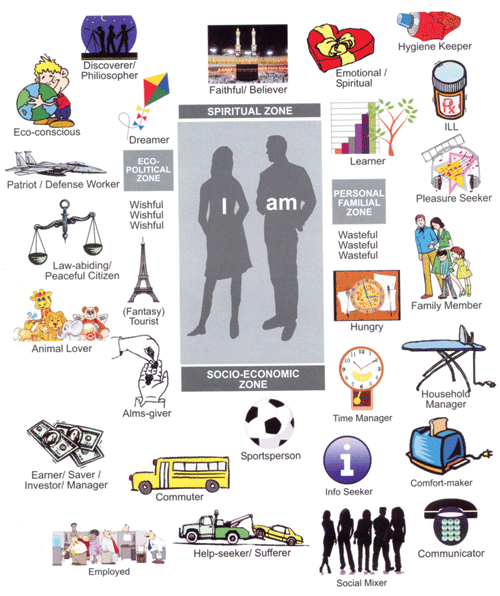
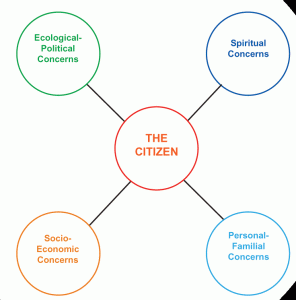
The template for seeing the individual in the context of their family and society and ‘world’ is presented in The People-Centered Model of Business (March 2008). In this simple visual model, the individual “I” is at the center, with four life-zones mapped around them: the spiritual zone, the personal-familial zone, the socioeconomic zone, and the ecological-political zone. Premise? All this activity, which I called ‘business’, owes to the presence of the individual. This is a tool first and foremost for seeing– seeing the society in terms of its individuals, and study them in the four life zones.

Perhaps I should rename this tool The Person-Generated Model of Creativity. I never felt it had quite the right name. I did define business as ‘busy-ness of life’, which must have been my then-word to refer to the big elephant in the drawing room: CREATIVITY!

Note: The model is now called The Salaam Matrix.

Our Future: Collective Creativity

The story comes full cycle: why are humans tearing down the boundaries? Boundaries of what, and for what? I am willing to bet that it is a frustrated creative force at work. The Internet has unleashed the giant of human potential. It can no longer be contained within the bounds of conventions. The nature of the struggle of various peoples is different; their direction is the same.

Our world is not operating in a balance right now. To redress the drastic imbalance, we are applying patchwork fixes, such as the Giving Pledge by Bill Gates, Warren Buffet, and other billionaires (Giving: The New Imperative; Oct 2010). Currently, these fixes are needed. Ultimately, humanity needs to move beyond this historical seesaw of injustice/ drastic redressing.

Humanity needs to move, with each person on board, towards collective creativity.


NOTES:

This article is part of a series of articles Ramala Hubb’Allah wrote (with her then name) during 2008-11 for Pakistan-based publication, Triple Bottomline Magazine, published by Asiatic Public Relations. The publication’s focus was Corporate Social Responsibility, Climate, Environment, and Developmental themes. This is the twelfth and the last article in the series, published in May 2011. Original version in print; web version on the TBL site here.

This article has been published largely without changes, in its original form, on the Hubb’Allah website. It is reproduced to present the collected body of Ramala’s works on the Triple Bottomline Magazine. An updated version with new cases and applications will be available on the Hubb’Allah website soon.

If you enjoyed this article, you may enjoy this YouTube playlist by Ramala Hubb’Allah (below).
Giving: The New Imperative

The Giving Pledge – Billionaires Give Back!

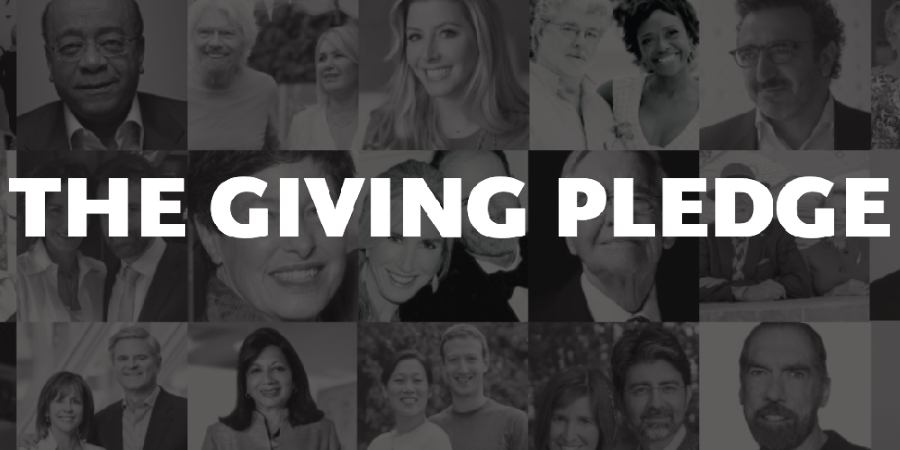
Finally, all those chain email hoaxes about Bill Gates giving his wealth away have come true in a form that may defeat even the most fanciful imagination: Bill & wife Melinda Gates have pledged to give billions of dollars’ worth of wealth away to philanthropy. They are joined by billionaire investor friend Warren Buffet who has pledged 99% of his wealth away. More dramatically, together this team of three have created an initiative, The Giving Pledge, which invites billionaires to pledge to give a majority of their wealth away either at death or within their lifetime.

Because the task of convincing billionaires to part with their money is complicated – not the least due to legal implications, or the need to know what exactly to give money – the proposition of the pledge has been kept simple: commit to give at least 50% of one’s wealth. The total Buffet and the Gates are aiming at? US$ 600 billion.

So far, over 40 pledges have been gathered and shared at a website curated by Melinda Gates: givingpledge.org. The exact total cannot be
determined, for wealth of such magnitude is likely to shift over time.

See the full list of pledgers on the Giving Pledge website.

How Will This Change the World?

Each pledge is personal, with money being channeled to a cause dear to the giver. The donors have written letters sharing what their view of philanthropy is, what cause they are dedicating to, and why. Director George Lucas for instance is “dedicating the majority of [his] wealth to improving education”. The Gates are giving to health and education especially for the very poor.

An examination of the letters, shared on the website givingpledge.org, reveal that these donations will quench some very thirsty needs of the world.

The point of the Giving Pledge is more in the spirit of unconditional giving. The idea is that the very rich should actively (and necessarily) consider philanthropy; and that not just with a relatively small part of their wealth – but that only a small part is retained for the self and the heirs. By sharing letters from the billionaire who have taken the oath, the Pledge creates a positive ‘peer pressure’ for their proposition.

Criticism

Critics have taken issue with the Pledge, or the very idea of giving. Some have argued that one has every right over her/his wealth, and does not need to ‘feel guilty’ or morally obliged to share (Don Watkins and Yaron Brook of the Ayn Rand Center of Individual Rights).

Cynics wonder if this is about tax play or a publicity stunt.

The writer’s view is that it’s reasonable to assume that one (such as Warren Buffet) does not give away 99% of their hard-earned billions to look good, especially if they are already considered good. Indeed, the truth is that motives would be individual and complex — ranging from joy, to guilt, to joining the good billionaires’ club, to realizing that this may be the way forward for doing business in a world that is ailing with need.

The Multiplier Effect and The Giving Ratio

Consider this interesting fact: each billion dollar given multiplies into billions of dollars worth of giving.

This is due to the Multiplier Effect, which suggests that each time a unit of money is spent, it creates an onward cycle of spending from one receiver to another. So, if you give Rs. 100 to someone, they will keep some (it’s called their ‘propensity to save’) and spend some (‘propensity to consume’). Say they save 30% and spend Rs. 70. If the next person has the same saving/spending ratio, they will spend Rs 49 and save Rs. 21.

If the population’s average propensity to save is 20%, then Rs. 100 translates into a total income of Rs. 500 in the population. At 30%, it’s Rs. 333; at 40% saving or withholding rate, it’s Rs. 250. The higher the savings, the less money is passed on each time, and this also means fewer persons become part of the cycle of ‘income’. On the converse, the higher the giving ratio, the more number of people benefit, each beneficiary receiving a higher amount. In sum, where there is a giving habit, more people flourish, support one another, and are collectively better off.

Note that we have shifted the word from ‘consume’ to ‘giving’. Consuming, which in pure economics may simply have alluded to spending away without describing the quality of that spending. Giving is different: it is for charity, for philanthropy, or for fostering community by building something that is not for one’s immediate use. Giving is not about consumption of material by the giver (though these sometimes overlap in the case of social business ? such as when one would buy crafts from disabled or underprivileged people to help them).

In Pakistan, Pleading for the Pledge

The spirit of the Giving Pledge has traveled far and wide partly through the word getting out, partly because Buffet and the Gates are now reaching out to rich people in other parts of the world to encourage them to replicate the same idea. In China, long-time philanthropist Chen Guangbiao has convinced a 100 other rich Chinese to commit a majority of their wealth to charitable causes.

In Pakistan, construction giant Bahria Town’s CEO Malik Riaz Hussain has come forth with a pledge of US$2 billion for flood relief. In a manner typical of these very large commitments, he is dedicating his wealth to an area where he has passion and, in his case, expertise: constructing places to live.

It is in this sense that this newer form of giving is more than just parting with one’s wealth. It is about giving smartly, ensuring that specific, measurable objectives are achieved. Riaz has also issued an open appeal to the 100 richest Pakistanis. As he perceives, the rich of Pakistan could face a violent uprising against themselves and their assets if they do not choose to voluntarily step up and share with the poor of Pakistan.

To date, there is no public pledge in response. Ironically, it is only giving that can cure the economic ailment and restore mutual trust by building inter-dependency. Other alternatives may lead to closed ends.

I would go further to propose that the Propensity to Give become a separate, independent metric from the propensity to consume, and be recognized as such in positive economic literature. It recognizes that giving is an imperative, not just an occasional act of personal greatness.

Human societies have taken all kinds of shapes and structures. The kind of society that considers itself integrated, cohesive, and communal is more likely to have members that understand that giving is a part of the cycle of life; that the one who earns (money) is not the sole consumer (of money), but must share that earning with others such as family, neighbors, deserving poor, and the sick.

Is World-Wide Cluttering Impoverishing the Human Body?

Leading thinkers, such as the curator of TED conference Chris Anderson, are foretelling the forming of humanity into a super-organism. In short, this means that all humanity will organize like a single body — an idea familiar to those who have engaged in a philosophical examination of the world.

This has several implications. For once, the accumulation of ‘stuff’ at one point means a depletion of necessities at another point. Interestingly, this does not benefit the accumulator, for the disease that arises in the deficient part affects the accumulating part. This process accelerates in an interconnected world (because the ‘damage’ can transmit more seamlessly in a better-connected world).

Hoarding, saving above and beyond need, and cluttering are behavioral issues with real economic costs. They lead to mass depravity, crime, and a morose socioeconomic structure. This behavior occurs within nations, and even between nations because geography and the transmission of benefit or harm know no national boundary. Take the recent global viral scares, for instance. Originating in one place, the viruses, such as flu, hopped planes quickly to spread globally.

On the flip side, the opportunity in this inter-connected world is that if giving for doing good becomes a habit, then it can unleash massive positive change, from nation to nation.

Historically, some nations are more inclined to accumulate than others which has, arguably, led to depravity in other parts of the world. This is an imbalance with such deep consequences that not just governments but also businesses and humanitarians have now risen to redress the balance.

It is my understanding that once such massive, unconditional giving crosses national barriers, and it becomes not an occasional incident but a way of doing things, that humanity will be rapidly able to overcome its most abject crises that include super-floods, droughts, mass deaths, disease, and war and terrorism that arise in deprivation and poverty. We may even begin to find a way out of that most damning crisis of all: a human-unfriendly shift in the Earth’s climate.


NOTES:

This article is part of a series of articles Ramala Hubb’Allah wrote (with her then name) during 2008-11 for Pakistan-based publication, Triple Bottomline Magazine, published by Asiatic Public Relations. The publication’s focus was Corporate Social Responsibility, Climate, Environment, and Developmental themes. This is the eleventh and the penultimate article in the series, published in October 2010. Original version in print; web version on the TBL site here.

This article has been updated with a headline, with the rest of the text unchanged, on the Hubb’Allah website. It is reproduced to present the collected body of Ramala’s works on the Triple Bottomline Magazine.

Not Flat But Textured

Relationships and Growth in an Interconnected World

Thomas Friedman declared that we live in a flat world that has got even flatter. That technology especially the Internet has the most significant part to play in it. Those who have grown with the Internet and are inextricably glued to their cellphones will testify to this.

But with 6.8 billion humans on the planet, how flat can the world get?
Does this flatness mean you must connect with everyone?
Does that not pulverize the individual or the group?
Have all boundaries truly eroded?
And if so, how are we ‘safe’?
Where do we belong?
In the face of overwhelming flows of information and noise, where is the individual’s voice?
How does this affect our relationships?

The fact is that information is eroding the boundaries of the individual and the group. Secondly, it fundamentally alters the landscape of relationships by apparently making everyone ‘equal’ and therefore making priorities hard to determine, leading several people to make confused choices that may overtax their system and resources.

The Keyword Is: Apparently

Here is the good news: there is, indeed, a design, a sense, a scheme to this ‘flat’ world. That it is equal, but not so equal that an individual or a group cannot determine their priorities. There is a way that an individual in the contemporary world can render sense, all over again, to their self, their relationships, and their business of life.

The story of this sense, and alignment of an individual, their purpose (passion), and their global context begins with an individual’s attention and intention…

Attention & Intention: The Building Blocks of Life

Attention: Seeing The World

The most powerful tool a human has is their attention. It is by way of investment of attention that anything is created and grown, and it is by divestment of attention that things deplete and fall in disarray. (Decay and death, however, is part of the natural cycle of life. It is not to do with lack of attention, but the end of one life-cycle.)

When the attention is focused on contribution, an interesting thing happens: a natural scope is determined. Why? Because an individual is restricted by their organism (the body) and the environmental context and is subject to natural limitations of speed, time, distance, aging, incoming energy. Contributing takes away from the individual, and therefore, one can only give as much. This gives a limitation to one’s extent of involvement in the world’s affairs.

When the attention is focused on taking from the world, the natural limitation on attention erodes. Theoretically, one can take on the entire world. One can take on three jobs, unnecessarily, at one time. One can sign up for as many classes as they want, and have as many friends as they like if they are not going to pay any attention to what they have.

There is an interim state, too: recruiting someone else, by power (or money) or sheer force, to manage what one has acquired. Manipulation is the tool of the taker to sustain their acquisition. Entire nations construct laws that permit them to overtake other territories in order to fulfill their own needs. This may be in the form of war or even trade.

Intention: Giving or Taking?

There are fundamentally two kinds of outlooks on the world with respect to the self: either one sees that the self is here to take from the world, or here to contribute to the world. These two outlooks determine one’s character. The first kind of character is concerned with more, and grows through acquiring. The second kind of character is concerned with less, and grows through contribution and service (which can be for pay, of course).

These two characters have moral and ethical implications. Interestingly, they also create a different ecological footprint and organizational design. Conglomerates and inefficient mergers that attempt to take on the world with size and encroaching urban landscapes are two instances, intangible and tangible, of the taking mindset.

Life, Growth and Relationships: The Connection

Growth is an outcome of being alive and it takes place through interconnections which we can call ‘relationships’. An organism that is not connected to any other organism cannot find incoming nourishment and thus will not sustain. In reality, a wholly disconnected organism does not even exist.

Hence life is a system thriving on relationships, and it grows by its very design. But what is growth?


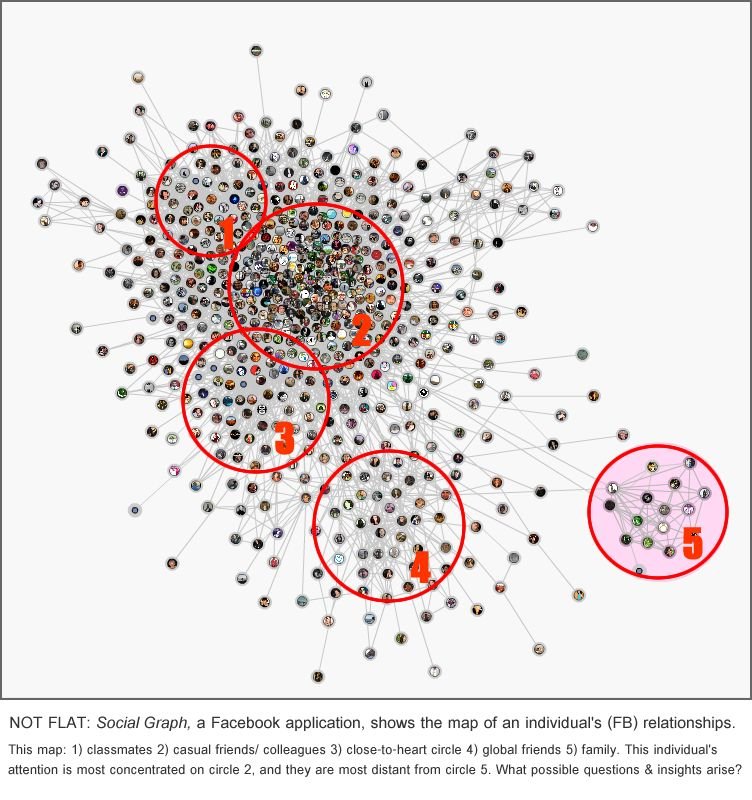
At the time of the publication of the article in 2010, Facebook allowed external applications such as Social Graph to connect to Facebook profiles and access data such as Friends lists, which were categorizable into labels that a user gave them, for example “Colleagues”, “Family”, “Classmates”, and so on. The writer generated a map to study what their Facebook relationships look like, and where is the highest concentration. This graph happens to be representative of a young urban person with a sociable profile. The graph, if generated today, could be highly insightful. Perhaps an app can be used to generate a map of one’s contacts and relationships, and one can study where their time and attention is concentrated the most. This is where their life will grow–but do the groups that they hang out most with, truly grow them? The answer depends. While our article proposes the natural family as the highest alignment, it is possible that people define families variably or find peace in a different group (that acts as a family). Also, the article assumes functional and well-formed families, and an ecological civilization where families are aligned, and people are connected to Land. When achieved, this is the easiest form of natural alignment.

Growth Is Not Just One Thing

Growth has long been defined in material terms: more money, more space, more territory, more things. It is seen in terms of more of the exterior.

The emerging understanding of growth is shifting towards an inner meaning. Nalini Nadkarni, an ecological scientist who studies tree canopies, observed: if one sees the tree’s growth and movement in terms of its dynamic twigs and not its static trunk, they will notice that trees, too, move. A single vine maple tree in her study made a movement equivalent to circling the Earth 7 times, in a single year!

That observation gave Nalini an insight: one can move and grow even when standing in one place. Armed with this insight, she started programs for Washington prison inmates that engaged them to become productive members of the society within confinement. Her inmates voluntarily attended science workshops and began a conservation program planting nurseries for local forest restoration. This also healed them as condemned individuals. Thus by redefining growth, Nalini opened the doors of growth and connection for those who are physically restrained.

I am advancing the idea that growth is not just one thing: it means different things to different people ? and that subjective definition is not just acceptable, it is the only way to have an interesting, rewarding experience of the world. The world is richer for the variety of aspirations and thus contributions of individuals. The narrative that has long defined growth in only one way has destroyed relationships, created exploitative businesses and structures prone to collapse because they cannot be sustained by definition.

Destruction as Opportunity

Relationships are the structure upon which life thrives. Life by definition is a forward movement, a bristling, an evolution, a growth. Even the apparently static thing is in movement, the disconnected is connected. Yet if the attention is veering off, and the intent is based on taking, both the structure and growth suffer. We are observing the malevolent structures premised upon taking & more are collapsing. We are also observing a world with depleting restrictions where access is becoming fluid and open.

This is actually a time for great opportunity. What we are witnessing is not a deluge of information out to get us, but a release from traditional constructs. We are no longer bound by restrictions. Yet, with their erosion, we are also experiencing a lack of comfort that came within these walls, a massive dissolution of familiar structures. By focusing our attention on what is, and with good will, we can begin to render a new, fluid, open, dynamic structure suitable for these times.

Inside-Out Relationships: A Structure for Growth

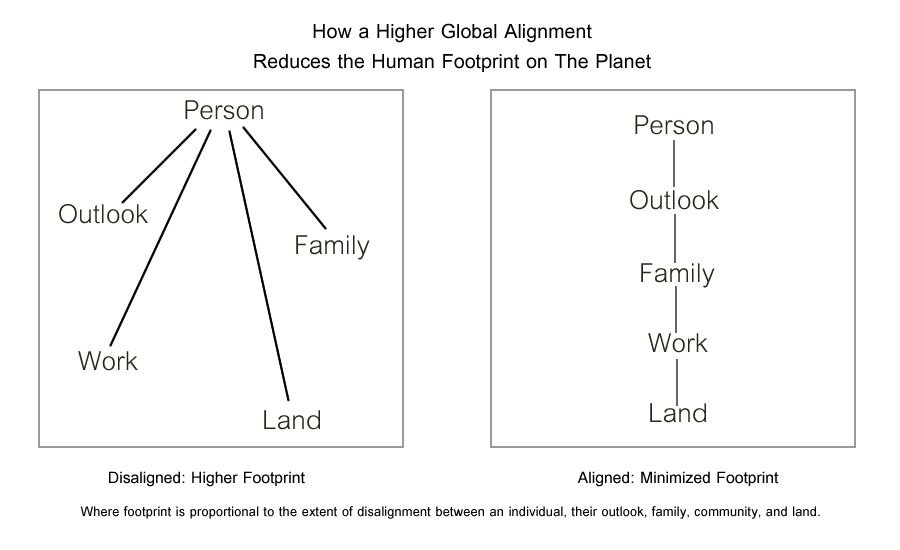
I propose that this new structure is built inside-out: from the individual to the family to the community to the larger world. Further, that it is based on a benevolent intent (contribution). The inside-out structure supports sustenance of attention, which is not dispersed all over the place. The proximity in this structure ensure a history of transactions which in turn becomes a basis of incremental trust. Care is the fiber this system is weaved of.

To take an example: if you are to grow a food farm, would you rather do it in your city, or the neighboring town? If you wish to do business in the next town, why are you in this town? I am arguing that we bring businesses and their infrastructure home or migrate to where our heart is, thus bringing ourselves home one way or the other. This will reduce the footprint that is caused by being distant from wherever your purpose is taking place.

Online communities, too, are arranged on similar principles. We are increasingly observing that the netizens are congregating around local issues. This is more visible in geographies that were previously politically closed or economically disadvantaged. Nations which were already organized are ahead on the curve: communities-of-purpose are arising and these nations are on the forefront of discharging benevolent ideas within the global population. Think TED.com–the great reservoir of best human ideas in the contemporary world.


This image roughly shows the alignment of a person and their outlook with their family, their work and their land (second part) vs. when their being is scattered in the instance of misalignment between their family, their outlook, their land and their work (first, left part).

Individual: The Epicenter of Growth & Relationships

All growth starts from one person, and that ‘one person’ is not a hero figure or a privileged person, but one’s own self. Hence when I think of growth, I tackle the question for me; when you think of growth, you tackle the question for you.

Attention and intent of the individual are the starting points of growth: that which is paid attention to, grows. Intention determines how the relationships around the individual get rendered. An intent of giving allows one to connect with the exterior, even if the exterior is an alien, say, a foreign country. In other words, paying attention with an intent to give allows an individual to create a relationship by becoming useful.

Families: The Natural Partners in Growth

The blind poet John Milton consoled himself thus about his condition: “Those also serve who stand and wait.” This has long struck me as very insightful, for at any given point in time, most members of the population are physically rooted in one place and inextricably linked to their relations.

When I was a young child and had natural aspirations for growth, I could not reconcile how those who stay put. I was thinking of most of my family members who never grow by the external standards of the world. If growth was the acquisition of more, certainly most members of most families failed the criteria. That includes mothers and grandparents as the epitome of those who are ‘losing’ by way of caring for the other.

If we see these relations by the externalist measure, these are the most sorrowful individuals on the planet. And yet, many find their roles joyful (though they may be made to believe otherwise by the cultural narrative), and they are making real economic impact and contribution. Attempt replacing families and their care with institutions, and we will end up with an unmanageable task and an emotionally dysfunctional population prone to crime.

This massive opportunity cost is a clear indicator of the real, valuable contribution families and communities are making even if they are not snatching territory. Indeed, their greatest contribution, whenever they make it, is not snatching territory while providing nourishment and opportunity to the world’s population.

Communities: Infrastructure for Growth

Communities provide a context and infrastructure for growth. There are two factors at work: the hard element, that is the physical landscape, architecture and design of the community; and the soft element, that is the culture of the community.

The individual has two choices: to align with their given community (and transform it slowly from within through their contribution), or to migrate, and in some cases, initiate a new community. The choice is determined by the individual’s assessment of which situation grows them best.

The right local community (including online communities) nurtures its individuals and may grow them by occasionally challenging them. However, if the balance is tipped out of favor of nurturing and tilts towards taxing (burdening), the society, that is to say, a constellation of individuals, perishes as a collective.


A Global Alignment

It is increasingly possible in this world today to be emotionally and physically in a place that is aligned with the individual’s inner purpose, while being an involved part of the larger world. This balance of the micro within the macro is an unprecedented occurrence in human history. The only thing needed to make this change is the individual’s courage to embrace it.


NOTES:

If you enjoyed this article, you may enjoy this YouTube playlist by Ramala Hubb’Allah (below). This article is part of a series of articles Ramala Hubb’Allah wrote (with her then name) during 2008-11 for Pakistan-based publication, Triple Bottomline Magazine, published by Asiatic Public Relations. The publication’s focus was Corporate Social Responsibility, Climate, Environment, and Developmental themes. This is the tenth article in the series, published in August 2010. Original version in print; web version on the TBL site here.
This article has been updated with new images and the text is republished as it is, with light formatting, on the Hubb’Allah website. It is reproduced to present the collected body of Ramala’s works on the Triple Bottomline Magazine.

This Ramadan, Count Your Riches: Scarcity to Abundance Perspective

What if there were a way to reduce our (currently outrageous) footprint on Earth such that:

  • the shift is convenient
  • it reduces economic cost and saves technological effort
  • it reinforces benevolent relationships
  • it creates organic, effortless growth
  • it is consistent with ethical and spiritual values
  • it enriches the social whole by nurturing the individual person or group?

What if this way were as simple as shifting how we ‘see’ things, especially the nature of our work?

The answer is: Yes. It is possible to achieve all the objectives outlined above, at once, by simply a first shift in perspective. This first shift in perspective then leads to shift in actions, and therefore outcomes. And this shift is as simple as changing your fundamental question about growth.

Change Your Question: From ‘Need’ to ‘Have’

Instead of asking: “I need _______ to get ________.” Ask: “Where do I want to go? What do I have, right now, to get there?”

The shift that we are seeking is one from a Scarcity Perspective to an Abundance Perspective. Note that the second key word is ‘perspective’. This shift is not about lying to the self about resources and growth, but rather seeing things as they are and then choosing to pay one’s attention in a certain direction. In sum, if you have 10 acres of land, you are not psyching yourself into believing that you have more than 10 acres. Indeed, you stay reasonable and grounded about the land’s known natural capacity, but shift your attention to what can be done with the land rather than what cannot be done with the land.

In the first way is potential for growth. In the second is anything from anxiety, to greed, to the urge to steal, to depression.

How Does This Work?

The “have” mindset in people or organizations is indeed only just a mindset: it requires soft intra-personal or intra-organizational work, but it yields hard results including structural transformation.

The “have” mindset:

makes intelligent use of given resources to get things done. Take the instance of technical innovation. In Pakistan, the word ‘jugaar’ is used for a technical/mechanical patch-up that makes things happen. In Africa, the same concept goes by the name of ‘tinkering’ ? it is now being recognized as a very smart form of innovation. India, for instance, has a grassroots innovation network.

highlights strengths-to-grow rather than weaknesses-as-excuse.

yields planet-friendly development and growth. Needs are limitless and greedy, and lead to growth by taking. ‘Have’s’ are identified and content, and lead to organic, natural, rightful growth by giving.

How To Put The Abundance Perspective Into Practice?

The shift from the Scarcity Perspective to the Abundance Perspective is a reflective exercise first and foremost. It requires less action, more silent thinking. Action comes after the perspective shift has occurred.
See it through this example: you want to choose a place for vacation. The first decision about where to go on holiday requires no action (other than research, perhaps) but thought: you figure your budget, your priorities, your style, your mood internally. Once the decision is made, you then gather and align required resources. If you choose to ski in the cold mountains, you will not invest in scuba-diving in warm waters. If, however, you do not make up your mind, you may end up with chaotic resources and decisions. Even serendipitous, unplanned travel is known to be such. You decide not to over-plan.

Apparently small decisions such as this translate into large costs or savings for individuals and the planet. Unnecessary acquisitions whether by individuals planning a holiday or organizations investing in new ventures ? lead to ineffective decisions, delayed action, lack of (worker) spirit, and wasted resources that could be leveraged elsewhere.

This Ramadan, Shift to Abundance

This shift to the Abundance Perspective requires slowing down, pausing, taking stock of one’s current life, evaluating what is, and then moving forward. It is not easy in a fast-paced daily life for organizations or persons to find time for this extensive reflection.

In this situation, Ramadan, the Muslim month of fasting, provides an excellent opportunity for an organizational shift that is driven by reflection. The natural rhythms of the human body and therefore the pace of work slows down during fasting. Quick-paced activity is not as possible. It is thus an ideal time to do collective reflection everyone (or everyone in the fasting whole) is slow-paced, together, for an entire month, and there is a general aspiration to do good, do right.

The context and the motivation are already present ? and so, dedicating Ramadan to asking the big questions about the organization’s mission and purpose is in itself a great practice of working with what one ‘has’.

Conversations: a Tool For Shifting to Abundance Perspective No matter how complex an organization is or how sophisticated its products and systems are ? it is made up of human beings. The start of the shift in an organization lies with human beings, and humans can begin reflective shifts using an age-old tool: conversations. This simple tool is so potent that today, ‘changing the conversation’ has become the most powerful tool in a change-makers’ toolkit.

Conversations can be held in ways suitable to each organization. The best method is to have face-to-face personal conversations in groups of no more than 8 persons. Alternatively, a larger, in-house ‘Reflection Conference’ may have some core themes for all, and topical break-out sessions for smaller teams.

A contemporary alternative is to have online conversations in secure groups or even on blogs (this blog does not have to be public ? only shared within a particular group or organization). Eventually, it will be noticed that small groups break out on their own and they should be encouraged in doing so for individuals cannot concentrate in large, many-to-many conversation.

At The Oneness Breakfast, an inner peace initiative that I have co-founded, we use food-sharing and a Native Indian-styled conversation for transformation of the person within the collective. We have actually flipped the conversation to “TLC: The Listening Circle”. Some of the themes covered: sustainability, local food, attention management, nation-building, and education-for-all. One of the outcomes of the circles has been the participants’ voluntary involvement with Manzil Organization, a free school for slum children, including voluntary teaching, media coverage, and fund-raising.

Abundance: A Living Practice

Ramadan is a time to bring ethical values that humanity holds dear into action, making them a living practice.

Illness arises when the belief and the practice are on two different tracks such as when one believes in contentment (Abundance Perspective) but lives by fear & greed (Scarcity Perspective).

Spirit is, by definition, ‘action when it’s taking place.’ The Qur’an defines spirit (‘ruh’) as: “the act of/ by act of Allah” (17:85). I understand it to mean that the very act or movement is called spirit. This is also the popular meaning of the word; hence we say sportsman’s spirit, high spirit, low spirit. Spirit is action. Practice is to live the spirit deliberately (by choice), daily, as routine.

This Ramadan, invite yourself and your organization to shift to the liberating Abundance Perspective, and converse about how to make it a living practice.


NOTES:

This article is part of a series of articles Ramala Hubb’Allah wrote (with her then name) during 2008-11 for Pakistan-based publication, Triple Bottomline Magazine, published by Asiatic Public Relations. The publication’s focus was Corporate Social Responsibility, Climate, Environment, and Developmental themes. This is the ninth article in the series, published in August 2010. Original version in print; web version on the TBL site here.

This article has been updated with new images and the text republished as it on the Hubb’Allah website. It is reproduced to present the collected body of Ramala’s works on the Triple Bottomline Magazine.

6point8 Billion: The Citizen Stakeholders

Is it possible to engage each and every human on the planet as a stakeholder? Is it possible to make every single voice count? Is it possible to get all citizens on board to arrive at decisions that are relevant to the entire population?

The answer is: YES. A resounding, no dream, all hard fact ‘yes!’.

It is possible, in this day, to create a super democratic system that engages every individual concerned with an enterprise, counts their voice, marks their presence, and assigns them tasks. It is possible to end the problem of disenfranchisement. It is possible to engage the citizen as a stakeholder.

The Citizen Stakeholder

Any modern organization – be it a public service body, the government, a corporation, or a non-profit organization – has theoretically always factored in ‘the common person’ as a stakeholder.

In truth, however, that has not been possible due to the technical limitations of engaging every single person. That technical inability has led to two kinds of intents:

  • The everyday stakeholder is deliberately kept out, and control is exerted by the few. OR
  • There is a willingness to engage the common person, but the process has been long, frustrating, and at best helped by scientific methods of sampling (with constant corrections for bias).

Let us name this common person as ‘the citizen’. When the citizen is kept out of the creation process, whether deliberately or not, two possible outcomes occur:

  1. Costs are passed on to the citizen. The citizen has not accepted to take on these costs – and each project has costs until a perfect sustainability is achieved. The citizen is neither equipped nor ready to take on unexpected negative outcomes – such as, the cleanup required after a civil construction project.
  2. Possible value addition, that comes through the input and involvement of the citizen collective, is missed. For instance, the citizen could suggest that all new area houses have storage to harvest rainwater. It’s good value for the individual household, who may altogether ‘miss’ the opportunity to create this value through a lack of knowledge or motivation.

    In another scenario, positive externalities are not acknowledged or credited. For instance, a business organization may not be credited for care shown to employee families, when the focus of organizational accountability and performance audits is on profits alone. In this case, the organization may find little motivation to do the right thing.
Externalities: Definition
“In economics, an externality (or transaction spillover) is a cost or benefit, not transmitted through prices, incurred by a party who did not agree to the action causing the cost or benefit. A benefit in this case is called a positive externality or external benefit, while a cost is called a negative externality or external cost. For example, manufacturing that causes air pollution imposes costs on the whole society, while fire-proofing a home improves the fire safety of neighbors.”
Wikipedia

A Portfolio of Concerns

6point
The citizen is capable of holding concern in a number of what Ramala described as “The Four Life Zones”. For a full description, see The Salaam Matrix (website).

There is an upside to having the citizen stakholder on board: the citizen does not have just one concern or interest. Rather, there is a ‘portfolio of concerns’. At any given time, the ‘pull’ on the citizen comes from various directions: the belief system, the family structure, the social network, the economic activity, and the larger political world.

Once an organizational structure is imposed, however, the person starts to lean towards the biases of the organization. Hence, in a worst case scenario, a person in a not so responsible corporation does not concern themselves with the environmental impact of economic activity, and a person in an environmental preservation NGO does not concern themselves with its impact on business and livelihood. This scenario has often been played out in real life. Consider Green-peace vs. The Corporation.

On the other hand, the person as a citizen is blessed with a complex eye that sees more than one concern. Collectively, aware and empowered citizens have the ability to diffuse special interests – in other words, no single agenda dominates permanently at the expense of others. When it does, contrarian forces emerge until balance is restored.

Technology Case Usage: UShahidi

In the wake of the 2007 Kenyan post-election crisis, a web-based platform, UShahidi (Swahili for “witness” or “testimony”) was created to generate incident reports from the public. The hallmark of UShahidi was the ability of the public to report incidents through SMS. The incidents would be classified in categories, and mapped visually for public viewing. The project was a great success.

Today, UShahidi’s open, free platform is deployed for various purposes ranging from snow cleanup in the USA (snowmageddon.com) to identifying peace heroes in Kenya (peaceheroes.ushahidi.com).

Kibera: Africa’s Largest Slum

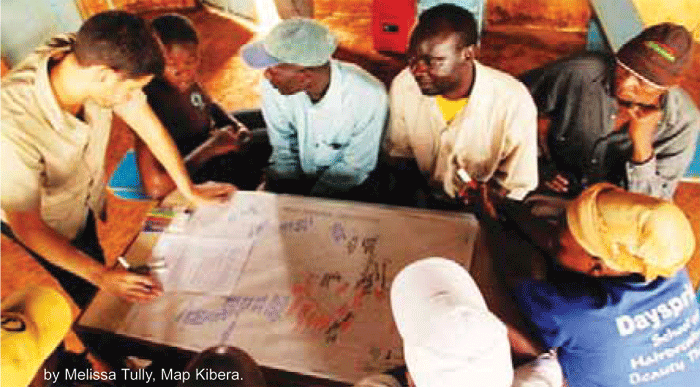
Group mapping exercise – citizen project mappers are trained by Map Kibera
Kiberian citizen journalists equipped with cameras and mobiles are the eyes and ears of the Map Kibera project.

In the Kenyan slums of Kibera a community ridden with typical slum issues, and long a laboratory for NGOs and activists UShahidi has found a new purpose: digitally mapping the community.

Led by Map Kibera, young Kiberans are creating a thematic digital map ‘Voice of Kibera’ (kibera.ushahidi.com). Key themes include Health, Security, Education, and Water/Sanitation. In their own words:

“Map Kibera is, at the core, about empowering communities to use technology for their own agenda, all players openly sharing and creating information for transparency and equitable discussion, and confronting the reality of technology on the ground, in marginalized communities.”- mapkibera.org

The idea: once the community’s resources (corresponding to its issue – health, etc.) are mapped, a better picture will emerge that will better enable organizing for social change and informed decision-making. It also brings the community together around issues that matter to the collective, reducing disruptions along the way.

Pakistan: An Unorganized Global Powerhouse

Closer to home, Pakistan Changemakers Hub (http://changemakers.pk) is deploying UShahidi to create a platform where the Change makers innovators and community leaders of Pakistan can be mapped, organized by their field of action. The end result is a citizen-generated visual directory very similar to Voice of Kibera.

The idea: connect the disconnected Changemakers in order to accelerate Change. The directory serves the functional purposes of making hidden Changemakers known and available. Its more subtle function is coordination, hope, connection, motivation. It organizes Pakistanis causes we care for rather than identities that divide us.

Final Question: Do Citizens Care?

Yes. What they need is a direction and a method to organize the chaos. Globally, we’ve witnessed citizens organizing for Tsunami relief, Haiti, and recently, against BP’s handling of the oil spill. In Pakistan, the ‘civil society’ has risen in (near) concert during the 2005 Earthquake and the 2007 political unrest.

The underlying theme, however, in all these cases is accident. The question, can creative projects create the same kind of momentum? The part of the answer that comes from technology and ability is: yes. The part of the answer that comes from will is: up to you.


NOTES:

This article is part of a series of articles Ramala Hubb’Allah wrote (with her then name) during 2008-11 for Pakistan-based publication, Triple Bottomline Magazine, published by Asiatic Public Relations. The publication’s focus was Corporate Social Responsibility, Climate, Environment, and Developmental themes. This is the eighth article in the series, published in June 2010. Original version in print; web version on the TBL site here.

This article not been edited except a headline and images and republished as it on the Hubb’Allah website. It is reproduced to present the collected body of Ramala’s works on the Triple Bottomline Magazine.