I was watching this video clip of a longer conversation between host Tucker Carlson and guest Shawn Ryan, the full conversation being centered around Shawn Ryan’s disenchantment with the world of politics, social media, podcasting and his awakening into faith.
What struck me in this clip is a wholly unamused and tired Shawn declaring that “everything is a lie”. For Shawn and his family, the Bible, family time, and paying attention to God (from a Christian lens) is the way forward. He has had some intense encounters with otherworldly forces and has often met with the likes of exorcists (Father Dan Reehil, Father Chad Ripperger) to understand the nature and the shenanigans of evil.
I have been watching with quiet amusement how the likes of him, Tucker, and a whole host of other podcasters went on a journey of diving deeper into the nature of what I will call “The Empire” in code. This is mostly a Western construct of power, control, and spread… which may in fact be alien and extraneous to whatever is native to the soul and morality of the West. “What if any is the true morality and value system of the West?” is possibly especially pertinent for the more agnostic Christians who do not come from a traditionally religious background, who are feeling the urge to be more devout and attentive to what their chosen moral codes and paths mean.
I wish them good luck on their journey. In general, I think this should have been a time for contemplation, reflection and introspection for humanity, as the tribes and the issues and values of the diverse humanity come face to face with one another across the globe, and we have to find more grounding and safety in what our value systems are — while also determining whether our values truly hold up or not.
The utility of a tool such as The Salaam Matrix is exactly to map our question, our values, and our paths (based on what the purpose of the usage of the tool is), so that we may more clearly obtain a picture of where we stand today, and where we want to go in future, using the methods, paths, and worlds (such as Church or family time, in this case) that we choose.
What Questions May Come
Based on what we are gleaning from the podcasts’ general content and the nature of ruminations, these are questions that the likes of Ryan and Carlson contend with.
What is meaning? What is purpose? Who are the enemies? Who are the allies? What is the direction of our human and constitutional project? What is the end game? Why are certain faiths and beliefs finding themselves meeting more challenge than other faiths are seemingly meeting? Is the danger from within or without?
I cannot participate honestly and truthfully in this debate without dropping my real opinion, and my real opinion and advice to the Christians is: Examine how you are incorrectly interpreting the role and extent of Mercy and Empathy in life.
The operative Christian value is Mercy, Kindness, Love and Relation.
This value needs the container of boundaries, extent, and place and time.
You cannot simply be a random flash flood of Mercy, you have to contain it within the riverbanks of discernment, and accountability for Self and the Other.
This is the operative Polarity in this situation. Figuring this out will begin solving the puzzle and make the path easier and clearer for our truly devoted Christian friends, who are the true seekers of God, and not of political power or disempowerment. In other words, people who are seeking to understand and correct the basic moral code and foundational values of the belief systems.
This is all I will say on the matter for now.
Best of luck to the true seekers of order and pattern, regardless of your age, faith, creed, race, nation, color, and tribe.
~Ramala Hubb’Allah
Note: This is a pop culture-coded commentary and should be read and treated in that context only. This is offered on a “whom it may concern” basis and may not concern or serve the purposes of any audience other than the media personalities, podcasters, ex intelligence agents and otherwise- once driven and influential participants of Western politics, who are currently doing soul-searching and revision and reflection, particularly through the instrument of podcasts. Thank you.
First of all, let me tell you this fine day of June 2026: In the months since that I have been silent on this website, I have done excessive contemplations on The Salaam Matrix. I found an astounding number of applications of the model… applications and contemplations that are leading to constant revelation! And that has led to some profound discoveries that are going to solve some of the perennial knots in our heads about how to live integrated, coherent lives in this fragmentation of a century.
Take the insight about CULTURE. I am in the process of making several revisions to the model and asked myself:
“Where does CULTURE go in the Salaam Matrix?”
Does it belong in the Socioeconomic Zone (Zone 3)?
If so, is it powerful enough a factor for me to rename the Zone as “Cultural-Socioeconomic Zone”?
Is it already a silent part of the Ecological-Political zone? Not very likely, because that is concerned with structure, policy, governance.
Does Culture straddle the Personal-Familial Zone (2) and the Socioeconomic one, because the family zone definitely is a great determinant of culture!
To answer this, we need to put a few things together.
The Flow of Influence and Affect in the Matrix
With the rising investment of the global discourse and attention into the arena of politics, With citizens around the world becoming increasingly vocal, investigative and hands-on with global and respective nation affairs, With politics of the likes of the Strait of Hormuz affecting the price and freshness of groceries on the aisle of your North American and the volume of petrol in your Pakistani vehicle… the discourse online has shifted from the era of when individual “influencers” and thinkers seemed to be shaping the world, towards a somber reflection about the interconnected nature of our world and how it impacts our daily, very local and very personal lives.
Are we the people shaping the world, or is the world not shaping us but is whacking us the people about at our workplaces, in our schools, and in our homes?
Earlier, I contemplated on the nature of flow of influence in the Salaam Matrix: Is it outside-in, or inside-out? Where does that place culture? Is culture an emergent quality of what persons and households do and believe, or is it imposed structurally from the top-down/outside-in from political atmosphere? Or is there a meeting point in the middle?
I try to determine the placement and origin of Culture while my mind is inwardly shifting from feeling as though I affect the world, to observing how the world affects me. This line of inquiry is particular to me as a designer, guide, teacher and thinker who has long stayed at a distance from the world, and seen it as an observer, often through the crystal ball of the social Internet. At one time, it seemed that a handful of powerful actors were impacting key decisions in the world; but today, we have billions of voice on board and no clear sense of direction and point of origin of thought, action, and reaction.
Admittedly, this is happening in the backdrop of rising social suspicion about “hidden hands and forces” in the world, which some of us call by the mystery-laden moniker “they/them” in the Internet space. “They are hiding facts from us!”, “They are putting ideas in our heads and sowing conflict!” The distrust, whether right or wrong or partly correct, is high.
There are also classical polar discourses angling for attention and domination in the social spaces: The battle of genders with the classic “wars” between women and men even as we are introducing and cancelling new genders, leftism and rightism, North-West vs. South-East socioeconomic conflicts and struggles are not only dividing humanity on the one side and establishing health boundaries on the others, but many of us are left shaking and wondering where do we belong and what do we impact? And who and what is impacting us, and whether we have any say in this situation what with the absurd laws in some regions and the total lack of supervision in other regions… all clashing with one another in one glorious, largely unstructured space called the Internet.
Culture Is the Salaam Matrix
All this signals to me, after all, is a mix of felt and real lack of knowing and ownership about the world, about how the world is structured and composed, and how influence is made and how it travels. We are doing this force-field analysis in the backdrop of genuinely altered values, and the creation of new power and impact centers.
Culture is no longer of static and manufactured origin in this beautiful and wild world. Nor does it belong to any one Zone in the Salaam Matrix. This leads to the realization:
Culture is being birthed, lived, and transformed simultaneously in all four Zones of the Salaam Matrix in an autonomous population.*
Culture may in fact be what we feel and sense as the living activation of the Zones, once the Zones of the Matrix are set in motion in a population of concern! Culture is when the theater of life comes to Life!
* Controlled and dictatorial nations may still be birthing cultural directives in the decrees of government, and in other cultures, one or another generation is the keeper and designer of the symbols and traditions. Whether this is a source of tension or not, and how are shifts integrated, requires a separate examination.
Return to the Basics!
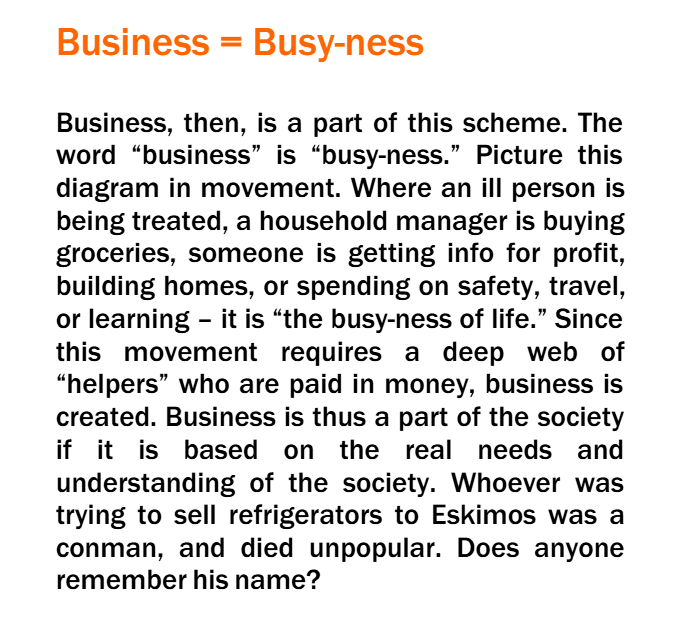
Now is the moment to pay homage to the farsightedness of the original 2006 paper that drew and defined the original version of The Salaam Matrix, and related that to “business”, which the model saw as integral to the society, not as a “cancer” that is sometimes becomes when it is seen as external, cruel, extractive, exploitative and unconcerned. This suspicion-laden view of business and socioeconomic activity is especially true in regions that experience conflict and alienation through colonization, unintegrated refugees and migrants, class conflict, educational disparity, and the felt sense that some of the ideas and practices within a population are somehow alien and not fully organic and absorbed.
The Busy-Ness of Life
The seminal Salaam Matrix paper (then titled “The People-Centered Model of Business”) insisted that the life zones and the “roles” that people play in them are not static and isolated–they are dynamic, alive and in a flow. This is why the paper cheekily characterized “business”, then and to this day seen as a controlling, aloof, and uncaring entity, as the busy-ness, the movement, the sound and sights, the flow and the dance of life. Note that this does not imply that business and socio-economy bleed into all aspect of life and “no stone is left unturned and non-monetized” which would be cruel, absurd, intrusive and lead to distrust. Rather, business (the money one) was part of the woven fabric and the theater of living in dynamism, with seasons and from role to role as a person of certain beliefs, as part of a family and community, as part of the economic machinery of life and ultimately as an engaged citizen.
This movement, flux, and role shifts and integrations have always positioned The Salaam Matrix as a model that studies not just Elements, but also Relationships and Movements. What we called the “busy-ness of life” not all aspects of which are monetized but all aspects of which can be value-adding, intentional, and liable to upgrades and shifts by being treated with the same attention, discipline and accountability that we have wrongfully isolated in the business sector (Socioeconomic Zone in the Salaam Matrix).
Culture is Heritage and Movement
This is the idea that would need its own home as a longer reflection one day, but for now, the more I read the Salaam Matrix, the more I am tapping into the feeling that “Culture”, which is the source of argument and strife in many parts of the world including the once remote Himalayan regions where I live, is a mix of inherited and determined values, and also, the arrival and movement of new ideas and practices. In place that are far from the larger centers of exchange, the cosmopolitans and the ports of the words, change is slow and icon, ideas, and practices are retained for long. Culture tends to become more dynamic and is subject to intense and short-term flux in regions of the world where many tribes and practices converge.
This used to be a source of fascination but is now becoming a pain point in some place and a welcome shift in the other. This is exactly the kind of exquisite ambiguity and tension that the Salaam Matrix helps resolve or ease when a situation is processed using this tool, its features and the questions that it generates.
Culture is Intentional
Finally, Culture when seen through the lenses of the Salaam Matrix is neither esoteric, nor a hidden movement or force, but is seen to be seeding and germinating in many origin points across the Salaam Matrix zones, and the Roles and Relations within.
The atomic nature of The Salaam Matrix helps to pin down lineage, origin, problems, opportunities, and action areas in the Matrix with respect to culture and what enriches or depletes it. I imagine a situation where, when faced with hazy and angry opinions in a tense situation, a politician’s assistant is pointing them to the map and saying, “Madam Minister, this is where the conflict originates”. Or when two or more cultures are meant to merge, we find the points of convergence on this very map and identify the areas where most leverage lies–and take it from there.
Lately, I have thought about the role of outside-in influences in the Salaam Matrix, and whether the major force of influence in the Matrix are the two zones that represent the Collective–the zones being the 3rd (Socioeconomic) and the 4th (Ecological-Political) zones.
\For long, I believed that those were the derivative zones. You see, Zone 1 (Spiritual) and Zone 2 (Personal-Familial) have long been my areas of interest as potential origins of influence, as I looked at society through the inner (or as some call it, “Feminine”) lens, or what is in fact the Spiritual lens.
Taking the inside-out approach, society and its ways are formed through what happens in the belief systems of persons, and in the families that these persons form, because these are the two zones where the basic unit of society, PERSON, is most centered, powerful and operational. I have long lived a way of life and held an outlook that deeply centers the PERSON as the holder of the point-of-view in this world; this outlook is correct when you are, in fact, looking at the world through the eyes of a mystic, a contemplative, and an observer (regardless of what your faith system or worldview is).
My very recent forays into dabbling in the affairs of the world through my opinions and advice on social media after years of taking a primarily contemplative path, and the deep unrest in the global affairs, have made me shake out my contemplative stupor and look at the impact of the Collective Zones.
I need to reckon that though the flow in the Matrix is such that Spiritual Zone is the first, and the model culminates in the largest form of the collective organization of humans, in the Ecological-Political Zone, it can in fact be true that the political influences and the socioeconomic conditions can dictate the lives of people, and the form, capacity and output of the society.
The more I think of this, the more I realize that there is no inherent direction of influence in the Matrix, the direction is in perspective (outside-in vs. inside-out), and, in the moment of analysis, in asking where does the leverage lie in that instance?
Which means to say that there is a perennial bidirectional relationship between the Outer and the Inner in the Salaam Matrix. Additionally, where does a problem or opportunity lie at a certain time or situation shifts from zone to zone and is an ongoing matter of investigation. No one zone is the fixed origin of Change, when we are looking at the society as a collective. It is never fixedly determined, which is why we need the model to read the world afresh, each time and for each use case.
It is still my assertion though that nothing really changes sustainably or register in the consciousness and nervous systems of the people until the change is logged, if not initiated, in the Spiritual Zone.
Your belief can change your life, or your life will change your belief. Either way, it is the belief that needs to reset and retabulate and upgrade for “change” to have effectively taken place. This remains the KEY zone of the Matrix.
Why the World’s Falling Apart, and Why It’s a Good Thing!
Author’s Note: After having written for Triple Bottom Line for three years, it is time to string the work together. My work has been about defining the Big Picture, re-imagining new definitions for old concepts, and indicating a path ahead. This is to give a context for social responsibility. If we understand what things are, and how they work, we may be internally motivated to make the right individual and collective decisions. This has been my drift. With this review, the reader may understand the great canvas upon which today’s dramatic events are painted. They will realize that this chaos was predictable all along.
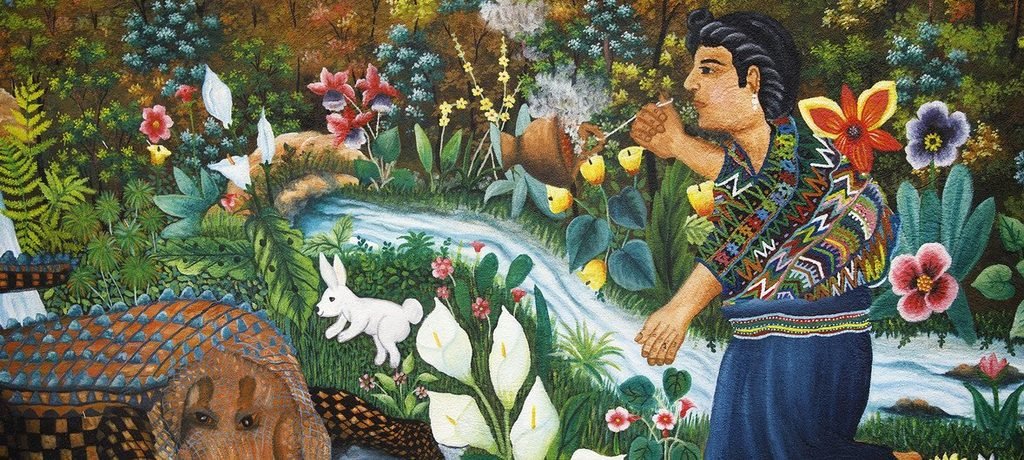
UN Women/Ryan Brown | Detail from the mural at the Center for the Historical Memory of Women in San Juan Comalapa, Guatemala. (April 2018) | Taken from the UN website
As the scenes of a nation-by-nation Arab uprising unfold on the TV screen, I am reminded of the foresight published on the pages of Triple Bottom Line: “The Internet is the government of the commons, which has leveled social, and class and racial and other barriers. For the first time in history, humans across the globe have created a government that is truly a government of the people, by the people, for the people.” (The Internet: True Government of the People; Dec 2008 issue.)
Two years later, the words have rung true. On Facebook and Twitter, people are gathering to take down governments, to form alternative and inclusive governments, and to create bottom-up constitutions. Saudis have taken to the Facebook to create a group, “The people want reform of the system” (in Arabic). This group is proposing a 10-point constitution that includes “public freedoms and the rights of women”.
The point? The change that has been spoken of for so long is finally here. Internet has changed the nations, and it may even begin to reform physical boundaries if need be.
Meanwhile, WikiLeaks has transformed the art of governance using guerrilla tactics. One may say that WikiLeaks opens governments and Facebook & Twitter change governments. The change is not only of a national and international nature, but it is at once local and micro.
Change: All Hands, On Board!
That was the point of the June 2010 article, 6point8 Billion: The Citizen Stakeholders. We now have the technology to engage each and every person, potentially, in governance and creative enterprise. No human left behind. Using electronic connectivity, the human species can develop the inclusive efficiency and enterprise of bee and ant colonies, and we can be as elegant as a shoal of fish that dances in amazing, instantaneous synchronicity.
But with great power comes great responsibility, and, some fear, great danger. Who will control this suddenly empowered humanity? Do we not need to return to an era of tightly controlling super-ethical rulers who rule badly behaving humans through a mix of fear and punishment? No. The times of humanity’s darkness are over (though the opposite seems to be the case). The evolutionary course of humanity has been running on such a path that eventually each person shall be responsible for their own action, and also have the capability to choose and comprehend their action without the need to turn to a single hero human (or ‘guru’) for their interpretation.
This is the highest form of an ethical society. This is not a governance-free society, rather a self-regulating one. In such a society, the core unit is an individual: their aspirations, enterprise, and the benevolent-for-others path that they take in order to both thrive personally and do well to the other.
This individual can only thrive in a hyper-connected world with instant accountability on the basis of a benevolent intent.
Benevolent Intent: “I Am Here to Give!”
What is Benevolent Intent? The May 2008 interview, Intent, Care & Growth, with transformation consultant Etsko Schuitema answers: Intent is of two types—being here (in this life) to give or being here to take. The former intent is benevolent, and the latter, malevolent.
It is not as though human beings must not receive from the world. Indeed, being receptive is a subtle quality of character. The difference in what a person pays attention to: the receiving part of the cycle, or the giving part?
The ideal collective ethic is that each being pays attention to what it has to give, to offer. In that case, the rightful receivers will automatically receive — and, in turn, they will give forward. (And when they do not receive their right, they struggle with incremental levels of force. This is just and fair.)
The cycle of life, in fact, starts with giving, not taking. That is the premise of the essay How Collaboration Can Save the Planet, and Your Business (Feb 2009). “Everything on this planet is part of a cycle of birth-death-regeneration. There is a water cycle, a carbon cycle, a consumption cycle. Money, too, revolves. It is spent-earned-spent. Each cycle has a starting point, and that point is ‘contribution’.” The effortless continuation of these cycles, and the deliberate removal of blocks that arise, is what Sustainability essentially is.
Only then will eternity take care of itself. For what is eternity, but a string of single moments?
From Scarcity to Abundance
This shift to being concerned with giving, however, is difficult for some people. This may more likely be the case in a society that is marked with oppression and a lack of communal care. The individuals in such a society may perpetually experience a state of crisis, a lack of due attention. How can such a person make a shift to being a part of the flow of life (‘Sustainability’)? Why would not people be compelled to act selfishly? This is a genuine question, an authentic state of (sorry) affairs.
The answer may lie in shifting to an abundance perspective. The August 2010 Ramadan special article, This Ramadan, Count Your Riches: Scarcity to Abundance Perspective, sheds a surprising light on how accessible it is to shift to an abundance mindset with a simple question: “What do I have, right now, to get where I want to be?”
I will take a moment to swear for the effectiveness of this simple question by sharing my own story. I was thinking about my project Pakistan Changemakers Hub, and it occurred to me that this is the question a changemaker asks, versus a change-awaiter who is focused on needs. As I picked this thought to expand in the Ramadan article, I felt surprised by what I was writing: shifting from focusing on what one needs to what one has. I asked myself: how would that change my own life?
I realized I do not need another degree to start a new career; rather, I am enjoying the process of teaching myself a creativity course. I did not, after all, need another creative space to rent, too. My own house has become the backdrop of video productions, and I have finally realized that I prefer to toy with the Internet over traditional media in order to move an audience. (Before this insight, I wasn’t making focused use of the media I was advocating!) Now, I can create with more focus, and less distraction and waste of energy. A focus of what I needed was depleting my energy on search; a focus on what I have has brought me back to creation. As an extra reward, the process itself has become a continuous joy.
Asking this question is just as applicable to corporations. Or nations. Or groups of any kind. Focus on assets rather than needs. One would be surprised even further: they may find that what they considered a liability and a burden that was not leaving them alone was indeed their asset all along! The other August 2010 story, Not Flat But Textured, explored a subject that is at once dear and taboo to many: the subject of one’s family and community as one’s asset, not a liability, as one engages in creation.
Caring Co-Creation
Creativity (which is perhaps the real thing that is referred to by the much smaller concept of economic activity) is an embedded human trait. All humans create. Yet somehow the world of creativity has shrunk to refer only to ‘economic activity’, and that has shrunk further to only mean ‘jobs’. By this line of thinking, those who do not have jobs are not participating in creative activity.
Enter: families. Mothers engaged in caring for children, people who are supporting other people who do jobs, and others such who create, but are not necessarily employed or selling. Families also make mobility less likely, and somehow, jobs can be dispersed in geographical areas that one may not even prefer to work in, but one must relocate to because of employment.
There is not anything necessarily wrong or evil about this. It is only that this was a less-than-perfect system which did not fully accommodate the needs of those who would balance freedom with (personal) growth and the ability to create.
This requires several spinal adjustments for the society. First, the issue of mobility is now largely solved through the Internet. Also, work has restructured such that one person can do the multi skilled job of an organization (Future Scape: An Organization of One; July 2008). Secondly, if creativity is seen as more than ‘having a job’ but rather as value addition and service, more people will be relieved of the burden of feeling and acting uncreative. This re-definition may foster greater creativity within families and communities, where some members currently lie dormant as ‘reserves’, making no good of their talent because there is no attention on them, no opportunity for them. Third, seeing families and communities as resources rather than as liabilities can yield several benefits to each creative member of the family: this ranges from psycho-social relief to lower carbon footprint to the opening of new possibilities of doing projects with people who are most willing and available to one, and with whom there is a natural relationship of care, trust, and interdependency. The family and the community as a creative unit is an untapped, phenomenal force of benevolent change in the world. The key factor is CARE.
This care-based co-creation is the subject of ‘Service’ Lets the World Stay Round (March 2010). If we create to serve, the needs of individuals in the social group will be spontaneously fulfilled.
A self-organizing, coherent system will arise which will simultaneously fill need gaps and create less junk on the planet.
The question now arises: what is my community? The answer is: how far can you see?
From ‘The Individual’ to ‘The World’
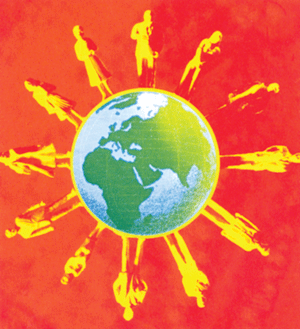
The template for seeing the individual in the context of their family and society and ‘world’ is presented in The People-Centered Model of Business (March 2008). In this simple visual model, the individual “I” is at the center, with four life-zones mapped around them: the spiritual zone, the personal-familial zone, the socioeconomic zone, and the ecological-political zone. Premise? All this activity, which I called ‘business’, owes to the presence of the individual. This is a tool first and foremost for seeing– seeing the society in terms of its individuals, and study them in the four life zones.
Perhaps I should rename this tool The Person-Generated Model of Creativity. I never felt it had quite the right name. I did define business as ‘busy-ness of life’, which must have been my then-word to refer to the big elephant in the drawing room: CREATIVITY!
Note: The model is now called The Salaam Matrix.
Our Future: Collective Creativity
The story comes full cycle: why are humans tearing down the boundaries? Boundaries of what, and for what? I am willing to bet that it is a frustrated creative force at work. The Internet has unleashed the giant of human potential. It can no longer be contained within the bounds of conventions. The nature of the struggle of various peoples is different; their direction is the same.
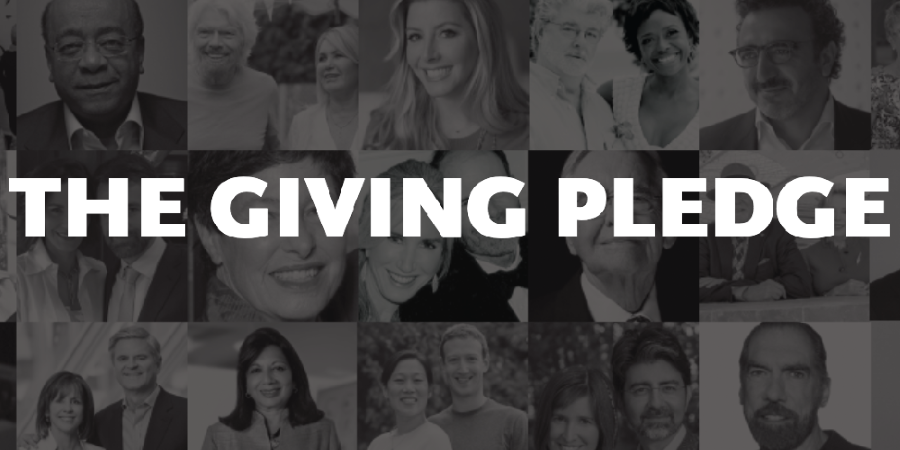
Our world is not operating in a balance right now. To redress the drastic imbalance, we are applying patchwork fixes, such as the Giving Pledge by Bill Gates, Warren Buffet, and other billionaires (Giving: The New Imperative; Oct 2010). Currently, these fixes are needed. Ultimately, humanity needs to move beyond this historical seesaw of injustice/ drastic redressing.
Humanity needs to move, with each person on board, towards collective creativity.
NOTES:
This article is part of a series of articles Ramala Hubb’Allah wrote (with her then name) during 2008-11 for Pakistan-based publication, Triple Bottomline Magazine, published by Asiatic Public Relations. The publication’s focus was Corporate Social Responsibility, Climate, Environment, and Developmental themes. This is the twelfth and the last article in the series, published in May 2011. Original version in print; web version on the TBL site is here.
An updated version of this final article in the series, with new cases and applications, may be published over time on one of the Ramala Hubb’Allah websites or projects (See also: HubbAllah.com). Her current works carry the thematics forward.
If you enjoyed this article, you may enjoy this YouTube playlist by Ramala Hubb’Allah (below).
Finally, all those chain email hoaxes about Bill Gates giving his wealth away have come true in a form that may defeat even the most fanciful imagination: Bill & wife Melinda Gates have pledged to give billions of dollars’ worth of wealth away to philanthropy. They are joined by billionaire investor friend Warren Buffet who has pledged 99% of his wealth away. More dramatically, together this team of three have created an initiative, The Giving Pledge, which invites billionaires to pledge to give a majority of their wealth away either at death or within their lifetime.
Because the task of convincing billionaires to part with their money is complicated – not the least due to legal implications, or the need to know what exactly to give money – the proposition of the pledge has been kept simple: commit to give at least 50% of one’s wealth. The total Buffet and the Gates are aiming at? US$ 600 billion.
So far, over 40 pledges have been gathered and shared at a website curated by Melinda Gates: givingpledge.org. The exact total cannot be determined, for wealth of such magnitude is likely to shift over time.
Each pledge is personal, with money being channeled to a cause dear to the giver. The donors have written letters sharing what their view of philanthropy is, what cause they are dedicating to, and why. Director George Lucas for instance is “dedicating the majority of [his] wealth to improving education”. The Gates are giving to health and education especially for the very poor.
An examination of the letters, shared on the website givingpledge.org, reveal that these donations will quench some very thirsty needs of the world.
The point of the Giving Pledge is more in the spirit of unconditional giving. The idea is that the very rich should actively (and necessarily) consider philanthropy; and that not just with a relatively small part of their wealth – but that only a small part is retained for the self and the heirs. By sharing letters from the billionaire who have taken the oath, the Pledge creates a positive ‘peer pressure’ for their proposition.
Criticism
Critics have taken issue with the Pledge, or the very idea of giving. Some have argued that one has every right over her/his wealth, and does not need to ‘feel guilty’ or morally obliged to share (Don Watkins and Yaron Brook of the Ayn Rand Center of Individual Rights).
Cynics wonder if this is about tax play or a publicity stunt.
The writer’s view is that it’s reasonable to assume that one (such as Warren Buffet) does not give away 99% of their hard-earned billions to look good, especially if they are already considered good. Indeed, the truth is that motives would be individual and complex — ranging from joy, to guilt, to joining the good billionaires’ club, to realizing that this may be the way forward for doing business in a world that is ailing with need.
The Multiplier Effect and The Giving Ratio
Consider this interesting fact: each billion dollar given multiplies into billions of dollars worth of giving.
This is due to the Multiplier Effect, which suggests that each time a unit of money is spent, it creates an onward cycle of spending from one receiver to another. So, if you give Rs. 100 to someone, they will keep some (it’s called their ‘propensity to save’) and spend some (‘propensity to consume’). Say they save 30% and spend Rs. 70. If the next person has the same saving/spending ratio, they will spend Rs 49 and save Rs. 21.
If the population’s average propensity to save is 20%, then Rs. 100 translates into a total income of Rs. 500 in the population. At 30%, it’s Rs. 333; at 40% saving or withholding rate, it’s Rs. 250. The higher the savings, the less money is passed on each time, and this also means fewer persons become part of the cycle of ‘income’. On the converse, the higher the giving ratio, the more number of people benefit, each beneficiary receiving a higher amount. In sum, where there is a giving habit, more people flourish, support one another, and are collectively better off.
Note that we have shifted the word from ‘consume’ to ‘giving’. Consuming, which in pure economics may simply have alluded to spending away without describing the quality of that spending. Giving is different: it is for charity, for philanthropy, or for fostering community by building something that is not for one’s immediate use. Giving is not about consumption of material by the giver (though these sometimes overlap in the case of social business ? such as when one would buy crafts from disabled or underprivileged people to help them).
In Pakistan, Pleading for the Pledge
The spirit of the Giving Pledge has traveled far and wide partly through the word getting out, partly because Buffet and the Gates are now reaching out to rich people in other parts of the world to encourage them to replicate the same idea. In China, long-time philanthropist Chen Guangbiao has convinced a 100 other rich Chinese to commit a majority of their wealth to charitable causes.
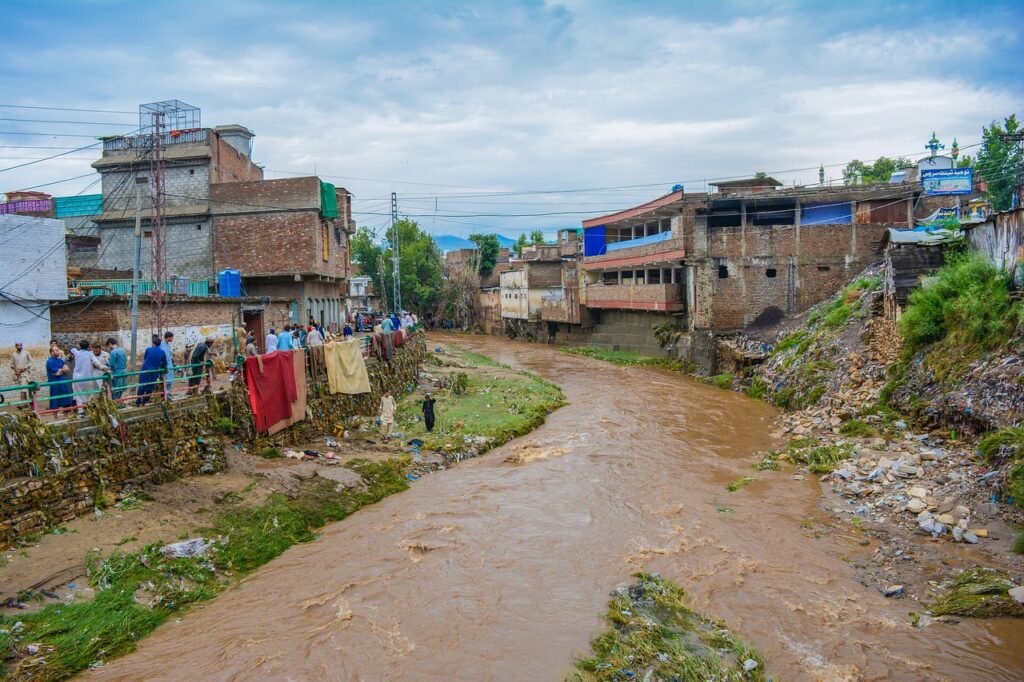
In Pakistan, construction giant Bahria Town’s CEO Malik Riaz Hussain has come forth with a pledge of US$2 billion for flood relief. In a manner typical of these very large commitments, he is dedicating his wealth to an area where he has passion and, in his case, expertise: constructing places to live.
It is in this sense that this newer form of giving is more than just parting with one’s wealth. It is about giving smartly, ensuring that specific, measurable objectives are achieved. Riaz has also issued an open appeal to the 100 richest Pakistanis. As he perceives, the rich of Pakistan could face a violent uprising against themselves and their assets if they do not choose to voluntarily step up and share with the poor of Pakistan.
To date, there is no public pledge in response. Ironically, it is only giving that can cure the economic ailment and restore mutual trust by building inter-dependency. Other alternatives may lead to closed ends.
I would go further to propose that the Propensity to Give become a separate, independent metric from the propensity to consume, and be recognized as such in positive economic literature. It recognizes that giving is an imperative, not just an occasional act of personal greatness.
Human societies have taken all kinds of shapes and structures. The kind of society that considers itself integrated, cohesive, and communal is more likely to have members that understand that giving is a part of the cycle of life; that the one who earns (money) is not the sole consumer (of money), but must share that earning with others such as family, neighbors, deserving poor, and the sick.
Is World-Wide Cluttering Impoverishing the Human Body?
Leading thinkers, such as the curator of TED conference Chris Anderson, are foretelling the forming of humanity into a super-organism. In short, this means that all humanity will organize like a single body — an idea familiar to those who have engaged in a philosophical examination of the world.
This has several implications. For once, the accumulation of ‘stuff’ at one point means a depletion of necessities at another point. Interestingly, this does not benefit the accumulator, for the disease that arises in the deficient part affects the accumulating part. This process accelerates in an interconnected world (because the ‘damage’ can transmit more seamlessly in a better-connected world).
Hoarding, saving above and beyond need, and cluttering are behavioral issues with real economic costs. They lead to mass depravity, crime, and a morose socioeconomic structure. This behavior occurs within nations, and even between nations because geography and the transmission of benefit or harm know no national boundary. Take the recent global viral scares, for instance. Originating in one place, the viruses, such as flu, hopped planes quickly to spread globally.
On the flip side, the opportunity in this inter-connected world is that if giving for doing good becomes a habit, then it can unleash massive positive change, from nation to nation.
Historically, some nations are more inclined to accumulate than others which has, arguably, led to depravity in other parts of the world. This is an imbalance with such deep consequences that not just governments but also businesses and humanitarians have now risen to redress the balance.
It is my understanding that once such massive, unconditional giving crosses national barriers, and it becomes not an occasional incident but a way of doing things, that humanity will be rapidly able to overcome its most abject crises that include super-floods, droughts, mass deaths, disease, and war and terrorism that arise in deprivation and poverty. We may even begin to find a way out of that most damning crisis of all: a human-unfriendly shift in the Earth’s climate.
NOTES:
This article is part of a series of articles Ramala Hubb’Allah wrote (with her then name) during 2008-11 for Pakistan-based publication, Triple Bottomline Magazine, published by Asiatic Public Relations. The publication’s focus was Corporate Social Responsibility, Climate, Environment, and Developmental themes. This is the eleventh and the penultimate article in the series, published in October 2010. Original version in print; web version on the TBL site here.