Category Archives: Sustainability

‘Service’ Lets the World Stay Round

A Need Spotted

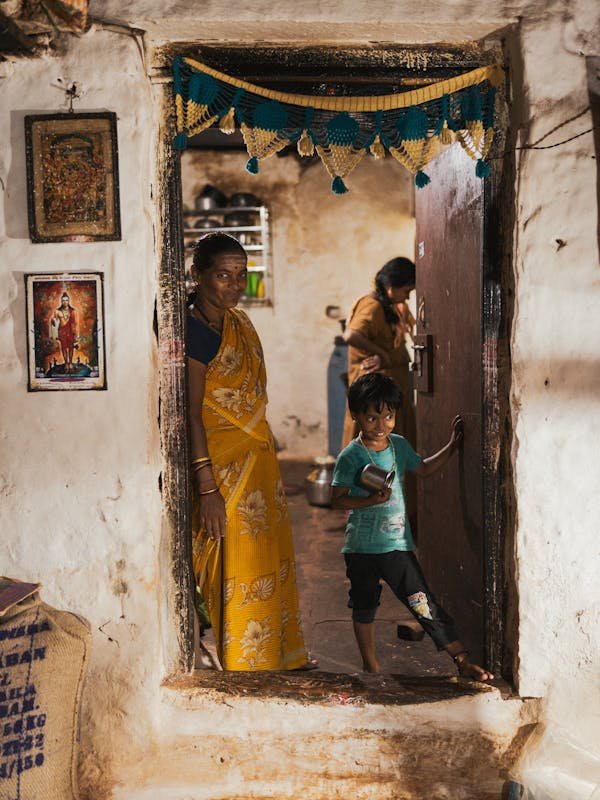
Image is representational image of a modest family home, the kinds of places the author has later seen during travels, and sometimes wanted to serve or connect to the larger grid of social activity and giving and service, where there is need as felt by the author and affirmed by the stakeholders.

I went to visit the doctor two days ago. At the clinic, I was given a waiting number. Now this clinic is a bit of a run-down operation, but I trust the doctor for his accurate diagnostic skills and the ability to treat a patient with more kindness and less medicine. He also chooses to run a clinical practice in a less-privileged area. When asked why, he once said, “This is where I am needed.”

So, I sat with the square little cardboard paper card that bore my patient-calling number. I noticed, during the ample idle time, this card. It had been fashioned out of medicinal packaging ‘repurposed’, so to speak with the number ’23’ written with a blue ballpoint pen. Highly unimaginative, this piece announced, “You are sick!” in subtle ways.

My mind wandered at this sight, and I thought: “Why, in all my years of visiting this clinic run by a rather selfless man who could have earned millions healing people in a ‘better’ facility, have I not thought of contributing anything to this clinic?”

I looked around and saw many flu-ridden children amongst the patients. I noticed that the bookrack had books that were wilting due to overuse. There were some nice posters on the wall masked advertisements of pharmaceutical companies. All in all, the clinic could use a paint job, some fresh art on the walls, and new books and magazines in the racks. It could use something to engage the children in waiting, something better than the ancient TV overhead. It could use some engagement for the men and women, seated in separate quarters, who sometimes spend more than an hour waiting for their turn. Precious productive time was idled away at this clinic.

Finally, the clinic could certainly use more imaginative and perhaps enduring – not to mention hygienic cards or chips with waiting numbers.

I imagined:

What if I go home and make artistic cards for them with a beautiful, heartening picture and perhaps some uplifting words? What if I bring some art for the walls? What if I bring some of my magazines and books?

Then I ploughed a bit deeper with my question:
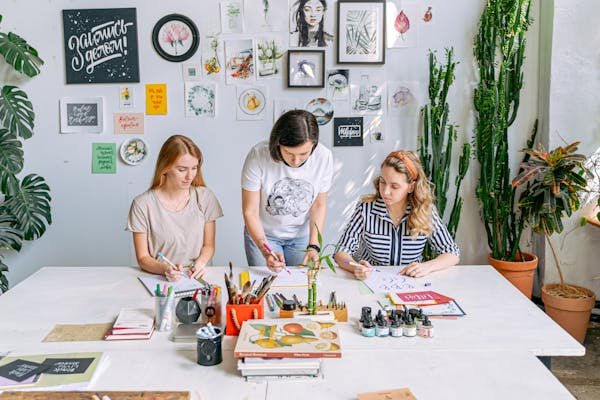
Image is representative of a generic art class. An appropriate image of ‘discarded art’, as was often the case during the years of the writer’s own schooling where art and murals were locked and forgotten in stores, is not shared here.

Art classes. There are so many art classes in so many schools in this city. And they create ‘stuff’ only to relegate most of it to the dark, fungal cupboards of the class. Some schools do not let the children take their projects home – especially if those are examination assignments – and most of the productions simply end up as piles of junk.

In school, we often made art no one eventually cared for. Most children created with half a heart because they could not ‘see’ the end purpose of this enterprise. “What’s the use of all this?” is a common complaint in classrooms and campuses.

Yet here, in this city, there are clinics and homes and bus stands that could use more art, more beauty.

Why is There a Gap Between the Two?

In this gap, one is forever needy, and the other is forever producing unappreciated, unused junk. There is a break in what ought to be a cycle of giving and receiving.

I recalled that some years ago, I became familiar with the idea of ‘service learning’ – that is, learning in academic settings through real service projects. For instance, a student of architecture would actually implement a working solution for a (needy) community in order to obtain a pass in the subject. Real service projects are carried out under this paradigm. What an idea! Academia does not waste years of knowledge that children acquire, asking them to wait till they grow up to become functionally useful (as traditional education does). One serves and learns as one goes – and (almost) everything that is produced is utilized.

Service. That was the key theme that I was digging for. Business, academia, communities, individuals – if they act to serve, not only will there be many needs fulfilled and bonds created but so, too, will there be less physical junk in the world.

Service. Service keeps our relationships cyclic, in action – service keeps us connected as people and as organized groups.

Service. This is what makes a human of whichever station or status useful and therefore connected to other humans.

Service. This is going to make life (more) sustainable – for sustainability is nothing more than ‘elements of life in an effortless perpetual cycle’, a definition I proposed in my article ‘Why We’re Failing to Sustain – and How Can We Succeed, Right Now’ published in tbl in July 2009.

It all made sense to me. I looked down at the little crumbling cardboard slip in my hand. It was made out of the cover of a package which must have contained a cough syrup bottle within. The negligible little card had educated me about the scheme of things. It also showed me the way to begin.
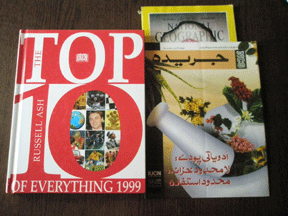
jareedah
Archive image featured with the article, featuring the items selected by the writer for donation. Even old books are great for children who cannot read, but enjoy images.

Bridging the Gap

On my next trip to the clinic, I am taking along with me some posters and books and magazines that I have tried to give away in the past. Mysteriously, they have refused to go away and ended up with me again. They know better; that there is a just-right place in the world for them; they refuse to be sold away to a paper junk dealer (one who thought they are ‘too good’ to be taken away) or to be taken up by visiting friends (“Too heavy! I shall take them next time!”).

I shall donate those to the clinic. My junk will become treasure through service.
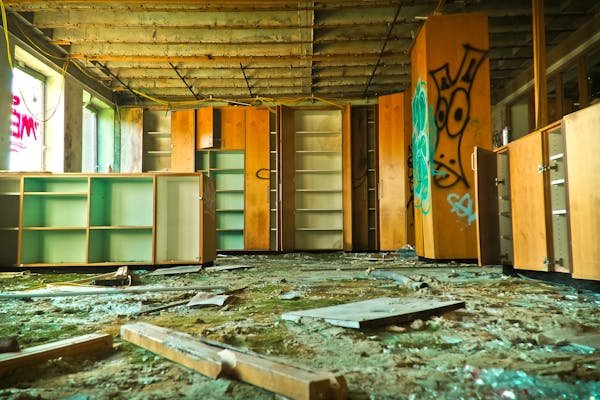
Perhaps such discards can be salvaged for donations to needy communities, in a zero waste, circular society

NOTES:

This article is part of a series of articles Ramala Hubb’Allah wrote (with her then name) during 2008-11 for Pakistan-based publication, Triple Bottomline Magazine, published by Asiatic Public Relations. The publication’s focus was Corporate Social Responsibility, Climate, Environment, and Developmental themes. This is the seventh article in the series, published in March 2010. Original version in print; web version on the TBL site here.

This article not been edited except a headline and images, and republished as it on the Hubb’Allah website. It is reproduced to present the collected body of Ramala’s works on the Triple Bottomline Magazine.

Why We’re Failing to Sustain – and How Can We Succeed, Right Now

How Do You Define ‘Sustainability’?

I just had an Aha! moment about what’s the problem with sustainability. Consequently, I saw how that “problem” can be fixed instantly. Because that problem does not lie in nature. The ‘problem’ is how we define sustainability.

This is the current (2009) Wikipedia definition and by design, it’s the current definition of the collective humanity:

“Sustainability, in a broad sense, is the capacity to endure. In ecology, the word describes how biological systems remain diverse and productive over time. For humans it is the potential for long-term maintenance of wellbeing, which in turn depends on the wellbeing of the natural world and the responsible use of natural resources.” (Wikipedia)

Additionally, this is a widely popular theory in business schools:

“When applied to business, [sustainability] refers to the ability of an organization to stay profitable over a long period.”

Earlier, I defined sustainability in Triple Bottom Line’s January/February issue, in the feature ‘How Collaboration Can Save the Planet – And Your Business’, as follows:

“Everything on this planet is part of a cycle of birth-death-regeneration. There is a water cycle, a carbon cycle, a consumption cycle. Money, too, revolves. It is spent-earned-spent. A cycle is a complete loop. The very definition of “un-sustainability” is an incomplete loop – a cycle broken by excess (accumulation) or by withholding (depletion).

Simply defined: Sustainability is “the act of elements revolving in an effortless cycle.”

(Ramala Hubb’Allah’s definition)

The Problem? TIME!

Comparing the aforementioned definitions, the problem with popular definitions of sustainability stands up like a prickly cactus thorn to attention: The problem with popular definitions of sustainability is that they are time-based.

‘Forever’ is not what sustainability is. Sustainability has nothing to do with time. Sustainability has to do with the “ability to sustain”.

The Two Tyrannies of Time

There are two natural, contrary outcomes of time-based definitions, both of which justify my suggestion of giving up the notion of relating sustainability with time:

1. Short-Term Gratification

The justification of short-term behavior. Because that would be the rational thing to do for those who sincerely cannot perceive what 10, 100, or a 1,000 years mean. Short-term behavior makes sense. Greed and fear are the consequences of a focus on “time”.

2. Long-Term Tradition

The preservation of tradition for the generations to come. This is the opposite of short-term behavior. In this scenario, people take a “higher path” – apostrophes intended – and decide to create a way for how their children, grandchildren, and their generations will live henceforth. They attempt to create a perfect system. In remote geographic locations, they can – because newcomers do not visit them. In accessible geographic locations, they become adamant traditionalists. “Our ancestors perfected a way of living,” the subsequent generations will say, “and it cannot be changed. It is the way of life.”

All “ways” of life have an expiration date, after which they become extinct, or they evolve. Only ‘life’ itself sustains, not one way or another. Life is the phenomenon of the change of ways, and yet the continuation of existence.

In sum, this concern with longevity and perennial ways and “the forever” leads to oppression. Because oppression is the only way that an outdated way can be granted life beyond its natural time.

Whether it’s the short term, or the long term – both are tyrannical, fundamentally harmful at any given time, and inappropriate. More importantly, they take attention away from what the purpose, mission and outcome of sustainability is: Giving.

Giving forth, yielding, nourishing, handing over to the Other. Sustaining the Other (and the Other reciprocates).

What Does It Mean “to Sustain”?

This is the definition of the word ‘sustain’ found in the Merriam-Webster online dictionary:

  1. To give support or relief to
  2. To supply with sustenance: nourish
  3. Keep up, prolong
  4. To support the weight of
  5. To buoy up. For example, sustained by hope
  6. To bear up suffer, undergo
  7. To support as true, legal, or to allow or admit as valid
  8. To support by adequate proof: confirm

Of these eight definitions, only the third definition has to do with the notion of time. Other online dictionaries have additional definitions. For instance, the Free Dictionary adds:

“To support the spirits, vitality, or resolution of; encourage.”

Dictionary.com has a definition that elaborates upon this in a way that the concept of ‘time’ is removed:

“To keep up or keep going, as an action or process: for example, to sustain a conversation.”

Another interesting definition is:

“To support the spirits, vitality, or resolution of; encourage.”

Hence, since the 13th century, the word ‘sustain’ has centered on the single concept of giving.

Sustain-ability is enabling a system to be continuously, cyclically giving.

This improves, also, upon the way I understood sustainability earlier. Sustainability is still “the act of elements revolving in an effortless cycle”. “Enabling continuous giving” only looks at it from another angle. Which is, “What can we do to make this happen?” In other words, it grants humans (observers) will, power, and autonomy.

We need to answer this question because we ask this question. We ask this question because we are humans. We are sentient. And we want to do something.

Experiencing Sustainability: Two Somatic Exercises

Sustainability is not ‘linear’ and it is not time-based. It is ‘cyclic’, it is right now. The best way to understand it may be to visualize it. Stand in a space, literally or mentally, and imagine these two scenarios:

1. You are standing in the middle of a long, wide road. Visualize yourself as a spot somewhere on this line, which represents a road. You are a spot traveling down the long road, having already traveled a long distance which is now behind you.

2. You are standing in a field. Extend both your hands outwards, spin, and imagine the whole, wide world around you. Right now. A big, round circle, radiating outwards from you. Feel free to imagine yourself to be the queen or king of the world.

.

.

.

How do these two opposing scenarios make you feel?

It is when we experience that whole, big, circular nature of the elements of life, of the whole world, in one instant – as in the second imagery – that we begin to understand the nature of sustainability. When you perceive the world in this way, you will want the entire world to do well, because it will be your world.

This still requires work. It requires giving and contribution. It requires personal character and benevolence to live in such a world. It requires the ability to truly accept responsibility. It is also about experiencing the abundance of life, in the now. To think of ourselves is not to think of ourselves in terms of taking from others, but in terms of giving.

Sustainability is Harmony

If a major trouble with the world today is due to errant human behavior, then this implies that corrected human behavior shall prevent, stop, and in instances even reverse the damage. Indeed, we can look forward to a harmonious coexistence.

When we get out of obstructing the cycles of nature, eliminate our time-based fears and thereby let go of our greed and fear, let things be and learn to live with the vast, thriving, abundant planet – then we shall be able to hold it up. To nurture ourselves and our fellow elements on the planet. To partake in supporting the weight of existence as animals, plants and mountains and rivers have been doing far before humans first appeared on the planet.

To, in short, sustain the other and thus sustain our selves.


NOTES:

This article is part of a series of articles Ramala Hubb’Allah wrote (with her then name) during 2008-11 for Pakistan-based publication, Triple Bottomline Magazine, published by Asiatic Public Relations. The publication’s focus was Corporate Social Responsibility, Climate, Environment, and Developmental themes. This is the sixth article in the series, published in July 2009. Original version in print; web version on the TBL site here.

This article is lightly edited (reformatted, definitions cleared up) for clarity for republication on the Hubb’Allah website. It is reproduced to present the collected body of Ramala’s works on the Triple Bottomline Magazine.