
Collaboration: How it Can Save The Planet—AND Your Business!

What’s Our Problem?

By the time this article is being written (February 2009), it is clear: those who warned against the unsustainability of greed (getting more than one deserves) and fear (contributing less than one’s potential) are vindicated. No matter what the consultants advocate, the truth is that the old way of working is over. Now that we have damaged the planet sufficiently, and as a result hurt the population that rests upon it – is it any surprise that neither the planet nor the people can afford the ways profit is made?

This is a mantra that needs no other proof than the current state of affairs. No matter the details of the collapse, there is a single concept that sums the situation and its possible remedy: ‘Sustainability’.

Sustainability: a Simple Definition

Everything on this planet is part of a cycle of birth death regeneration. There is a water cycle, a carbon cycle, a consumption cycle. Money, too, revolves. It is spent-earned-spent. Each cycle has a starting point and that point is ‘contribution’. It starts when Entity A chooses to contribute to the ‘Whole’/System (Entity B). Then Entity B pays it forward, until the contribution returns to Entity A in a new form. Entity B can be one person, or it can be many. For example, if I work as a guard in a TV channel, I contribute by letting in the right person (who has the potential to become a talented actor) through the door and keeping the gatecrashers out. Overtime the actor clears audition and performs in a play. The play is aired and earns the channel its income. I get my salary. This is a cycle – this is ‘Wholeness’. It is true for all systems of the entire world; the only difference is the level of complexity.

Given that the start of a cycle is at contribution; the life cycle starts at birth, the water cycle at rain, the money cycle initiates at spending, and the cycle of business starts at enterprising talent.

But there can be no continued contribution unless there is graceful reception on the other side. So in totality we can see a cycle as ‘an act of cooperation, a continued collaboration’. The giver is also a receiver – always. We receive with realization and give with choice.

A cycle is a complete loop. The very definition of unsustainability is an incomplete loop – a cycle broken by excess (accumulation) or by withholding (depletion).

The Giant Collapse of 2008

If material stuff is produced, but not recycled back into the system, we will end up with pollution: blocked drains, toxic landfills, and smoke-filled air. If there is money earned such as through big business, but not spent back such as through fair wage, we will end up with vast populations unable to afford business any longer – and at a tipping point, the whole system will suddenly collapse. That tipping point was reached in 2008 – when all unsustainable cycles from the natural to the economic collapsed together.

The Solution:
Enable Sustainability Through Collaboration

When bad times hit, do what the poor do: help one another. Create sustaining relationships, keeping in mind the definition above: sustainability is a cycle when it is in smooth motion. This also means that when it is time for a certain cycle to end, such as in the case of an end to an entire industry, everyone in the cycle can sense the closure at once and get prepared to move on. It is more difficult to move on to bigger and better things when one is either too empowered or too weakened by a dysfunctional cycle. The first one has a vested interest in keeping things as they are, and the second one has no willpower.

It is tragicomic that in spite of the 2008 catastrophic wipeouts, most organizations are still pursuing the aim of meeting their old projected profits and other objectives using the same methods that often directly brought about this breakdown.

It is clear by now that the game and the rules have changed. But how do we move on? The real issue at this time may be a sense of insecurity and high uncertainty – the end of greed and the beginning of fear.

In my view, this is exactly the current challenge. We are no longer oblivious of the fact that the planet is in peril, and people are severely endangered from our own actions and the backlash of nature. It is also apparent by now that we have at once the responsibility, and (some say perhaps) the power to do something.

Interestingly, at this point in human history, we happen to have a technology for every need. We have also tested almost every social, political, and economic system great human minds could envision. In other words, the “hard” and the “soft” elements are present. What, then, do we need?

Answer: Collaboration

Wikipedia defines collaboration as: “A recursive process where two or more [entities] work together towards an intersection of common goals. For example, an intellectual endeavour that is creative in nature – by sharing knowledge, learning and building consensus.”

Precisely because we have all the requisite technology and ideology at our disposal, our next task is to put things together in a way that benefits the wholeness of our systems. The systems are already whole (cyclic) by their nature and definition. Our real task is to develop a method that facilitates the motion of cycles. And that method is a value: working together. Collaboration.

Collaboration is a means to an end: the end is sustainability – enabling the cycle of life.

The Principles of Collaboration

There are several processes, behaviors and conversations that relate to collaboration. They are too many to remember intellectually. Another approach is to understand the fundamental principle and then apply it to individual situations.

The basic principle is: Collaboration is to facilitate the motion of a cycle.

The two aspects of the cycling principle are:

  1. Increase/facilitate flow.
  2. Reduce blocks.

The first aspect is about being creative. The second aspect is about removing obstacles to creativity. Essentially both achieve the same result but are needed together. In my view, it is the second aspect that is the real need of the time.

Easy Guidelines for Situational Collaboration

It has been assumed for a while now, especially in the business and political world, that relationships can be ‘created’. There exist fundamental principles of relation between the large and small, giver and taker, weak and powerful, etc. The task of collaborative practices, then, is to honor that which exists and to orchestrate that to use – not to attempt to forge something beyond the system.

Based on this understanding, situational collaboration can be developed.

1. Work With What Is

Resource utilization is a critical contemporary issue. Though often we are concerned with “over-utilization,” the sustainability principle suggests that in each instance something is over-utilized, there is another thing that is being under-utilized – because it is ignored or sacrificed.

The solution is to ‘work with what is’ – evaluate one’s assets, and contribute. Rather than want more resources than are already given, work with what is already given. It is far better to adjust one’s ambitions and ideas than to stretch or waste one’s resources.

2. Work With Who Is

One of the anomalies of the workplace is the poor utilization of people’s talent – though humans are the fundamental orchestrator of all creativity! Author Etsko Schuitema suggests in his “Care & Growth Model of Leadership” that we only have the license to help someone grow if we care for them.

If the utilization of a person’s energy under our supervision is to help them grow, what precedes this is taking care to get to know the innate potential of that person.

There is an inborn quality in each person. That quality shapes their contribution. It is the task of the system as a whole and a leader in specific to see that quality and co-create work around it. Schuitema suggests that work is a means to engage the individuals in a relationship. This brings delight back into relationships, even in the work arena.

An implied application is to use experiential experts’ help. Receive the knowledge that others have to offer. Often we refuse to work with talent that is available, in order to pursue imaginative goals. In Pakistan’s context as well as of other developing nations, this non-acceptance of our unique abilities and offerings is leading to the belief that there is a dearth of talent. If that were the case, none of the developing nations would be able to destroy as much as they do, for destruction suggests the presence of energy not utilized.

3. Increase Collaboration, Reduce Competition – Deliberately?

Competition has long been a virtue, and it had its rightful place in the evolution of human endeavor as we strove to push the boundaries of our potential and existence. I think there is less blame to be assigned to competition itself – rather the need is to realize that the time to compete has simply passed.

In this age, we must intentionally lower “competitive think” and replace it with “collaborative think”. In my work with a beauty products client, for instance, we have chosen to see household-based women entrepreneurs as friends and partners rather than as threats to our business. There is an acceptance that there will increasingly be small entrepreneurs who will test their own mettle. Traditionally the Big Business attempts to drown them out. My client took the approach of changing their business model to a modular one that suits the variable nature of workers in the fragmented marketplace for today. The immediate benefit is that energy is now reserved to co-create joyful solutions, and to do the real task of carrying the product to consumers to enhance their life – rather than being consumed by the anxiety of overcoming beyond control “competition.” (Note: We used homebased bloggers as beauty influencers in 2008, before it was a thing!)

4. Minimize Legislation, Maximize Relation

Legislation is oft invisible but often the most powerful of blocks in the way of human endeavor and relationship. The problem is very simple: we have come to believe that legislation exhausts the list of all possibilities.

Therefore, there must be a law for every DON’T and a description of every DO. This is a fallacy. Law is a limitation, and its only function is to mark boundaries and off-limit areas in a relationship. The off limits are those where, by definition, the relationship ends if one or all partners venture there.

The best constitutions of the world, therefore, are short or non-existent. A constitution as exacting as that of Pakistan, for instance, anticipates being violated as relationships and their needs evolve and as boundaries – which are not fixed – are re-marked.

Part of this practice in business is to create projects based on mutually ‘engaging’ rather than ‘acceptable’ terms. When we engage another on the basis of their fulfillment and joy they would co-create happily with us, while we can also create a beneficial ethic amongst ourselves, which helps the whole system.

The ‘Technology‘ for the Era

There are two broad types of technology for this era of Collaboration: one is soft (conceptual), and the other is hard (quasi-physical/physical).

The best kind of the first technology is described already: it is relationships—amongst people, and then people and every living and non-living thing.

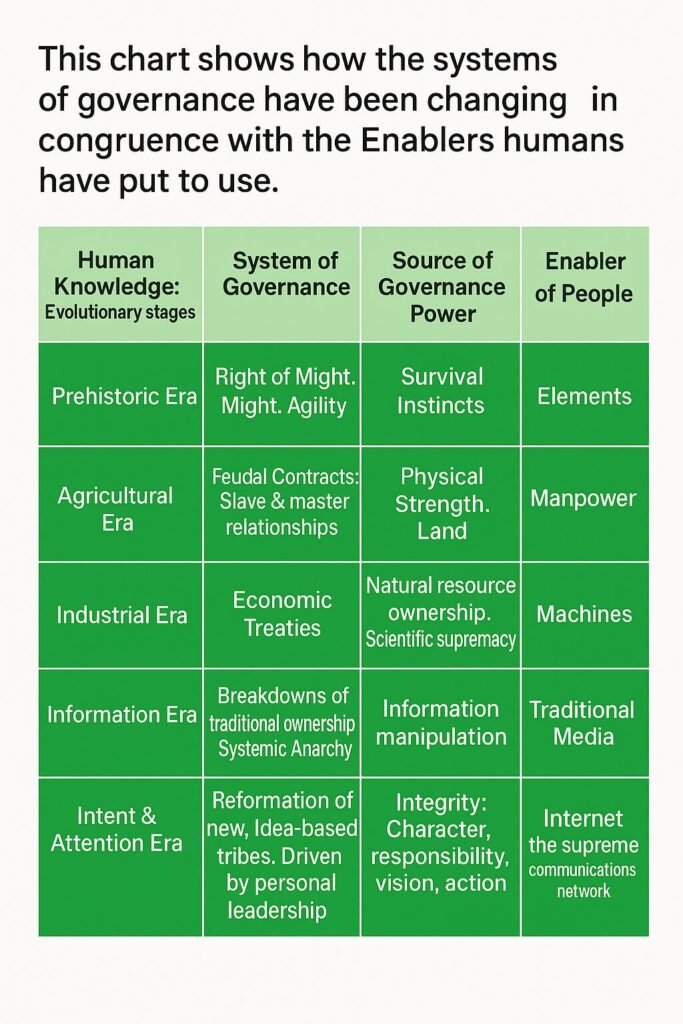
The best of the second type of technology is the Internet, identified as “the supreme communication network” and the “enabler of people” [the first and the vastly more important element in collaboration] in this Intent and Attention Era.

Outcome: Benefits of Collaboration

One would like to round off a solid case for collaboration by listing a set of definite outcomes. This, however, is not a great idea because ‘definite’ also means ‘limited’ – and limitation is resisted by human nature. Indeed it is a block in the cycle of growth. The truth is that the outcome of collaboration depends upon the clarity of understanding what it truly means to work together, to contribute, and the sincerity and intelligence with which this way is made a practice.

Despite this, the very technology of collaboration – such as shared workspaces – immediately yield certain benefits, such as:

1. Reduced Activity Footprint

Using fewer things means lesser material is being churned out on the planet and there is less pressure on the already exhausted systems. Carbon is a fundamental measure for “activity.” Eliminating the non-essential and sharing resources implies reduced activity and therefore reduced carbon footprint.

2. Reduced Cost: Competition is Cost

Primarily because it takes attention away from creative opportunities and the right application of one’s talent. Often an entity competes with one that is different from it. I have seen media enterprises in Pakistan who ditched their niche to chase the rival’s territory (such as entertainment) – and hence led to the decline of both. Competition is a cultural phenomenon that has led to megalomania-driven growth, and decline. Henceforth, our growth should be based on service to the whole system, not competing with elements.

3. Healthy Interdependence

This is a state where all elements in a cycle support and rely on each other and are clearly aware that mutual benefit is the real benefit. This is most practical at a local level where community members work with each other and support others’ enterprises.

It is my belief that the issue that we face is not of meltdowns and painfully wrenched bailouts. It is the issue of bringing values back to the way we work. The values, in turn, are employed so we can experience the joy of being alive. That joy, I believe, is the real aim and must become a part of the world of business – and the business of the world. Collaboration, when practiced faithfully, is that joy in itself.


NOTES:

This article is part of a series of articles Ramala Hubb’Allah wrote (with her then name) during 2008-11 for Pakistan-based publication, Triple Bottomline Magazine, published by Asiatic Public Relations. The publication’s focus was Corporate Social Responsibility, Climate, Environment, and Developmental themes. This is the fifth article in the series, published in Feb 2009. Original version in print; web version on the TBL site here.

This article is lightly edited for clarity for republication on The Salaam Matrix website. It is reproduced to present the collected body of Ramala’s works on the Triple Bottomline Magazine.
The Internet: True Government of The People

One day in June 2006…

I had a sudden realization: I am beyond borders and regulations on the Internet. Certainly, the regulations and norms of the “real world” no longer applied to the virtual interactions of hundreds of millions of people.

From chatting to creating social networking communities like Orkut and Facebook; from writing emails to sussing out the real from the fraudulent on MySpace, and taking citizen action through blogs, using our networked computers as our media centers – we are semi-consciously creating a new space with its own rules and codes of conducts.

It struck me that the Internet had indeed become my de facto government.

It was then that I proposed this at the NEXT> blog:

June 2, 2006:

If “government” means the “act of exercising authority,” then I must report that I believe my official government may not be my official government. In its broadest sense, ‘govern’ means “the power to administrate, whether over an area of land, a set group of people, or an association”.

If this is really what government is – a body of influence, whose rules and laws I form, obey and own—my government is now The Internet.


I think for the first time in history, humans across the globe have created a government that is truly a government of the people, by the people, for the people.

A reader at the blog questioned: “You’re sure? Internet is only the medium–it is neither the message nor the messenger. What thrives here is the open and accessible communication between far-flung human beings.”

My response: Exactly. What is government but a facilitator of the activities of human [societies]–a servant that administrates the complex function? That is why we say, “like people, like government.” By itself, the government is nothing.

Traditional non-participatory governments do not represent the people – rather they shape the minds of the people.

The (social) Internet does not exist to rule. It does not exist to create absurd laws. It is a collaborative space. It is inclusive, responsive, self-organizing, and evolving. It is a powerful source towards which the modern human is turning to share and to listen.

In fact, in my opinion, never before in the history of humankind has the democratic, human-centric definition of government been seen in practice. The Internet is not just any people’s government; it is the first truly human government.

The Power of Conversations

Here is the reason why the details of this exchange are shared. If we step back and look at the content of conversation and how it develops, we notice that:

  1. One person (I), using their territory (the blog) declared allegiance to a new kind of government. This declaration draws authority from another virtual territory – Wikipedia – which has a self-governing system. That territory is able to overcome differences of race, class, geography, language, sexual orientation, faith, etc. to create a thriving system.
  2. This declaration is willful and emergent — it emerges organically as the outcome of a process of thinking and practice.
  3. Another person challenges.
  4. And the first responds – demarcating their “law”.
  5. If the challenger agrees, this law is established between at least two people. There are also silent readers who are to be counted.

Within this conversation, an evolution of governance has taken place that is hard to emulate in the physical world in speed and authority. The power of such conversations in creating change is not to be underestimated, especially where the virtual community is strong and led ably. Conversations change people. People change spaces.


The Formation of a Government

One of the most powerful constitutions in the world is that of the United States of America. It was the result of the conversations between the founding fathers of that nation. The outcomes of their thoughts were published in The Federalist Papers – 85 essays outlining how the new government would operate and why that type of government was the best choice for the USA. Back in the days of print, the Federalist Papers meant to persuade New York voters to ratify the proposed constitution.

Internet: How It’s Changing the Territory

The process of writing a constitution is germinated in conversations and willingness. Internet is changing the way conversations take place. Humans are in a free space communicating with each other. The once slow and costly services have been replaced with fast, agile, free, and universal services.

Let’s step back in history and examine how countries came to be marked. In the most primitive times, it was oceans, rivers, mountains, forests, walls, wild animals, and other natural phenomenon that marked distances and differences. Soon enough, humans began marking fields, building walls, setting up colonies, and creating tribes.

Over time, ideological boundaries led to the birth of countries. What separates the two sides of a no-man’s land but the differences in political constitutions and social contracts? Passports, visas, restrictions, treaties are the products of more recent times with respect to the human history.

This development has run parallel to an evolution in human knowledge.

November 2008: Generation-O(bama) Chooses a Government

There are many people who still believe that Internet has no reach, it is a waste of time, and above all – it’s an elite medium. Media are relevant. Let’s make it simple: which of the following seems the most inclusive?

  1. Print: Few write, many read.
  2. Radio/TV: Literate and groomed produce, many are audience.
  3. Internet: Many produce, many engage.

As a Pakistani, which of these media can I use to send a message to an official in Barack Obama’s transition team? To the world via CNN (iReport)?

More than 2 years after I first postulated the idea, a relatively unknown, young, multi-ethnic black man has been elected the President of the United States. Barack Obama’s campaign machine made unprecedented use of the Internet by forming community organizations, linked through their leaders who networked online.

Not everybody has to be online, only their community leaders. The argument about the Internet being elitist and non-effective has little merit. At any rate, Internet is growing to become more inclusive, not less. Obama’s victory is an affirmation to all believers in the power of Internet to create a true people’s government.

Making Sense of the Global Governance Breakdown

Governance, in its widest sense, is not just a political-national institution. From households to corporations, even down to the Self, the rules of governance apply.

What we are witnessing in this world as “breakdowns” – from financial meltdowns of USA, Europe and Asia to people’s resistance movements in Pakistan, Burma, Thailand – are often the signs of territories changing. Obama’s victory is the first but not the last time in human history when the networked structure of the Internet became a map for real-life organization – and change of government. It is a benevolent change – one that is brought about by acceptance, inclusion, and the will of the peaceful citizens working together to create a more positive world. (That is the intent.)

A Matter of Choice

Internet is not just a tool for passing time. It is at once the product of and the herald of a new era in human consciousness, and therefore systems of governance that are inclusive, self-reflective, transparent and swift.

The choice is up to humanity to accept the power of this enabler, and use it now to create benevolent governance from corporations to communities to nations. Or, as it happens at times of all evolutionary shifts, be left behind and perish.


NOTES:

This article is part of a series of articles Ramala Hubb’Allah wrote (with her then name) during 2008-11 for Pakistan-based publication, Triple Bottomline Magazine, published by Asiatic Public Relations. The publication’s focus was Corporate Social Responsibility, Climate, Environment, and Developmental themes. This is the fourth article in the series, published in Dec 2008. Original version in print; web version on the TBL site here.

This article is lightly edited for clarity for republication on The Salaam Matrix website. It is reproduced to present the collected body of Ramala’s works on the Triple Bottomline Magazine. This article was first published as a blog on Ramala’s then blog, NEXT> by Ramla here and here.
An update of this article’s premise, as well as the original version with commentary, is under works.


Future Scape: An Organization of ONE

An Organization of ONE

The Contemporary Organization

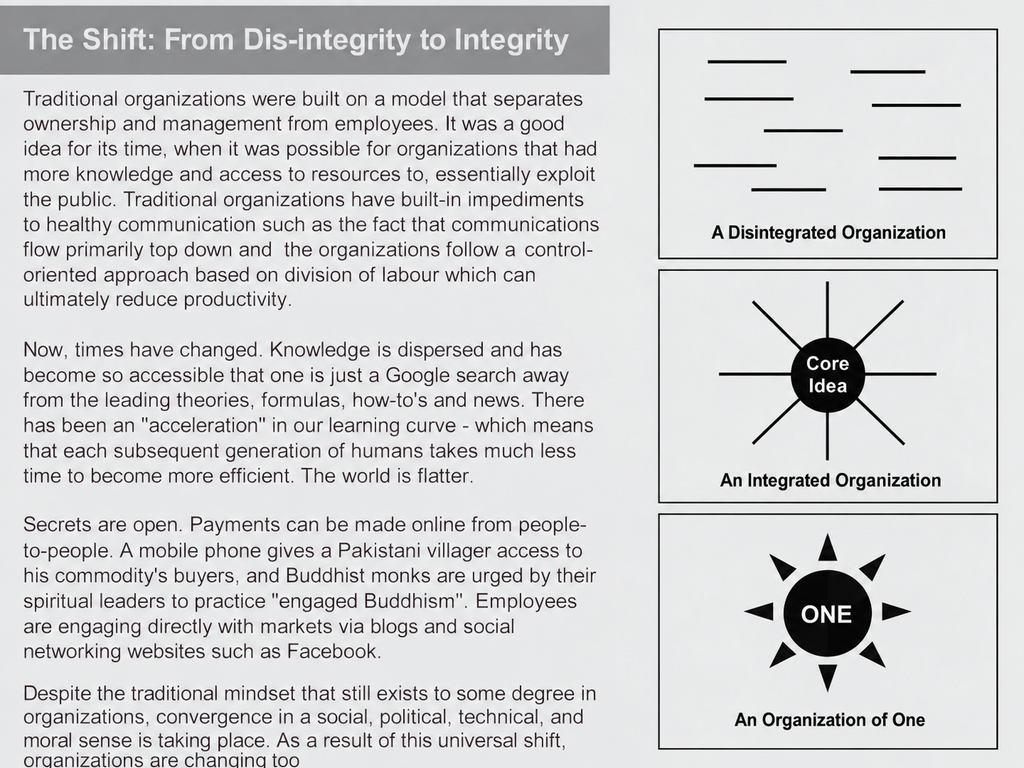
The emerging organization is breaking down the traditional divides between owner, manager, and employee in corporations: now, all roles are assumed by one person or an aligned group.

Generally, it all starts with an idea around which a group of free agents or entrepreneurs gather willingly. They are highly skilled individuals who have a common interest and divide the task among themselves according to their individual skills. The work is project-based, and legal relationships are ‘open’. Contracts are not enslaving, and group members may have other project engagements. In other words, they self-organize around an idea and a mission or purpose.

Self-Organizing Ends Forced Structures

Free will and the strength of the group’s relationship and integrity determine their sticking power. Because they are accountable to themselves, internal regulations and self-scrutiny allows them to stay competitive. Corrections are made as performance or capability gaps arise.

An organization based on such a model is vulnerable to shift because “managers” cannot exploit “employees” or fib about their performance to “shareholders.” Therefore, it constantly scrutinizes the external scenario to study opportunities or threats. Because such an organization is basically an idea “hub” around which skills have gathered as ”spokes” to get things rolling, it is knowledgeable on its own design and area of expertise.

Change, to the members of an intelligent organization, is a matter of perceiving things accurately and swiftly. As well as they perceive change, they can modify their own selves; they are not required to convince a separate entity (an owner, manager, employee). Hence, they evolve to suit the new circumstances. This is called “self-organization.” (Not very different from how the very intelligent “virus” works!)

Why Traditional Dis-Integrity No Longer Works

Most of the troubles harrowing today’s organizations are rooted in their disintegrated structure, which pits one part against another. It is a bit like the heart of a body taking a disliking to the stomach. The results are not nice!

Employee care and growth is seen as a cost. Because the home is not the office manager’s problem, there is a divide between work and life, with one competitive to another. This has led to high emotional and healthcare costs globally, followed by turnover.

Curiously, this set-up perceives the world as hostile. It is geared to exploit more than just the competitors. With the increased awareness of the downsides of this approach has come around a doubt about the workability of this model. The truth is that this structure will not cut it any longer in a world where people are joining hands to save the planet and themselves, and walls are being torn down.

How Integrated Organizations are Better

These organizations cut through layers of expensive hierarchy and the ensuing resentment. Collaboration is not just a new tool. It is a characteristic of such organizations. Decision-making is transparent, speedy, and agile. This subtle shift translates into a dramatic reduction in litigation.

Diversity emerges as the group automatically senses its “gaps” and fills them. There is no arbitrary third-party (second party?) policy to bow to especially when such a policy flying in the face of common sense of the organization. People set rules, not vice versa.

Work is based on passion – a requirement as today’s work requires high levels of knowledge, agility, and personal insight. Being passionate about your work is important as this fosters inspiration, creativity and innovation. The possibilities for the emergence of a satisfied and creative person’s contributions are limitless!

Through their very design, such an organization is both geared to and restricted to contribute to society (instead of exploit) or else it will disintegrate, as no policy, external funding or lies can protect it from constant external scrutiny. The final measure of the goodness of such an organization is its contribution to the larger community, as judged by the community!

Three Special Cases of the Shape of Contribution:

Case 1: Innate Corporate Social Responsibility

Whose responsibility is the community anyway, when the elements of an organization itself don’t get together? The issue of an irresponsible organization could be closely related to its elements being competitive to each other. They are designed not to collaborate. Is it not surprising that as children we sincerely want to make the world a better place, and as adults, we derive our earnings from exploiting it? This personal-professional ethical dissonance is based in a lack of ownership.

The essence of Al Gore’s environmental campaign is that: “You cannot teach a man something if his salary depends on not understanding it.” If salary is tied to performance, which is measured as reduced (internal) cost at any (external) cost, it is easy to see that this math puts the business interest as inverse to the community’s.

When a person owns a small business, it is likely to be close to their home, or in their home. That is also true for an entrepreneurs’ group. Their children, family, friends, and lungs are breathing in that environment. Peace and security affect them. Social bonds exist within that area. This exerts not just an invisible social pressure, but more importantly, it creates an internal urge for responsibility. The entrepreneurs are directly answerable to themselves and to their families. They can now manage their work and life, and are aware that others in the group have similar priorities.

The group members do not see each other as ‘bits’ of contract or policy, but genuine human beings with whom they have a personal relationship. This creates an entirely new ethic.

Case 2: A Faster Company Built on Trust

I recently lunched with a group of bloggers headed by a team that proposed a code of ethics – which turned out to be a result of their own past ‘worst practices’. Everyone laughed and the larger group decided this code is not in the spirit of blogging; but can be turned into guidelines on how to have a more interactive or professional blog. Business opportunities were swapped and deals were closed; all at the speed of a lunch. Such fast organization was made possible by the trust that a blogger is ethically responsible to other bloggers not just by a sense of community, but also by a fear of earning a nasty blog entry in case of defection!

Case 3: Entrepreneurship Without Cubicle Borders

‘The Hub’ is an idea for a collaborative space for change agents. It started in London and has spread to other cities. Shared space is rented by hours, and free agents sit in an open space designed for communication and collaboration. Typically, the projects are social or civic in nature. Multidisciplinary teams form and gather in the physical space, and the culture is self-evolving. Projects include women’s art businesses to technology camps and films. Start-ups are born here. This is the new shape of the collaborative enterprise.


NOTES:

This article is part of a series of articles Ramala Hubb’Allah wrote (with her then name) during 2008-11 for Pakistan-based publication, Triple Bottomline Magazine, published by Asiatic Public Relations. The publication’s focus was Corporate Social Responsibility, Climate, Environment, and Developmental themes. This is the third article in the series, published in July 2008. Original version in print; web version on the TBL site here.

This article is lightly edited for clarity for republication on The Salaam Matrix website. The lead image has been updated. It is reproduced to present the collected body of Ramala’s works on the Triple Bottomline Magazine.

Etsko Schuitema on Intent, and the Care & Growth Model

An Interview

At the core of the crises humanity is facing is the spectacular failure of controls and policies – be that in food management, financial sectors, international relations, governance systems, or even inter-personal relationships.

In a world that is becoming fragmented and franchised, more controls are impossible to implement. Yet there is a need of collective decision-making by people: an engaged citizenry.

Etsko Schuitema, a transformation consultant, is the managing member of Schuitema – a consultancy about business transformation through business growth, based in South Africa, Pakistan, Europe and other parts of the world. In his work, Etsko has explored Intent as the core of being human and developed the Care & Growth Model of Leadership – derived primarily from his research in the African mining sector. This is a brief interview, taken in 2008, and featured in Triple Bottomline Magazine, Karachi, Pakistan.

Why do people matter?

People are the bottom line. An organization is built to serve its chosen customers by adding value; as long as it genuinely does that, it survives.

Organizational leaders care for and grow the employees. If the organization does not concern itself with the benefit of people, it will not prosper as people grow wary of the relationship.

Yet “people” are not the priority on most organizations’ plans!

That happens. There are two opposite models of leadership: The Pharaoh Model, and The Moses Model.

In the first model, the leader is the end, and people are the means. The society’s efforts are harnessed to glorify the leader and build grand structures of no value to the society. Pharaohs enslaved people to build pyramids.

The way of Moses is the complete opposite. People are the end, and the leader is the means to serve their best interest – which of course could sometimes require hard but fair measures by the leader. A true leader sacrifices to achieve the society’s fair aspirations.
The first kind of leadership does not thrive because it is not based on contribution to the society. It takes, it does not give. Only that which is generous, survives.

But all organizations serve customers. Where is the difference?

The issue is of where attention is given first. Is customer the primary concern, or profit? Profit follows happy customers. It’s not the other way round.

Then, who is the actual customer? In a school, for instance, it’s the students – not the parents, the management, or the society. The purpose of a school is to serve the students’ best interest. If that fails, everything else fails.

What is the essence of your Care & Growth Model of Organizational Leadership?

That an employer is a leader by virtue of empowering the people – by caring for and growing them; not by virtue of being able to ‘buy labor’.

Transactions occur between two equals.

The legitimate power structure is only where the leader provides unconditional care and fair and honest growth. The result of it is that employees are loyal to the leader.

Care refers to the ‘soft’ element: such as listening, empathy, genuine concern in the welfare of the employee, making provisions. Growth is the “hard” or control element: it means fairness and honesty, establishing accountability. Together, they serve the best interest of the people.

How does empowerment work?

People and things are not defined by boundaries, but by transcending their boundaries.

True leaders concern themselves with removing limitations to the realization of people’s potential. This is achieved by giving employees the means and the ability to perform their jobs, without which they are not truly accountable. Over time, the leader removes controls and creates conditions for growth, much like a gardener does not “grow” the plants but creates the right environment. Ultimately, leadership is about gradually surrendering control.

But for this, the leader needs to have the big picture in mind.

What is meant by the (incremental) surrender of control, as described in the model?

Organizations are like living organisms, composed of structures and systems. First, this means the flow of work and addition of value from input to output. Secondly, it entails the policies and procedures that govern the flow.

Living organisms change, so must organizations. The process of change is a gentle, incremental suspension of control. In little bites, the structure flattens over time. And the system shortens as it shifts from procedure-driven to policy-driven.

How does Intent function? How does it transform the organization’s relationship with the society?

Intent is a process of maturation – it’s a shift of attention from “I am here to get” to “I get to give/ I give to get” to finally “I am here to give.” From malevolent intent to benevolent.

The first stage of this maturation journey is an infantile attention; it’s selfish and based on own needs. Its primary concern is greed.

The second is the adolescent concern with fear; which leads to hostility and aggression. Its organizational equivalent is a focus on competitiveness. In later adolescence there is a shift towards bargaining: service is conditional on getting back.

The third intention is mature. Organizations at this stage are concerned with generosity, which means good (corporate) citizenship. The focus is on leaving something to the community and social engagement.

This journey of maturation is not necessarily bound by specific time, but it occurs over these stages.

Intent defines the framework and seeps down to the operational level. It’s not enough to have benevolent intent; the best organization measures itself by it.

How do organizations ensure sustainability?

Sustainability by extending more controls is not achievable – it should not even be the goal. Death is the most certain of all things, and we all die alone. Showing courage in the face of death is the measure of one’s preparedness. Organizations don’t die like people do, by age, but they do if they don’t concern themselves with generosity and ultimately courage.

What courage means is that there comes a stage where there are issues larger than the collective – the interests of society. Groups mean the individual participant has to surrender some value at some point to the collective. Courage is to walk the path alone. To look beyond one’s interest, and even the demands of the society. To do the right and the appropriate, even if no one approves.


NOTES:

This article is part of a series of articles Ramala Hubb’Allah wrote (with her then name) during 2008-11 for Pakistan-based publication, Triple Bottomline Magazine, published by Asiatic Public Relations. The publication’s focus was Corporate Social Responsibility, Climate, Environment, and Developmental themes. This is the second article in the series, published in May 2008. Original version in print; web version on the TBL site here.

This article is lightly edited for clarity for republication on The Salaam Matrix website. Any changes in the works and ideas of the interviewee are not noted here, please research on your own for latest updates. This article is reproduced to present the collected body of Ramala’s works on the Triple Bottomline Magazine.


The People-Centered Model of Business (PC-MoB—aka The Salaam Matrix)

The Dilemma

Sometimes, we refuse to change not because we don’t want to, but because we don’t know how to – and what to change to. Consider the dilemma of contemporary corporations within which kind souls wish to create a better world through business – but are caught in a worldview where business is equated with “not doing good.” Business is based on economics, and that, at its crude core is based on price and quantity. No wonder businesses only factor in Profits – not People and Planet.

What if we had a model that looked at the bigger picture?

PC-MoB: See the Big Picture

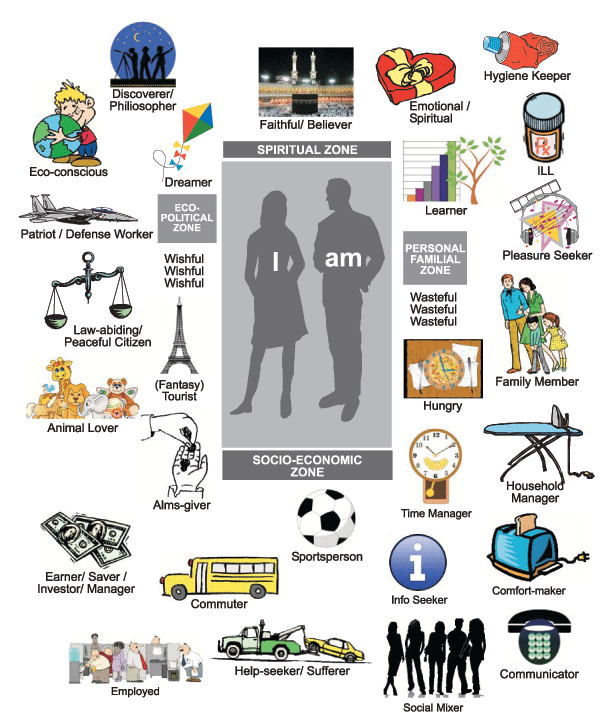
The People-Centered Model of Business (PC-MoB)
Note: PC-MoB is now The Salaam Matrix.

The People-Centered Model of Business (PC-MoB) is a practical tool through which organizations (businesses and others) examine the reality of their markets by focusing on human activity. It has multiple application modules including:

Market Insight, Trend-Forecasting, Entrepreneurship, Creativity, Organizational Leadership, and Social Business—the last is detailed in this article.

The Four Life Zones

1. Spiritual (S) Zone

This Life Zone deals with people’s beliefs, ideologies, and life outlook – or the lack of them. Closely related to the faith system of individuals is their heart, their intellectual mind and free will. To understand a person or culture, it is important to understand their belief and spiritual system. A belief can be true, false, completely wrong, or absent. S zone is the primary PC-MoB zone, as it determines a person’s behavior in the respective life zones.

2. Personal-Familial (PF) Zone

The family is the basic unit of society. A person will always be an individual, in the context of their family – whether it’s joint, nuclear, or dysfunctional. Personal beliefs shape family dynamics and families shape society. In Maslow’s terms, the PF zone is where a person seeks emotional and physical security and stability. This determines the level and quality of peace in society, and its creative energy.

3. Socio-Economic (SE) Zone

A person interacts with the larger community for economic and social purposes. This is where a transaction occurs between personal-familial values of individuals and household units as they begin to interact with one another. A shared vision that governs these social contracts is created out of those dynamics. These in turn determine society’s collective behavior.

In the SE zone, a person rises above the self-development and family care needs to communicate with society at large. Help is given and taken. A person is both an employer and an employee in the economic system. Information is traded; people earn, save and build; and money becomes a medium of exchange. Technology emerges to facilitate the speed and beauty of transactions between people and resources.

A person chooses their SE zone behavior in line with how they have developed in the S and PF zones. Societies that have accessible information and open communication, where transactions are facilitated, and social contracts are honored become creative – and foster open opportunity. Else, they are unfair and transgressive. The latter are marked by confusion, resentment, violence and warped employment dynamics – as the case of Pakistan could be interpreted.

4. Ecological-Political (EP) Zone

Finally, a balanced human being, or society, progresses enough to participate in the larger universe – of law, politics, ecology, and cosmic philosophy. “Balanced” describes experiencing, learning, and evolving from the previous three zones. Some groups try to short-cut the first three zones, and jump into the universal zone perhaps as a means to avoid their duties and establishment of rights in the S, PF, and SE zones. That results in a perpetual futile conflict between these wishful idealists and society, which rightfully needs able persons.

In mature societies, the EP zone represents universal love, art, entertainment, travel, and discovery. Media is the child and the lifeblood of this zone – because by definition, media is media between the real products and people who already exist. A media that exists out of harmony with its own society heralds its own disabling through frustration. The institutions of charity, establishment of good and prevention of evil, collective prayer, the judicial system, defense, foreign affairs, and struggle are in the EP zone. These are higher level societal institutions that cannot be imposed on/by immature people.

Note:  Learn more about The Four Life Zones here. 

The Cyclic Relationship of the Four Life Zones

The Four Life Zones are not strictly separate. Some roles overlap boundaries, others can fit into other zones. In a way, the four Life Zones are connected in a cycle: “The Circle of Life”. When each zone reinforces the other, it’s a progressive cycle. When each zone leads to spillover, ill effects on the next, it’s a vicious cycle.

Business = Busy-ness

Picture the Four Life Zones in movement. Where an ill person is being treated, a household manager is preparing food, one is building homes, or requires safety, travel, or learning – it is “the busy-ness of life.” Since these actions require a deep web of “helpers” who are paid in money, business is created. Business is thus a part of the society, if it is based on the real needs and understanding of the society. Whoever was trying to sell refrigerators to Eskimos was a true conman, and died unpopular.

The key is that our businesses cannot prosper without adding true value to their own consumers: an issue that is easily skirted -and hard to tackle- in a society as oft-ill-informed as Pakistan’s.

PC-MoB: The Social Business Module

“Social-izing business” is one of the most profound emerging global trends of the 21st century. This concept has various meanings, one referring to businesses whose primary aim is to serve social needs profitably. Business thinker C K Prahalad has built a case for doing profitable business for “bottom of the pyramid (BOP) markets” – which are the over 4 billion consumers of the world with modest but real spending powers. They represent a largely untapped market which can be served – and profitably so. Using PC-MoB to study the lives of the BOP market would reveal a multitude of niches that can be filled by small local businesses and create tremendous employment opportunities. This role has been typically relegated to NGOs and charities. We need a new construct that balances people + planet + profits; the imbalance of one shakes another

Application Scenarios

In Pakistan, food stock fluctuations can be better managed by improved warehousing and transport – leading to decrease waste in produce, and hence market prices. [SE-zone]

Tele-medicine services have seen an opportunity in sending mobile medical teams to otherwise inaccessible areas. [SE-zone]

In India, Unilever has a program called “Shakti” – literally meaning “power” – that empowers poor women by turning them into Unilever sales representatives – which in turn gives the women better lifestyles and expands the company’s reach. [PF-zone]

Note:  To explore the current applications and uses of this model, explore WORLDS on The Salaam Matrix website. A list of potential applications of the model is here. 

Business Realizes Human Potential

Business is not a cancer. It is an integral, legitimate part of a healthy social organism. The condition is that the business is empathetic to the society/societies it operates in and helps legitimate “busy-ness”. The entrepreneur affects change when s/he accepts the society as is, and does not create products and markets for a make-belief group. Then the entrepreneur is in a very powerful position to mobilize change. A business cannot effectively live in denial of the society and environment around it. Understanding this fine point will save many businesses a lot of heartache and headache.

The PC-MoB makes it simpler to understand the fabric of society – and hence the dynamics within which all organizations function. It also establishes the social context of the business so that unnecessary conflict is avoided. In fact, business becomes a pleasure – both for the markets being served, and for the entrepreneur who can use their innate potential for issues that are relevant to their own environment.

Characteristics of the PC-MoB

Questions, Not Answers

The PC-MoB is a template. These roles are questions, not answers. The role of “ill,” for instance, asks the studier: what ailment does this group of people suffer from? For instance, poor people suffer lesser from heart disease (often the result of overindulgence), more from infection (the product of filth). Thus, North American markets need obesity control as Africa or Pakistan might need disinfectants.

Realistic, Not Fictional

The PC-MoB demands reality, not fiction or desire. Facts lead to insight. How will we know the answers to these questions? With research. With unstoppable curiosity and fact-finding. With determination to really know the people we market to. To envision their needs, so needed solutions can be served and waste is prevented. That’s the higher purpose of business.

Empathetic

Empathy is elicited as a reader identifies the truth of the people being studied. It also gives perspective to consumer study and consumer insight.

Accommodates Diversity

There is a strong implication that one consumer group’s life profile cannot be projected reasonably onto another’s – owing to the variety of human nature and culture.

Drawing up a PC-MoB profile for each group of markets will lead to rich insights about their unique lives, tastes, aspirations.

Welcome Back Home!

The PC-MoB is an integral tool; it puts things together into the “big picture,” where one thing is related to another – as is the case in our daily lives. This is the reality of life that traditional single-disciplinary models could not perceive nor incorporate. The simple PC-MoB liberates organizations from the guilt of feeling “external” to the human life by weaving them back into the social fabric where they are active, healthy participants in human activity. This ends the fictional divide between “the good” and the necessity of “just doing my job/ business.” This, in short, is the beginning of the end of secluded, incomplete thinking patterns which is the root of why modern businesses compulsively act solely profit-centered as if there’s no other way.


NOTES:

PC-MoB: Originally Self-Published in 2006; this abridged and adapted version published in March 2008 in Triple Bottom-Line Magazine, Pakistan.

This article is part of a series of articles Ramala Hubb’Allah wrote (with her then name) during 2008-11 for Pakistan-based publication, Triple Bottomline Magazine (TBL), published by Asiatic Public Relations. The publication’s focus was Corporate Social Responsibility, Climate, Environment, and Developmental themes. This is the first article, published in March 2008. The magazine’s version has been duplicated on The Salaam Matrix site as it is, with only a change in the title. Original TBL article in print; web version is here.

This article is reproduced on The Salaam Matrix site to present the collected body of Ramala’s works on the Triple Bottomline Magazine.

The People-Centered Model of Business has been renamed as The Salaam Matrix in 2023-24, and you are reading this article on the website for the model and its codex. The visuals and applications of the model have been updated in most parts and are under further upgrade and review. See the Downloads section for updates visuals. See Timeline of Development here.