Not Flat But Textured

Relationships and Growth in an Interconnected World

Thomas Friedman declared that we live in a flat world that has got even flatter. That technology especially the Internet has the most significant part to play in it. Those who have grown with the Internet and are inextricably glued to their cellphones will testify to this.

But with 6.8 billion humans on the planet, how flat can the world get?
Does this flatness mean you must connect with everyone?
Does that not pulverize the individual or the group?
Have all boundaries truly eroded?
And if so, how are we ‘safe’?
Where do we belong?
In the face of overwhelming flows of information and noise, where is the individual’s voice?
How does this affect our relationships?

The fact is that information is eroding the boundaries of the individual and the group. Secondly, it fundamentally alters the landscape of relationships by apparently making everyone ‘equal’ and therefore making priorities hard to determine, leading several people to make confused choices that may overtax their system and resources.

The Keyword Is: Apparently

Here is the good news: there is, indeed, a design, a sense, a scheme to this ‘flat’ world. That it is equal, but not so equal that an individual or a group cannot determine their priorities. There is a way that an individual in the contemporary world can render sense, all over again, to their self, their relationships, and their business of life.

The story of this sense, and alignment of an individual, their purpose (passion), and their global context begins with an individual’s attention and intention…

Attention & Intention:
The Building Blocks of Life

Attention: Seeing The World

The most powerful tool a human has is their attention. It is by way of investment of attention that anything is created and grown, and it is by divestment of attention that things deplete and fall in disarray. (Decay and death, however, is part of the natural cycle of life. It is not to do with lack of attention, but the end of one life-cycle.)

When the attention is focused on contribution, an interesting thing happens: a natural scope is determined. Why? Because an individual is restricted by their organism (the body) and the environmental context and is subject to natural limitations of speed, time, distance, aging, incoming energy. Contributing takes away from the individual, and therefore, one can only give as much. This gives a limitation to one’s extent of involvement in the world’s affairs.

When the attention is focused on taking from the world, the natural limitation on attention erodes. Theoretically, one can take on the entire world. One can take on three jobs, unnecessarily, at one time. One can sign up for as many classes as they want, and have as many friends as they like if they are not going to pay any attention to what they have.

There is an interim state, too: recruiting someone else, by power (or money) or sheer force, to manage what one has acquired. Manipulation is the tool of the taker to sustain their acquisition. Entire nations construct laws that permit them to overtake other territories in order to fulfill their own needs. This may be in the form of war or even trade.

Intention: Giving or Taking?

There are fundamentally two kinds of outlooks on the world with respect to the self: either one sees that the self is here to take from the world, or here to contribute to the world. These two outlooks determine one’s character. The first kind of character is concerned with more, and grows through acquiring. The second kind of character is concerned with less, and grows through contribution and service (which can be for pay, of course).

These two characters have moral and ethical implications. Interestingly, they also create a different ecological footprint and organizational design. Conglomerates and inefficient mergers that attempt to take on the world with size and encroaching urban landscapes are two instances, intangible and tangible, of the taking mindset.

Life, Growth and Relationships:
The Connection

Growth is an outcome of being alive and it takes place through interconnections which we can call ‘relationships’. An organism that is not connected to any other organism cannot find incoming nourishment and thus will not sustain. In reality, a wholly disconnected organism does not even exist.

Hence life is a system thriving on relationships, and it grows by its very design. But what is growth?


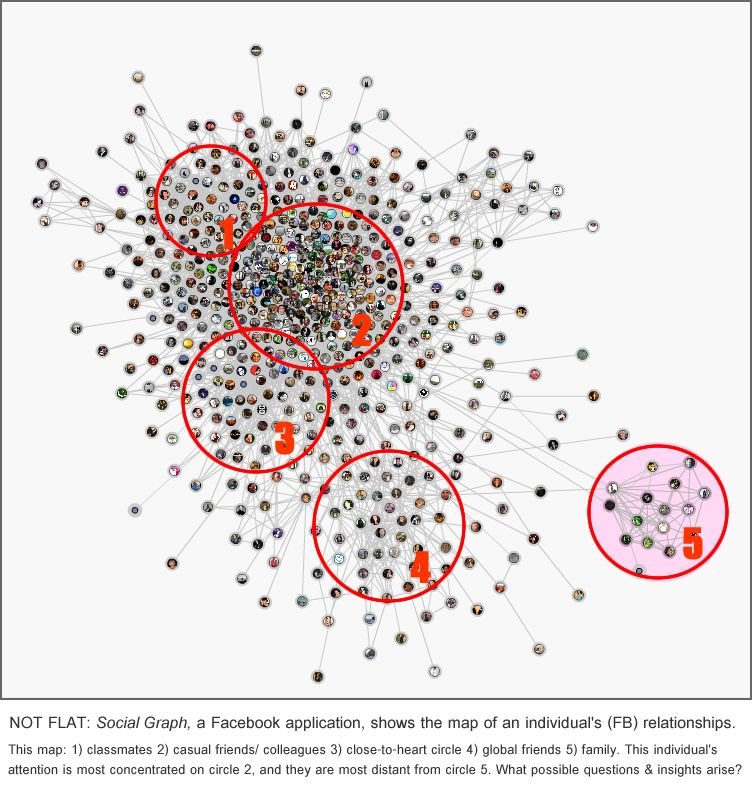
At the time of the publication of the article in 2010, Facebook allowed external applications such as Social Graph to connect to Facebook profiles and access data such as Friends lists, which were categorizable into labels that a user gave them, for example “Colleagues”, “Family”, “Classmates”, and so on. The writer generated a map to study what their Facebook relationships look like, and where is the highest concentration.

This graph happens to be representative of a young urban person with a sociable profile. The graph, if generated today, could be highly insightful. Perhaps an app can be used to generate a map of one’s contacts and relationships, and one can study where their time and attention is concentrated the most. This is where their life will grow—but do the groups that they hang out most with, truly grow them? The answer depends. While our article proposes the natural family as the highest alignment, it is possible that people define families variably or find peace in a different group (that acts as a family). Also, the article assumes functional and well-formed families, and an ecological civilization where families are aligned, and people are connected to Land. When achieved, this is the easiest form of natural alignment.


Growth Is Not Just One Thing
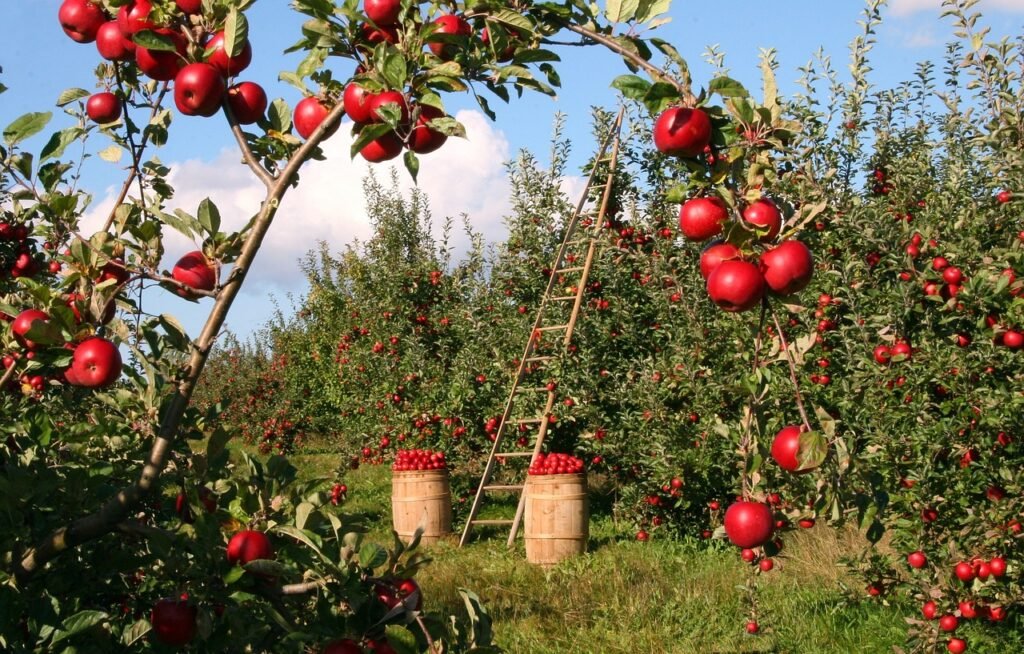
Growth has long been defined in material terms: more money, more space, more territory, more things. It is seen in terms of more of the exterior.

The emerging understanding of growth is shifting towards an inner meaning. Nalini Nadkarni, an ecological scientist who studies tree canopies, observed: if one sees the tree’s growth and movement in terms of its dynamic twigs and not its static trunk, they will notice that trees, too, move. A single vine maple tree in her study made a movement equivalent to circling the Earth 7 times, in a single year!

That observation gave Nalini an insight: one can move and grow even when standing in one place. Armed with this insight, she started programs for Washington prison inmates that engaged them to become productive members of the society within confinement. Her inmates voluntarily attended science workshops and began a conservation program planting nurseries for local forest restoration. This also healed them as condemned individuals. Thus by redefining growth, Nalini opened the doors of growth and connection for those who are physically restrained.

I am advancing the idea that growth is not just one thing: it means different things to different people ? and that subjective definition is not just acceptable, it is the only way to have an interesting, rewarding experience of the world. The world is richer for the variety of aspirations and thus contributions of individuals. The narrative that has long defined growth in only one way has destroyed relationships, created exploitative businesses and structures prone to collapse because they cannot be sustained by definition.

Destruction as Opportunity

Relationships are the structure upon which life thrives. Life by definition is a forward movement, a bristling, an evolution, a growth. Even the apparently static thing is in movement, the disconnected is connected. Yet if the attention is veering off, and the intent is based on taking, both the structure and growth suffer. We are observing the malevolent structures premised upon taking & more are collapsing. We are also observing a world with depleting restrictions where access is becoming fluid and open.

This is actually a time for great opportunity. What we are witnessing is not a deluge of information out to get us, but a release from traditional constructs. We are no longer bound by restrictions. Yet, with their erosion, we are also experiencing a lack of comfort that came within these walls, a massive dissolution of familiar structures. By focusing our attention on what is, and with good will, we can begin to render a new, fluid, open, dynamic structure suitable for these times.

Inside-Out Relationships:
A Structure for Growth

I propose that this new structure is built inside-out: from the individual to the family to the community to the larger world. Further, that it is based on a benevolent intent (contribution). The inside-out structure supports sustenance of attention, which is not dispersed all over the place. The proximity in this structure ensure a history of transactions which in turn becomes a basis of incremental trust. Care is the fiber this system is weaved of.

To take an example: if you are to grow a food farm, would you rather do it in your city, or the neighboring town? If you wish to do business in the next town, why are you in this town? I am arguing that we bring businesses and their infrastructure home or migrate to where our heart is, thus bringing ourselves home one way or the other. This will reduce the footprint that is caused by being distant from wherever your purpose is taking place.

Online communities, too, are arranged on similar principles. We are increasingly observing that the netizens are congregating around local issues. This is more visible in geographies that were previously politically closed or economically disadvantaged. Nations which were already organized are ahead on the curve: communities-of-purpose are arising and these nations are on the forefront of discharging benevolent ideas within the global population. Think TED.com–the great reservoir of best human ideas in the contemporary world.
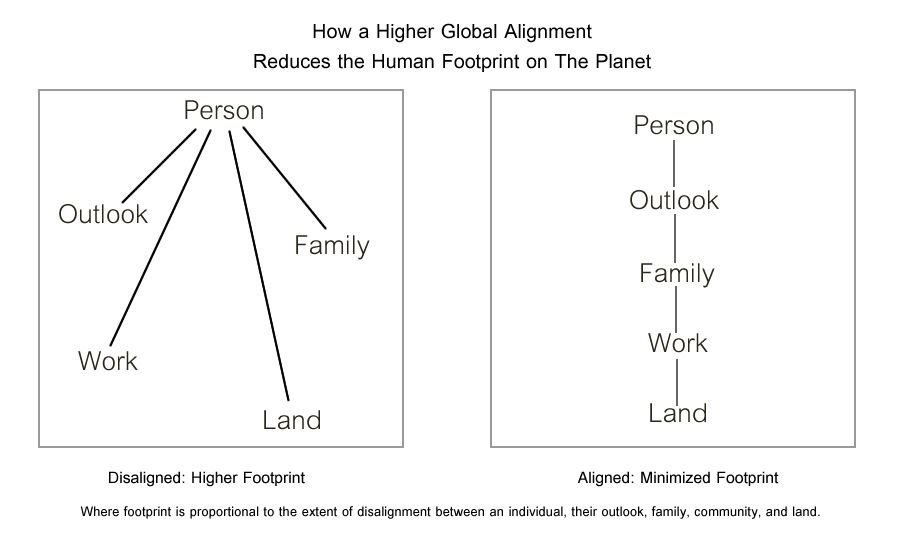

This image roughly shows the alignment of a person and their outlook with their family, their work and their land (second part) vs. when their being is scattered in the instance of misalignment between their family, their outlook, their land and their work (first, left part).


Individual: The Epicenter of Growth & Relationships

All growth starts from one person, and that ‘one person’ is not a hero figure or a privileged person, but one’s own self. Hence when I think of growth, I tackle the question for me; when you think of growth, you tackle the question for you.

Attention and intent of the individual are the starting points of growth: that which is paid attention to, grows. Intention determines how the relationships around the individual get rendered. An intent of giving allows one to connect with the exterior, even if the exterior is an alien, say, a foreign country. In other words, paying attention with an intent to give allows an individual to create a relationship by becoming useful.

Families: The Natural Partners in Growth
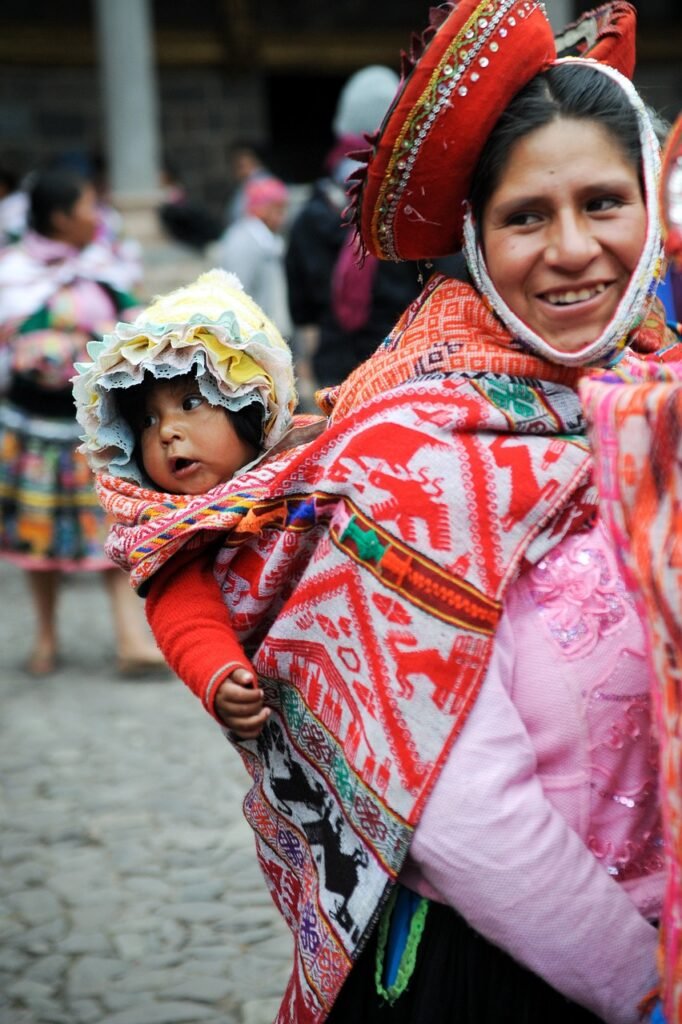
The blind poet John Milton consoled himself thus about his condition: “Those also serve who stand and wait.” This has long struck me as very insightful, for at any given point in time, most members of the population are physically rooted in one place and inextricably linked to their relations.

When I was a young child and had natural aspirations for growth, I could not reconcile how those who stay put, grow. I was thinking of most of my family members who never grow by the external standards of the world. If growth was the acquisition of more, certainly most members of most families failed the criteria. That includes mothers and grandparents as the epitome of those who are ‘losing’ by way of caring for the other.

If we see these relations by the externalist measure, these are the most sorrowful individuals on the planet. And yet, many find their roles joyful (though they may be made to believe otherwise by the cultural narrative), and they are making real economic impact and contribution. Attempt replacing families and their care with institutions, and we will end up with an unmanageable task and an emotionally dysfunctional population prone to crime.

This massive opportunity cost is a clear indicator of the real, valuable contribution families and communities are making even if they are not snatching territory. Indeed, their greatest contribution, whenever they make it, is not snatching territory while providing nourishment and opportunity to the world’s population.

Communities: Infrastructure for Growth

Communities provide a context and infrastructure for growth. There are two factors at work: the hard element, that is the physical landscape, architecture and design of the community; and the soft element, that is the culture of the community.

The individual has two choices: to align with their given community (and transform it slowly from within through their contribution), or to migrate, and in some cases, initiate a new community. The choice is determined by the individual’s assessment of which situation grows them best.

The right local community (including online communities) nurtures its individuals and may grow them by occasionally challenging them. However, if the balance is tipped out of favor of nurturing and tilts towards taxing (burdening), the society, that is to say, a constellation of individuals, perishes as a collective.


A Global Alignment

It is increasingly possible in this world today to be emotionally and physically in a place that is aligned with the individual’s inner purpose, while being an involved part of the larger world. This balance of the micro within the macro is an unprecedented occurrence in human history. The only thing needed to make this change is the individual’s courage to embrace it.


NOTES:

If you enjoyed this article, you may enjoy this YouTube playlist by Ramala Hubb’Allah (below). This article is part of a series of articles Ramala Hubb’Allah wrote (with her then name) during 2008-11 for Pakistan-based publication, Triple Bottomline Magazine, published by Asiatic Public Relations. The publication’s focus was Corporate Social Responsibility, Climate, Environment, and Developmental themes. This is the tenth article in the series, published in August 2010. Original version in print; web version on the TBL site here.

This article has been updated with new images, and the text is republished as it is, with light formatting, on The Salaam Matrix website. It is reproduced to present the collected body of Ramala’s works on the Triple Bottomline Magazine.


If you enjoyed this article, you may enjoy this YouTube playlist by Ramala Hubb’Allah (below).


This Ramadan, Count Your Riches: Scarcity to Abundance Perspective

A Different Footprint

What if there were a way to reduce our (currently outrageous) footprint on Earth such that:

  • the shift is convenient
  • it reduces economic cost and saves technological effort
  • it reinforces benevolent relationships
  • it creates organic, effortless growth
  • it is consistent with ethical and spiritual values
  • it enriches the social whole by nurturing the individual person or group?

What if this way were as simple as shifting how we ‘see’ things, especially the nature of our work?

The answer is: Yes. It is possible to achieve all the objectives outlined above, at once, by simply a first shift in perspective. This first shift in perspective then leads to shift in actions, and therefore outcomes. And this shift is as simple as changing your fundamental question about growth.

Change Your Question: From ‘Need’ to ‘Have’

Instead of asking: “I need _______ to get ________.” Ask: “Where do I want to go? What do I have, right now, to get there?”

The shift that we are seeking is one from a Scarcity Perspective to an Abundance Perspective. Note that the second key word is ‘perspective’. This shift is not about lying to the self about resources and growth, but rather seeing things as they are and then choosing to pay one’s attention in a certain direction. In sum, if you have 10 acres of land, you are not psyching yourself into believing that you have more than 10 acres. Indeed, you stay reasonable and grounded about the land’s known natural capacity, but shift your attention to what can be done with the land rather than what cannot be done with the land.

In the first way is potential for growth. In the second is anything from anxiety, to greed, to the urge to steal, to depression.

How Does This Work?

The “have” mindset in people or organizations is indeed only just a mindset: it requires soft intra-personal or intra-organizational work, but it yields hard results including structural transformation.

The “have” mindset:

makes intelligent use of given resources to get things done. Take the instance of technical innovation. In Pakistan, the word ‘jugaar’ is used for a technical/mechanical patch-up that makes things happen. In Africa, the same concept goes by the name of ‘tinkering’ ? it is now being recognized as a very smart form of innovation. India, for instance, has a grassroots innovation network.

highlights strengths-to-grow rather than weaknesses-as-excuse.

yields planet-friendly development and growth. Needs are limitless and greedy, and lead to growth by taking. ‘Have’s’ are identified and content, and lead to organic, natural, rightful growth by giving.

How To Put the Abundance Perspective into Practice?

The shift from the Scarcity Perspective to the Abundance Perspective is a reflective exercise first and foremost.

It requires less action, more silent thinking. Action comes after the perspective shift has occurred.


See it through this example: you want to choose a place for vacation. The first decision about where to go on holiday requires no action (other than research, perhaps) but thought: you figure your budget, your priorities, your style, your mood internally. Once the decision is made, you then gather and align required resources. If you choose to ski in the cold mountains, you will not invest in scuba-diving in warm waters. If, however, you do not make up your mind, you may end up with chaotic resources and decisions. Even serendipitous, unplanned travel is known to be such. You decide not to over-plan.

Apparently small decisions such as this translate into large costs or savings for individuals and the planet. Unnecessary acquisitions whether by individuals planning a holiday or organizations investing in new ventures ? lead to ineffective decisions, delayed action, lack of (worker) spirit, and wasted resources that could be leveraged elsewhere.


This Ramadan, Shift to Abundance

This shift to the Abundance Perspective requires slowing down, pausing, taking stock of one’s current life, evaluating what is, and then moving forward. It is not easy in a fast-paced daily life for organizations or persons to find time for this extensive reflection.

In this situation, Ramadan, the Muslim month of fasting, provides an excellent opportunity for an organizational shift that is driven by reflection. The natural rhythms of the human body and therefore the pace of work slows down during fasting. Quick-paced activity is not as possible. It is thus an ideal time to do collective reflection everyone (or everyone in the fasting whole) is slow-paced, together, for an entire month, and there is a general aspiration to do good, do right.

The context and the motivation are already present ? and so, dedicating Ramadan to asking the big questions about the organization’s mission and purpose is in itself a great practice of working with what one ‘has’.

Conversations: a Tool For Shifting to Abundance Perspective No matter how complex an organization is or how sophisticated its products and systems are ? it is made up of human beings. The start of the shift in an organization lies with human beings, and humans can begin reflective shifts using an age-old tool: conversations. This simple tool is so potent that today, ‘changing the conversation’ has become the most powerful tool in a change-makers’ toolkit.

Conversations can be held in ways suitable to each organization. The best method is to have face-to-face personal conversations in groups of no more than 8 persons. Alternatively, a larger, in-house ‘Reflection Conference’ may have some core themes for all, and topical break-out sessions for smaller teams.

A contemporary alternative is to have online conversations in secure groups or even on blogs (this blog does not have to be public ? only shared within a particular group or organization). Eventually, it will be noticed that small groups break out on their own and they should be encouraged in doing so for individuals cannot concentrate in large, many-to-many conversation.

At The Oneness Breakfast, an inner peace initiative that I have co-founded, we use food-sharing and a Native Indian-styled conversation for transformation of the person within the collective. We have actually flipped the conversation to “TLC: The Listening Circle”. Some of the themes covered: sustainability, local food, attention management, nation-building, and education-for-all. One of the outcomes of the circles has been the participants’ voluntary involvement with Manzil Organization, a free school for slum children, including voluntary teaching, media coverage, and fund-raising.

Abundance: A Living Practice

Ramadan is a time to bring ethical values that humanity holds dear into action, making them a living practice.

Illness arises when the belief and the practice are on two different tracks such as when one believes in contentment (Abundance Perspective) but lives by fear & greed (Scarcity Perspective).

Spirit is, by definition, ‘action when it’s taking place.’ The Qur’an defines spirit (‘ruh’) as: “the act of/ by act of Allah” (17:85). I understand it to mean that the very act or movement is called spirit. This is also the popular meaning of the word; hence we say sportsman’s spirit, high spirit, low spirit. Spirit is action. Practice is to live the spirit deliberately (by choice), daily, as routine.

This Ramadan, invite yourself and your organization to shift to the liberating Abundance Perspective, and converse about how to make it a living practice.


NOTES:

This article is part of a series of articles Ramala Hubb’Allah wrote (with her then name) during 2008-11 for Pakistan-based publication, Triple Bottomline Magazine, published by Asiatic Public Relations. The publication’s focus was Corporate Social Responsibility, Climate, Environment, and Developmental themes. This is the ninth article in the series, published in August 2010. Original version in print; web version on the TBL site here.

This article has been updated with new images and the text republished as it on The Salaam Matrix website. It is reproduced to present the collected body of Ramala’s works on the Triple Bottomline Magazine.


8point3 Billion: The Citizen Stakeholders

Note: Article name and URL have been updated to reflect the current population number in the world. At the time of writing, the population of the world was 6.8 billion, which has now swollen to 8.3 billion people.

Is it possible to engage each and every human on the planet as a stakeholder? Is it possible to make every single voice count? Is it possible to get all citizens on board to arrive at decisions that are relevant to the entire population?

The answer is: YES. A resounding, no dream, all hard fact ‘yes!’.

It is possible, in this day, to create a super democratic system that engages every individual concerned with an enterprise, counts their voice, marks their presence, and assigns them tasks. It is possible to end the problem of disenfranchisement. It is possible to engage the citizen as a stakeholder.

The Citizen Stakeholder

Any modern organization – be it a public service body, the government, a corporation, or a non-profit organization – has theoretically always factored in ‘the common person’ as a stakeholder.

In truth, however, that has not been possible due to the technical limitations of engaging every single person. That technical inability has led to two kinds of intents:

  • The everyday stakeholder is deliberately kept out, and control is exerted by the few. OR
  • There is a willingness to engage the common person, but the process has been long, frustrating, and at best helped by scientific methods of sampling (with constant corrections for bias).

Let us name this common person as ‘the citizen’. When the citizen is kept out of the creation process, whether deliberately or not, two possible outcomes occur:

  1. Costs are passed on to the citizen. The citizen has not accepted to take on these costs – and each project has costs until a perfect sustainability is achieved. The citizen is neither equipped nor ready to take on unexpected negative outcomes – such as, the cleanup required after a civil construction project.
  2. Possible value addition, that comes through the input and involvement of the citizen collective, is missed. For instance, the citizen could suggest that all new area houses have storage to harvest rainwater. It’s good value for the individual household, who may altogether ‘miss’ the opportunity to create this value through a lack of knowledge or motivation.

    In another scenario, positive externalities are not acknowledged or credited. For instance, a business organization may not be credited for care shown to employee families, when the focus of organizational accountability and performance audits is on profits alone. In this case, the organization may find little motivation to do the right thing.
Externalities: Definition
“In economics, an externality (or transaction spillover) is a cost or benefit, not transmitted through prices, incurred by a party who did not agree to the action causing the cost or benefit. A benefit in this case is called a positive externality or external benefit, while a cost is called a negative externality or external cost. For example, manufacturing that causes air pollution imposes costs on the whole society, while fire-proofing a home improves the fire safety of neighbors.”
Wikipedia

A Portfolio of Concerns

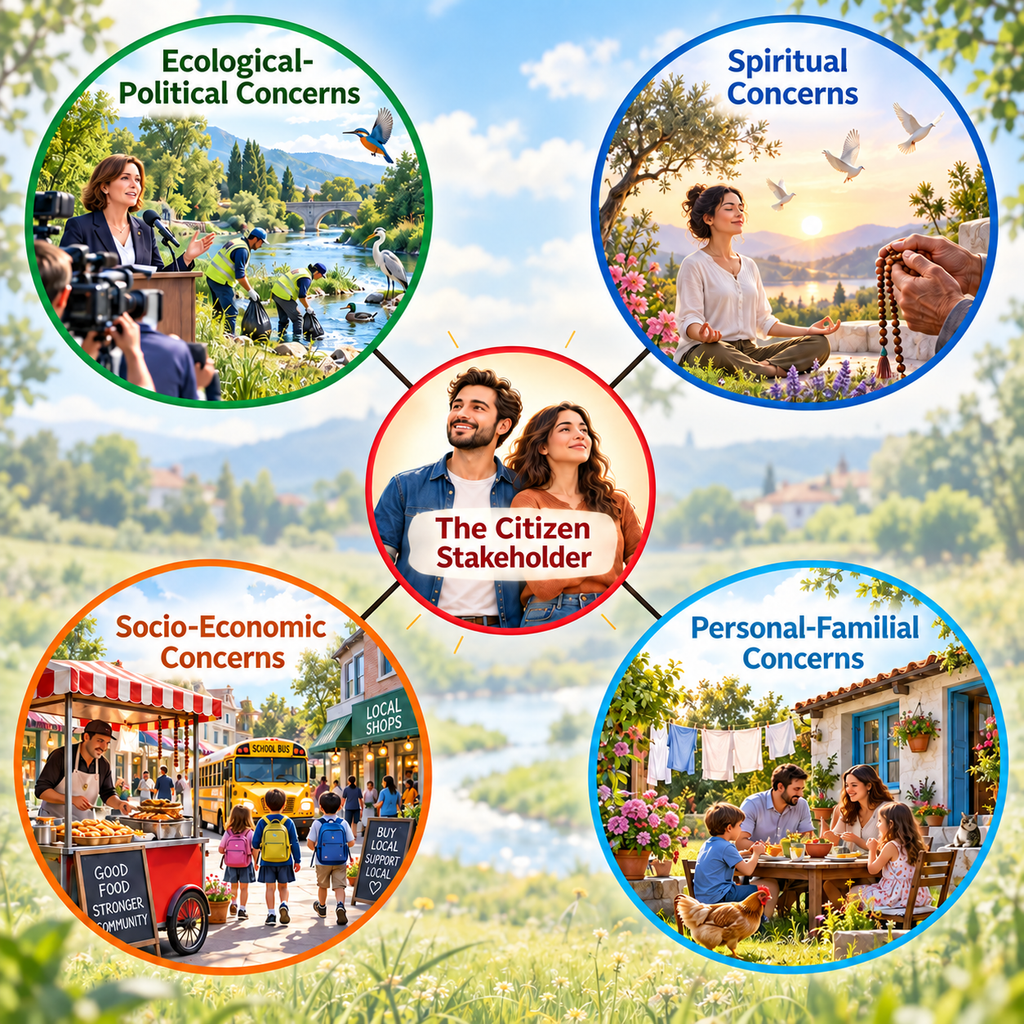
The citizen is capable of holding concern in a number of what Ramala described as “The Four Life Zones”.
For a full description, see Four Life Zones.

There is an upside to having the citizen stakeholder on board: the citizen does not have just one concern or interest. Rather, they have a “portfolio of concerns”. At any given time, the ‘pull’ on the citizen comes from various directions: the belief system, the family structure, the social network, the economic activity, and the larger political world.

Once an organizational structure is imposed, however, the person starts to lean towards the biases of the organization. Hence, in a worst-case scenario, a person in a not so responsible corporation does not concern themselves with the environmental impact of economic activity, and a person in an environmental preservation NGO does not concern themselves with its impact on business and livelihood. This scenario has often been played out in real life. Consider Green-peace vs. The Corporation.

On the other hand, the person as a citizen is blessed with a complex eye that sees more than one concern. Collectively, aware and empowered citizens have the ability to diffuse special interests – in other words, no single agenda dominates permanently at the expense of others. When it does, contrarian forces emerge until balance is restored.

Technology Case Usage: UShahidi

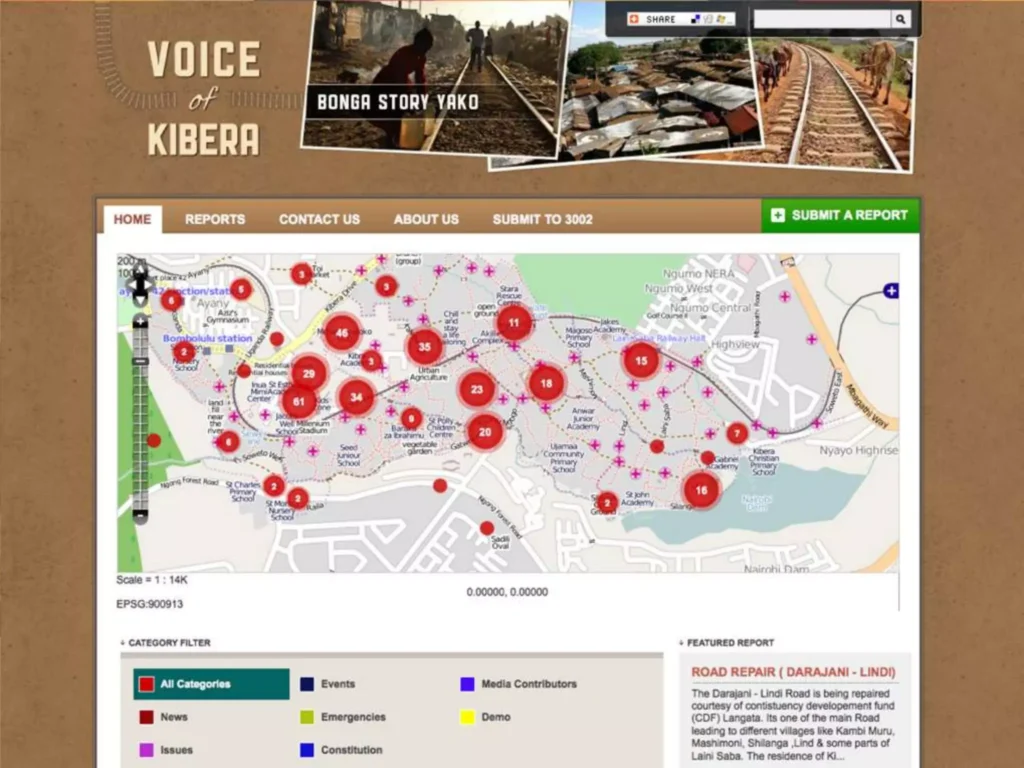
In the wake of the 2007 Kenyan post-election crisis, a web-based platform, UShahidi (Swahili for “witness” or “testimony”) was created to generate incident reports from the public. The hallmark of UShahidi was the ability of the public to report incidents through SMS. The incidents would be classified in categories, and mapped visually for public viewing. The project was a great success.

Today, UShahidi’s open, free platform is deployed for various purposes ranging from snow cleanup in the USA (snowmageddon.com) to identifying peace heroes in Kenya (peaceheroes.ushahidi.com).

Kibera: Africa’s Largest Slum

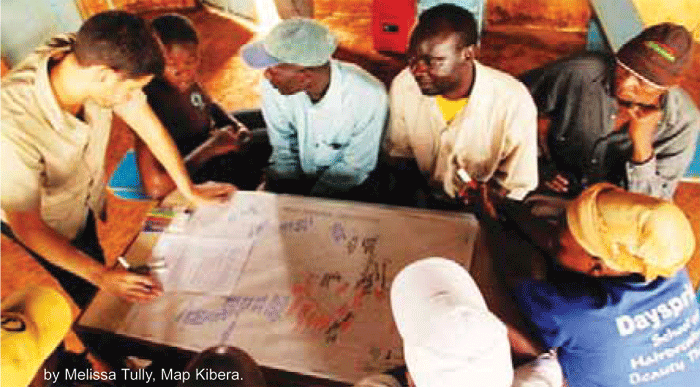
Group mapping exercise – citizen project mappers are trained by Map Kibera

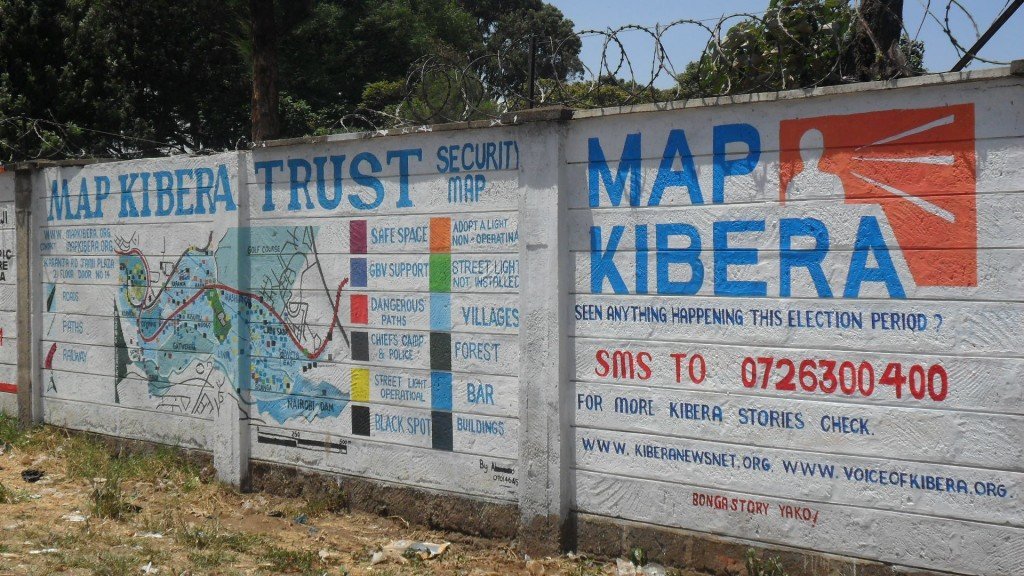
In the Kenyan slums of Kibera a community ridden with typical slum issues, and long a laboratory for NGOs and activists UShahidi has found a new purpose: digitally mapping the community.

Led by Map Kibera, young Kiberans are creating a thematic digital map ‘Voice of Kibera’ (kibera.ushahidi.com). Key themes include Health, Security, Education, and Water/Sanitation. In their own words:

“Map Kibera is, at the core, about empowering communities to use technology for their own agenda, all players openly sharing and creating information for transparency and equitable discussion, and confronting the reality of technology on the ground, in marginalized communities.”- mapkibera.org

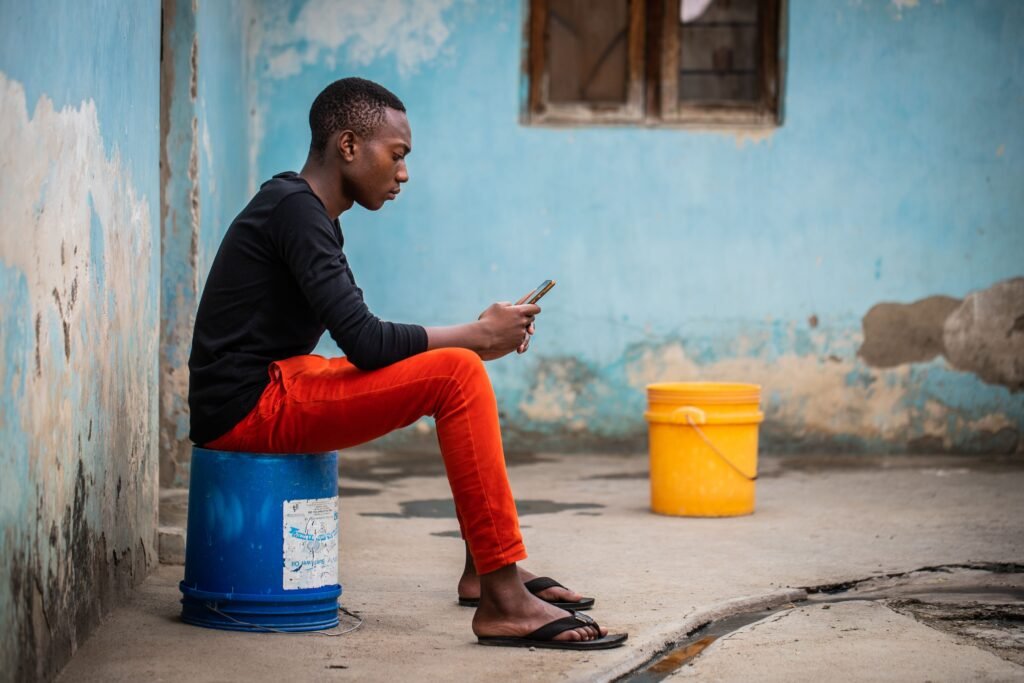
Kiberian citizen journalists equipped with cameras and mobiles are the eyes and ears of the Map Kibera project.
(Representational image)

The idea: once the community’s resources (corresponding to its issue – health, etc.) are mapped, a better picture will emerge that will better enable organizing for social change and informed decision-making. It also brings the community together around issues that matter to the collective, reducing disruptions along the way.


Pakistan: An Unorganized Global Powerhouse

Closer to home, Pakistan Changemakers Hub (http://changemakers.pk) is deploying UShahidi to create a platform where the Change makers innovators and community leaders of Pakistan can be mapped, organized by their field of action. The end result is a citizen-generated visual directory very similar to Voice of Kibera.

The idea: connect the disconnected Changemakers in order to accelerate Change. The directory serves the functional purposes of making hidden Changemakers known and available. Its more subtle function is coordination, hope, connection, motivation. It organizes Pakistanis causes we care for rather than identities that divide us.

Final Question: Do Citizens Care?

Yes. What they need is a direction and a method to organize the chaos. Globally, we’ve witnessed citizens organizing for Tsunami relief, Haiti, and recently, against BP’s handling of the oil spill. In Pakistan, the ‘civil society’ has risen in (near) concert during the 2005 Earthquake and the 2007 political unrest.

The underlying theme, however, in all these cases is accident. The question is, can creative projects create the same kind of momentum?

The part of the answer that comes from technology and ability is: yes.

The part of the answer that comes from will is: up to you.


NOTES:

This article is part of a series of articles Ramala Hubb’Allah wrote (with her then name) during 2008-11 for Pakistan-based publication, Triple Bottomline Magazine, published by Asiatic Public Relations. The publication’s focus was Corporate Social Responsibility, Climate, Environment, and Developmental themes. This is the eighth article in the series, published in June 2010. Original version in print; web version on the TBL site here.

This article has been edited with a new headline and population figure, as well as new images, to be republished on The Salaam Matrix website. It is reproduced to present the collected body of Ramala’s works on the Triple Bottomline Magazine.


‘Service’ Lets the World Stay Round

A Need Spotted

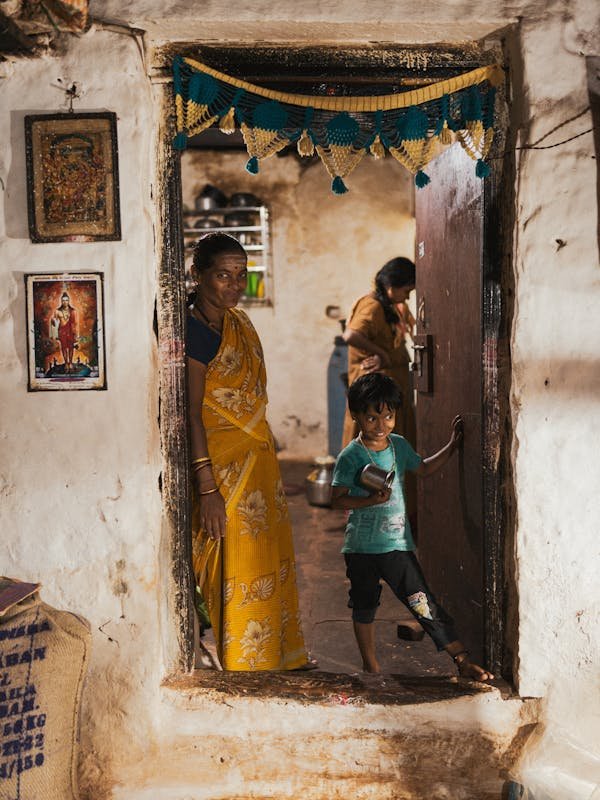
Image is representational image of a modest family home, the kinds of places the author has later seen during travels, and sometimes wanted to serve or connect to the larger grid of social activity and giving and service, where there is need as felt by the author and affirmed by the stakeholders.

I went to visit the doctor two days ago. At the clinic, I was given a waiting number. Now this clinic is a bit of a run-down operation, but I trust the doctor for his accurate diagnostic skills and the ability to treat a patient with more kindness and less medicine. He also chooses to run a clinical practice in a less-privileged area. When asked why, he once said, “This is where I am needed.”

So, I sat with the square little cardboard paper card that bore my patient-calling number. I noticed, during the ample idle time, this card. It had been fashioned out of medicinal packaging ‘repurposed’, so to speak with the number ’23’ written with a blue ballpoint pen. Highly unimaginative, this piece announced, “You are sick!” in subtle ways.

My mind wandered at this sight, and I thought: “Why, in all my years of visiting this clinic run by a rather selfless man who could have earned millions healing people in a ‘better’ facility, have I not thought of contributing anything to this clinic?”

I looked around and saw many flu-ridden children amongst the patients. I noticed that the bookrack had books that were wilting due to overuse. There were some nice posters on the wall masked advertisements of pharmaceutical companies. All in all, the clinic could use a paint job, some fresh art on the walls, and new books and magazines in the racks. It could use something to engage the children in waiting, something better than the ancient TV overhead. It could use some engagement for the men and women, seated in separate quarters, who sometimes spend more than an hour waiting for their turn. Precious productive time was idled away at this clinic.

Finally, the clinic could certainly use more imaginative and perhaps enduring – not to mention hygienic cards or chips with waiting numbers.

I imagined:

What if I go home and make artistic cards for them with a beautiful, heartening picture and perhaps some uplifting words? What if I bring some art for the walls? What if I bring some of my magazines and books?

Then I ploughed a bit deeper with my question:

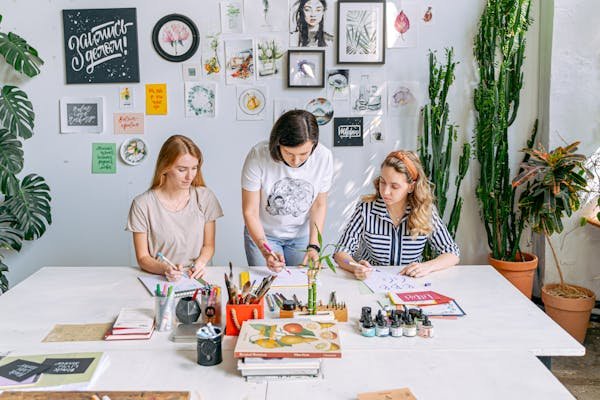
Image is representative of a generic art class. An appropriate image of ‘discarded art’, as was often the case during the years of the writer’s own schooling where art and murals were locked and forgotten in stores, is not shared here.

Art classes. There are so many art classes in so many schools in this city. And they create ‘stuff’ only to relegate most of it to the dark, fungal cupboards of the class. Some schools do not let the children take their projects home – especially if those are examination assignments – and most of the productions simply end up as piles of junk.

In school, we often made art no one eventually cared for. Most children created with half a heart because they could not ‘see’ the end purpose of this enterprise. “What’s the use of all this?” is a common complaint in classrooms and campuses.

Yet here, in this city, there are clinics and homes and bus stands that could use more art, more beauty.


Perhaps such discards can be salvaged for donations to needy communities, in a zero waste, circular society

Why is There a Gap Between the Two?

In this gap, one is forever needy, and the other is forever producing unappreciated, unused junk. There is a break in what ought to be a cycle of giving and receiving.

I recalled that some years ago, I became familiar with the idea of ‘service learning’ – that is, learning in academic settings through real service projects. For instance, a student of architecture would actually implement a working solution for a (needy) community in order to obtain a pass in the subject. Real service projects are carried out under this paradigm. What an idea! Academia does not waste years of knowledge that children acquire, asking them to wait till they grow up to become functionally useful (as traditional education does). One serves and learns as one goes – and (almost) everything that is produced is utilized.

Service. That was the key theme that I was digging for. Business, academia, communities, individuals – if they act to serve, not only will there be many needs fulfilled and bonds created but so, too, will there be less physical junk in the world.

Service. Service keeps our relationships cyclic, in action – service keeps us connected as people and as organized groups.

Service. This is what makes a human of whichever station or status useful and therefore connected to other humans.

Service. This is going to make life (more) sustainable – for sustainability is nothing more than ‘elements of life in an effortless perpetual cycle’, a definition I proposed in my article ‘Why We’re Failing to Sustain – and How Can We Succeed, Right Now’.

It all made sense to me. I looked down at the little crumbling cardboard slip in my hand. It was made out of the cover of a package which must have contained a cough syrup bottle within. The negligible little card had educated me about the scheme of things. It also showed me the way to begin.

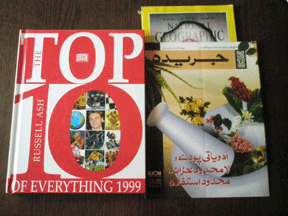
The items selected by the writer for donation. Even old books are great for people who cannot read but enjoy images.
(Note, the article was written in 2010.)

Bridging the Gap

On my next trip to the clinic, I am taking along with me some posters and books and magazines that I have tried to give away in the past. Mysteriously, they have refused to go away and ended up with me again. They know better; that there is a just-right place in the world for them; they refuse to be sold away to a paper junk dealer (one who thought they are ‘too good’ to be taken away) or to be taken up by visiting friends (“Too heavy! I shall take them next time!”).

I shall donate those to the clinic. My junk will become treasure through service.


NOTES:

This article is part of a series of articles Ramala Hubb’Allah wrote (with her then name) during 2008-11 for Pakistan-based publication, Triple Bottomline Magazine, published by Asiatic Public Relations. The publication’s focus was Corporate Social Responsibility, Climate, Environment, and Developmental themes. This is the seventh article in the series, published in March 2010. Original version in print; web version on the TBL site here.

This article not been edited except a headline and images and republished as it on The Salaam Matrix website. It is reproduced to present the collected body of Ramala’s works on the Triple Bottomline Magazine.


Why We’re Failing to Sustain—and How Can We Succeed, Right Now

How Do You Define ‘Sustainability’?

I just had an Aha! moment about what’s the problem with sustainability. Consequently, I saw how that “problem” can be fixed instantly. Because that problem does not lie in nature. The ‘problem’ is how we define sustainability.

This is the current (2009) Wikipedia definition and by design, it’s the current definition of the collective humanity:

“Sustainability, in a broad sense, is the capacity to endure. In ecology, the word describes how biological systems remain diverse and productive over time. For humans it is the potential for long-term maintenance of wellbeing, which in turn depends on the wellbeing of the natural world and the responsible use of natural resources.” (Wikipedia)

Additionally, this is a widely popular theory in business schools:

“When applied to business, [sustainability] refers to the ability of an organization to stay profitable over a long period.”

Earlier, I defined sustainability in Triple Bottom Line’s January/February issue, in the feature ‘How Collaboration Can Save the Planet – And Your Business’, as follows:


The Problem? TIME!

Comparing the aforementioned definitions, the problem with popular definitions of sustainability stands up like a prickly cactus thorn to attention: The problem with popular definitions of sustainability is that they are time-based.

‘Forever’ is not what sustainability is. Sustainability has nothing to do with time. Sustainability has to do with the “ability to sustain”.

The Two Tyrannies of Time

There are two natural, contrary outcomes of time-based definitions, both of which justify my suggestion of giving up the notion of relating sustainability with time:

1. Short-Term Gratification

The justification of short-term behavior. Because that would be the rational thing to do for those who sincerely cannot perceive what 10, 100, or a 1,000 years mean. Short-term behavior makes sense. Greed and fear are the consequences of a focus on “time”.

2. Long-Term Tradition

The preservation of tradition for the generations to come. This is the opposite of short-term behavior. In this scenario, people take a “higher path” – apostrophes intended – and decide to create a way for how their children, grandchildren, and their generations will live henceforth. They attempt to create a perfect system. In remote geographic locations, they can – because newcomers do not visit them. In accessible geographic locations, they become adamant traditionalists. “Our ancestors perfected a way of living,” the subsequent generations will say, “and it cannot be changed. It is the way of life.”

All “ways” of life have an expiration date, after which they become extinct, or they evolve. Only ‘life’ itself sustains, not one way or another. Life is the phenomenon of the change of ways, and yet the continuation of existence.

In sum, this concern with longevity and perennial ways and “the forever” leads to oppression. Because oppression is the only way that an outdated way can be granted life beyond its natural time.

Whether it’s the short term, or the long term – both are tyrannical, fundamentally harmful at any given time, and inappropriate. More importantly, they take attention away from what the purpose, mission and outcome of sustainability is: Giving.

Giving forth, yielding, nourishing, handing over to the Other. Sustaining the Other (and the Other reciprocates).

What Does It Mean “to Sustain”?

This is the definition of the word ‘sustain’ found in the Merriam-Webster online dictionary:

  1. To give support or relief to
  2. To supply with sustenance: nourish
  3. Keep up, prolong
  4. To support the weight of
  5. To buoy up. For example, sustained by hope
  6. To bear up suffer, undergo
  7. To support as true, legal, or to allow or admit as valid
  8. To support by adequate proof: confirm

Of these eight definitions, only the third definition has to do with the notion of time. Other online dictionaries have additional definitions. For instance, the Free Dictionary adds:

“To support the spirits, vitality, or resolution of; encourage.”

Dictionary.com has a definition that elaborates upon this in a way that the concept of ‘time’ is removed:

“To keep up or keep going, as an action or process: for example, to sustain a conversation.”

Another interesting definition is:

“To support the spirits, vitality, or resolution of; encourage.”

Hence, since the 13th century, the word ‘sustain’ has centered on the single concept of giving.


A Better Definition:

This improves, also, upon the way I understood sustainability earlier. Sustainability is still “the act of elements revolving in an effortless cycle”. “Enabling continuous giving” only looks at it from another angle. Which is, “What can we do to make this happen?” In other words, it grants humans (observers) will, power, and autonomy.

We need to answer this question because we ask this question. We ask this question because we are humans. We are sentient. And we want to do something.


Experiencing Sustainability:
Two Somatic Exercises

Sustainability is not ‘linear’ and it is not time-based. It is ‘cyclic’, it is right now. The best way to understand it may be to visualize it. Stand in a space, literally or mentally, and imagine these two scenarios:

1. You are standing in the middle of a long, wide road. Visualize yourself as a spot somewhere on this line, which represents a road. You are a spot traveling down the long road, having already traveled a long distance which is now behind you.


2. You are standing in a field. Extend both your hands outwards, spin, and imagine the whole, wide world around you. Right now. A big, round circle, radiating outwards from you. Feel free to imagine yourself to be the queen or king of the world.

⋆˚꩜。ּ

⋆˚꩜。ּ

⋆˚꩜。ּ

How do these two opposing scenarios make you feel?

It is when we experience that whole, big, circular nature of the elements of life, of the whole world, in one instant – as in the second imagery – that we begin to understand the nature of sustainability. When you perceive the world in this way, you will want the entire world to do well, because it will be your world.

This still requires work. It requires giving and contribution. It requires personal character and benevolence to live in such a world. It requires the ability to truly accept responsibility. It is also about experiencing the abundance of life, in the now. To think of ourselves is not to think of ourselves in terms of taking from others, but in terms of giving.

Sustainability is Harmony

If a major trouble with the world today is due to errant human behavior, then this implies that corrected human behavior shall prevent, stop, and in instances even reverse the damage. Indeed, we can look forward to a harmonious coexistence.

When we get out of obstructing the cycles of nature, eliminate our time-based fears and thereby let go of our greed and fear, let things be and learn to live with the vast, thriving, abundant planet – then we shall be able to hold it up. To nurture ourselves and our fellow elements on the planet. To partake in supporting the weight of existence as animals, plants and mountains and rivers have been doing far before humans first appeared on the planet.

To, in short, sustain the other and thus sustain our selves.


NOTES:

This article is part of a series of articles Ramala Hubb’Allah wrote (with her then name) during 2008-11 for Pakistan-based publication, Triple Bottomline Magazine, published by Asiatic Public Relations. The publication’s focus was Corporate Social Responsibility, Climate, Environment, and Developmental themes. This is the sixth article in the series, published in July 2009. Original version in print; web version on the TBL site here.

This article is lightly edited (reformatted, definitions cleared up) for clarity for republication on The Salaam Matrix website. It is reproduced to present the collected body of Ramala’s works on the Triple Bottomline Magazine.