The House of ‘Culture’ in the Salaam Matrix
First of all, let me tell you this fine day of June 2026: In the months since that I have been silent on this website, I have done excessive contemplations on The Salaam Matrix. I found an astounding number of applications of the model… applications and contemplations that are leading to constant revelation! And that has led to some profound discoveries that are going to solve some of the perennial knots in our heads about how to live integrated, coherent lives in this fragmentation of a century.
Take the insight about CULTURE. I am in the process of making several revisions to the model and asked myself:
“Where does CULTURE go in the Salaam Matrix?”
- Does it belong in the Socioeconomic Zone (Zone 3)?
- If so, is it powerful enough a factor for me to rename the Zone as “Cultural-Socioeconomic Zone”?
- Is it already a silent part of the Ecological-Political zone? Not very likely, because that is concerned with structure, policy, governance.
- Does Culture straddle the Personal-Familial Zone (2) and the Socioeconomic one, because the family zone definitely is a great determinant of culture!
To answer this, we need to put a few things together.
The Flow of Influence and Affect in the Matrix
With the rising investment of the global discourse and attention into the arena of politics,
With citizens around the world becoming increasingly vocal, investigative and hands-on with global and respective nation affairs,
With politics of the likes of the Strait of Hormuz affecting the price and freshness of groceries on the aisle of your North American and the volume of petrol in your Pakistani vehicle…
the discourse online has shifted from the era of when individual “influencers” and thinkers seemed to be shaping the world, towards a somber reflection about the interconnected nature of our world and how it impacts our daily, very local and very personal lives.
Are we the people shaping the world, or is the world not shaping us but is whacking us the people about at our workplaces, in our schools, and in our homes?
Earlier, I contemplated on the nature of flow of influence in the Salaam Matrix: Is it outside-in, or inside-out?
Where does that place culture?
Is culture an emergent quality of what persons and households do and believe, or is it imposed structurally from the top-down/outside-in from political atmosphere?
Or is there a meeting point in the middle?
I try to determine the placement and origin of Culture while my mind is inwardly shifting from feeling as though I affect the world, to observing how the world affects me. This line of inquiry is particular to me as a designer, guide, teacher and thinker who has long stayed at a distance from the world, and seen it as an observer, often through the crystal ball of the social Internet. At one time, it seemed that a handful of powerful actors were impacting key decisions in the world; but today, we have billions of voice on board and no clear sense of direction and point of origin of thought, action, and reaction.
Admittedly, this is happening in the backdrop of rising social suspicion about “hidden hands and forces” in the world, which some of us call by the mystery-laden moniker “they/them” in the Internet space. “They are hiding facts from us!”, “They are putting ideas in our heads and sowing conflict!” The distrust, whether right or wrong or partly correct, is high.
There are also classical polar discourses angling for attention and domination in the social spaces: The battle of genders with the classic “wars” between women and men even as we are introducing and cancelling new genders, leftism and rightism, North-West vs. South-East socioeconomic conflicts and struggles are not only dividing humanity on the one side and establishing health boundaries on the others, but many of us are left shaking and wondering where do we belong and what do we impact? And who and what is impacting us, and whether we have any say in this situation what with the absurd laws in some regions and the total lack of supervision in other regions… all clashing with one another in one glorious, largely unstructured space called the Internet.
Culture Is the Salaam Matrix
All this signals to me, after all, is a mix of felt and real lack of knowing and ownership about the world, about how the world is structured and composed, and how influence is made and how it travels. We are doing this force-field analysis in the backdrop of genuinely altered values, and the creation of new power and impact centers.
Culture is no longer of static and manufactured origin in this beautiful and wild world. Nor does it belong to any one Zone in the Salaam Matrix. This leads to the realization:
Culture is being birthed, lived, and transformed simultaneously in all four Zones of the Salaam Matrix in an autonomous population.*
Culture may in fact be what we feel and sense as the living activation of the Zones, once the Zones of the Matrix are set in motion in a population of concern! Culture is when the theater of life comes to Life!
* Controlled and dictatorial nations may still be birthing cultural directives in the decrees of government, and in other cultures, one or another generation is the keeper and designer of the symbols and traditions. Whether this is a source of tension or not, and how are shifts integrated, requires a separate examination.
Return to the Basics!
Now is the moment to pay homage to the farsightedness of the original 2006 paper that drew and defined the original version of The Salaam Matrix, and related that to “business”, which the model saw as integral to the society, not as a “cancer” that is sometimes becomes when it is seen as external, cruel, extractive, exploitative and unconcerned. This suspicion-laden view of business and socioeconomic activity is especially true in regions that experience conflict and alienation through colonization, unintegrated refugees and migrants, class conflict, educational disparity, and the felt sense that some of the ideas and practices within a population are somehow alien and not fully organic and absorbed.
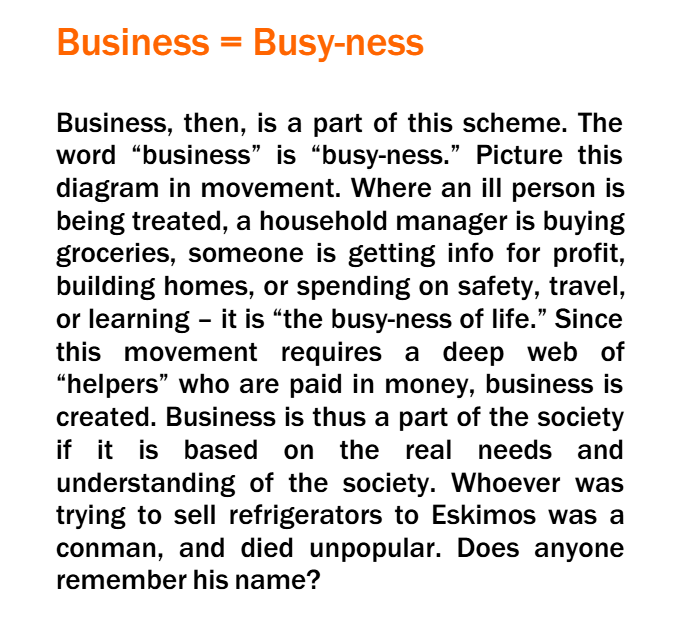
The Busy-Ness of Life
The seminal Salaam Matrix paper (then titled “The People-Centered Model of Business”) insisted that the life zones and the “roles” that people play in them are not static and isolated–they are dynamic, alive and in a flow. This is why the paper cheekily characterized “business”, then and to this day seen as a controlling, aloof, and uncaring entity, as the busy-ness, the movement, the sound and sights, the flow and the dance of life. Note that this does not imply that business and socio-economy bleed into all aspect of life and “no stone is left unturned and non-monetized” which would be cruel, absurd, intrusive and lead to distrust. Rather, business (the money one) was part of the woven fabric and the theater of living in dynamism, with seasons and from role to role as a person of certain beliefs, as part of a family and community, as part of the economic machinery of life and ultimately as an engaged citizen.
This movement, flux, and role shifts and integrations have always positioned The Salaam Matrix as a model that studies not just Elements, but also Relationships and Movements. What we called the “busy-ness of life” not all aspects of which are monetized but all aspects of which can be value-adding, intentional, and liable to upgrades and shifts by being treated with the same attention, discipline and accountability that we have wrongfully isolated in the business sector (Socioeconomic Zone in the Salaam Matrix).
Culture is Heritage and Movement
This is the idea that would need its own home as a longer reflection one day, but for now, the more I read the Salaam Matrix, the more I am tapping into the feeling that “Culture”, which is the source of argument and strife in many parts of the world including the once remote Himalayan regions where I live, is a mix of inherited and determined values, and also, the arrival and movement of new ideas and practices. In place that are far from the larger centers of exchange, the cosmopolitans and the ports of the words, change is slow and icon, ideas, and practices are retained for long. Culture tends to become more dynamic and is subject to intense and short-term flux in regions of the world where many tribes and practices converge.
This used to be a source of fascination but is now becoming a pain point in some place and a welcome shift in the other. This is exactly the kind of exquisite ambiguity and tension that the Salaam Matrix helps resolve or ease when a situation is processed using this tool, its features and the questions that it generates.
Culture is Intentional
Finally, Culture when seen through the lenses of the Salaam Matrix is neither esoteric, nor a hidden movement or force, but is seen to be seeding and germinating in many origin points across the Salaam Matrix zones, and the Roles and Relations within.
The atomic nature of The Salaam Matrix helps to pin down lineage, origin, problems, opportunities, and action areas in the Matrix with respect to culture and what enriches or depletes it. I imagine a situation where, when faced with hazy and angry opinions in a tense situation, a politician’s assistant is pointing them to the map and saying, “Madam Minister, this is where the conflict originates”. Or when two or more cultures are meant to merge, we find the points of convergence on this very map and identify the areas where most leverage lies–and take it from there.
–RH

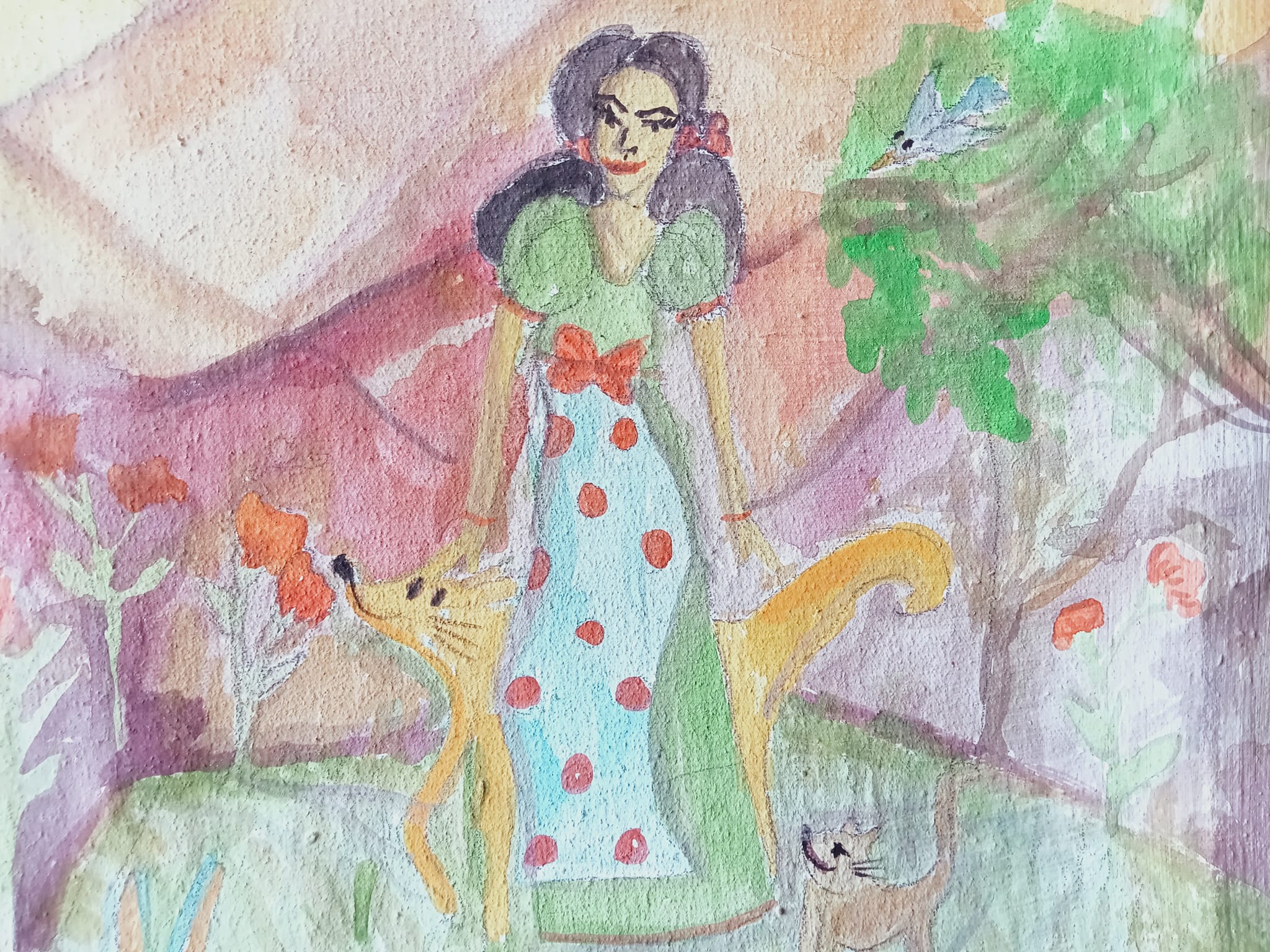 The current human civilization seems to define humans as predominantly consumers or, in other instances, as victims. There is a polarization: of the colonizers and the natives. This polarization is also the divide between those who are actively consuming planetary resources, and those who are serving those needs off their land. Another way the division runs is workers versus those who employ them. Another way the split runs is government that appears to “rule” the citizens. And yet another way this division runs is the exploitative and abusive (and not natural and benevolent) dominance of the Masculine over the Feminine, that has moved away from being supportive, loving and kind as it ought to have been.