Category Archives: New Economy

Chaos Today, Creativity Tomorrow

Why the World’s Falling Apart, and Why It’s a Good Thing

Author’s Note: After having written for Triple Bottom Line for three years, it is time to string the work together. My work has been about defining the Big Picture, re-imagining new definitions for old concepts, and indicating a path ahead. This is to give a context for social responsibility. If we understand what things are, and how they work, we may be internally motivated to make the right individual and collective decisions. This has been my drift. With this review, the reader may understand the great canvas upon which today’s dramatic events are painted. They will realize that this chaos was predictable all along.

Tip: View all the articles reprinted together on The Salaam Matrix website here. 

True Government of the People: It Starts!

As the scenes of a nation-by-nation Arab uprising unfold on the TV screen, I am reminded of the foresight published on the pages of Triple Bottom Line: “The Internet is the government of the commons, which has leveled social, and class and racial and other barriers. For the first time in history, humans across the globe have created a government that is truly a government of the people, by the people, for the people.” (The Internet: True Government of the People; Dec 2008 issue.)

Two years later, the words have rung true. On Facebook and Twitter, people are gathering to take down governments, to form alternative and inclusive governments, and to create bottom-up constitutions. Saudis have taken to the Facebook to create a group, “The people want reform of the system” (in Arabic). This group is proposing a 10-point constitution that includes “public freedoms and the rights of women”.

The point? The change that has been spoken of for so long is finally here. Internet has changed the nations, and it may even begin to reform physical boundaries if need be.

Meanwhile, WikiLeaks has transformed the art of governance using guerrilla tactics. One may say that WikiLeaks opens governments and Facebook & Twitter change governments. The change is not only of a national and international nature, but it is at once local and micro.

Change: All Hands, On Board!

That was the point of the June 2010 article, 6point8 Billion: The Citizen Stakeholders. We now have the technology to engage each and every person, potentially, in governance and creative enterprise. No human left behind. Using electronic connectivity, the human specie can develop the inclusive efficiency and enterprise of bee and ant colonies, and we can be as elegant as a shoal of fish that dances in amazing, instantaneous synchronicity.

But with great power comes great responsibility, and, some fear, great danger. Who will control this suddenly empowered humanity? Do we not need to return to an era of tightly controlling super-ethical rulers who rule badly behaving humans through a mix of fear and punishment? No. The times of humanity’s darkness are over (though the opposite seems to be the case). The evolutionary course of humanity has been running on such a path that eventually each person shall be responsible for their own action, and also have the capability to choose and comprehend their action without the need to turn to a single hero human (or ‘guru’) for their interpretation.

This is the highest form of an ethical society. This is not a governance-free society, rather a self-regulating one. In such a society, the core unit is an individual: their aspirations, enterprise, and the benevolent-for-others path that they take in order to both thrive personally and do well to the other.

This individual can only thrive in a hyper-connected world with instant accountability on the basis of a benevolent intent.

Benevolent Intent: ”I Am Here to Give”
What is a benevolent intent? The May 2008 interview, Intent, Care & Growth, with transformation consultant Etsko Schuitema answers: Intent is of two types — being here (in this life) to give or being here to take. The former intent is benevolent, and the latter, malevolent. It is not as though human beings must not receive from the world. Indeed, being receptive is a subtle quality of character. The difference in what a person pays attention to: the receiving part of the cycle, or the giving part?

The ideal collective ethic is that each being pays attention to what it has to give, to offer. In that case, the rightful receivers will automatically receive — and, in turn, they will give forward. (And when they do not receive their right, they struggle with incremental levels of force. This is just and fair.)
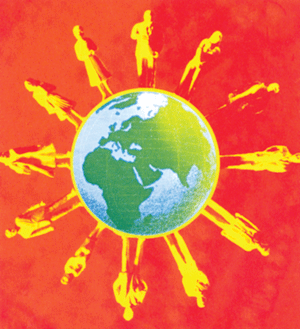
The cycle of life, in fact, starts with giving, not taking. That is the premise of the essay How Collaboration Can Save the Planet, and Your Business (Feb 2009). “Everything on this planet is part of a cycle of birth-death-regeneration. There is a water cycle, a carbon cycle, a consumption cycle. Money, too, revolves. It is spent-earned-spent. Each cycle has a starting point, and that point is ‘contribution’.” The effortless continuation of these cycles, and the deliberate removal of blocks that arise, is what Sustainability essentially is. Why We’re Failing to Sustain, and How Can We Succeed Right Now (July 2009) takes this theme further, and shares how Sustain-ability is not about ‘a very long time’; it is about presence, about doing things right in the moment.

Only then will eternity take care of itself. For what is eternity, but a string of single moments?

From Scarcity to Abundance

This shift to being concerned with giving, however, is difficult for some people. This may more likely be the case in a society that is marked with oppression and a lack of communal care. The individuals in such a society may perpetually experience a state of crisis, a lack of due attention. How can such a person make a shift to being a part of the flow of life (‘Sustainability’)? Why would not people be compelled to act selfishly? This is a genuine question, an authentic state of (sorry) affairs.

The answer may lie in shifting to an abundance perspective. The August 2010 Ramadan special article, This Ramadan, Count Your Riches: Scarcity to Abundance Perspective, sheds a surprising light on how accessible it is to shift to an abundance mindset with a simple question: “What do I have, right now, to get where I want to be?”

I will take a moment to swear for the effectiveness of this simple question by sharing my own story. I was thinking about my project Pakistan Changemakers Hub, and it occurred to me that this is the question a changemaker asks, versus a change-awaiter who is focused on needs. As I picked this thought to expand in the Ramadan article, I felt surprised by what I was writing: shifting from focusing on what one needs to what one has. I asked myself: how would that change my own life?

I realized I do not need another degree to start a new career; rather, I am enjoying the process of teaching myself a creativity course. I did not, after all, need another creative space to rent, too. My own house has become the backdrop of video productions, and I have finally realized that I prefer to toy with the Internet over traditional media in order to move an audience. (Before this insight, I wasn’t making focused use of the media I was advocating!) Now, I can create with more focus, and less distraction and waste of energy. A focus of what I needed was depleting my energy on search; a focus on what I have has brought me back to creation. As an extra reward, the process itself has become a continuous joy.

Asking this question is just as applicable to corporations. Or nations. Or groups of any kind. Focus on assets rather than needs. One would be surprised even further: they may find that what they considered a liability and a burden that was not leaving them alone was indeed their asset all along! The other August 2010 story, Not Flat But Textured, explored a subject that is at once dear and taboo to many: the subject of one’s family and community as one’s asset, not a liability, as one engages in creation.

Caring Co-Creation

Creativity (which is perhaps the real thing that is referred to by the much smaller concept of economic activity) is an embedded human trait. All humans create. Yet somehow the world of creativity has shrunk to refer only to ‘economic activity’, and that has shrunk further to only mean ‘jobs’. By this line of thinking, those who do not have jobs are not participating in creative activity. Enter: families. Mothers engaged in caring for children, people who are supporting other people who do jobs, and others such who create, but are not necessarily employed or selling. Families also make mobility less likely, and somehow, jobs can be dispersed in geographical areas that one may not even prefer to work in, but one must relocate to because of employment.

There is not anything necessarily wrong or evil about this. It is only that this was a less-than-perfect system which did not fully accommodate the needs of those who would balance freedom with (personal) growth and the ability to create.

This requires several spinal adjustments for the society. First, the issue of mobility is now largely solved through the Internet. Also, work has restructured such that one person can do the multi skilled job of an organization (Future Scape: An Organization of One; July 2008). Secondly, if creativity is seen as more than ‘having a job’ but rather as value addition and service, more people will be relieved of the burden of feeling and acting uncreative. This re-definition may foster greater creativity within families and communities, where some members currently lie dormant as ‘reserves’, making no good of their talent because there is no attention on them, no opportunity for them. Third, seeing families and communities as resources rather than as liabilities can yield several benefits to each creative member of the family: this ranges from psycho-social relief to lower carbon footprint to the opening of new possibilities of doing projects with people who are most willing and available to one, and with whom there is a natural relationship of care, trust, and interdependency. The family and the community as a creative unit is an untapped, phenomenal force of benevolent change in the world. The key factor is CARE.

This care-based co-creation is the subject of ‘Service’ Lets the World Stay Round (March 2010). If we create to serve, the needs of individuals in the social group will be spontaneously fulfilled.

A self-organizing, coherent system will arise which will simultaneously fill need gaps and create less junk on the planet.

The question now arises: what is my community? The answer is: how far can you see?

From ‘The Individual’ to ‘The World’
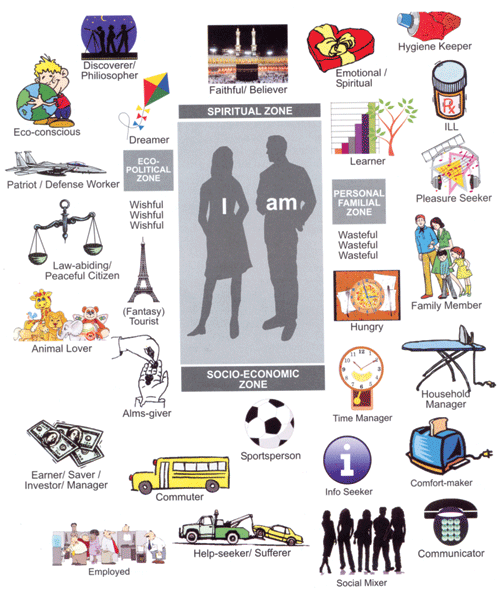
The template for seeing the individual in the context of their family and society and ‘world’ is presented in The People-Centered Model of Business (March 2008). In this simple visual model, the individual “I” is at the center, with four life-zones mapped around them: the spiritual zone, the personal-familial zone, the socioeconomic zone, and the ecological-political zone. Premise? All this activity, which I called ‘business’, owes to the presence of the individual. This is a tool first and foremost for seeing– seeing the society in terms of its individuals, and study them in the four life zones.

Perhaps I should rename this tool The Person-Generated Model of Creativity. I never felt it had quite the right name. I did define business as ‘busy-ness of life’, which must have been my then-word to refer to the big elephant in the drawing room: CREATIVITY!

Note: The model is now called The Salaam Matrix.

Our Future: Collective Creativity

The story comes full cycle: why are humans tearing down the boundaries? Boundaries of what, and for what? I am willing to bet that it is a frustrated creative force at work. The Internet has unleashed the giant of human potential. It can no longer be contained within the bounds of conventions. The nature of the struggle of various peoples is different; their direction is the same.

Our world is not operating in a balance right now. To redress the drastic imbalance, we are applying patchwork fixes, such as the Giving Pledge by Bill Gates, Warren Buffet, and other billionaires (Giving: The New Imperative; Oct 2010). Currently, these fixes are needed. Ultimately, humanity needs to move beyond this historical seesaw of injustice/ drastic redressing.

Humanity needs to move, with each person on board, towards collective creativity.


NOTES:

This article is part of a series of articles Ramala Hubb’Allah wrote (with her then name) during 2008-11 for Pakistan-based publication, Triple Bottomline Magazine, published by Asiatic Public Relations. The publication’s focus was Corporate Social Responsibility, Climate, Environment, and Developmental themes. This is the twelfth and the last article in the series, published in May 2011. Original version in print; web version on the TBL site here.

This article has been published largely without changes, in its original form, on the Hubb’Allah website. It is reproduced to present the collected body of Ramala’s works on the Triple Bottomline Magazine. An updated version with new cases and applications will be available on the Hubb’Allah website soon.

If you enjoyed this article, you may enjoy this YouTube playlist by Ramala Hubb’Allah (below).
Collaboration: How it Can Save The Planet – AND Your Business!

What’s Our Problem?

By the time this article is being written (February 2009), it is clear: those who warned against the unsustainability of greed (getting more than one deserves) and fear (contributing less than one’s potential) are vindicated. No matter what the consultants advocate, the truth is that the old way of working is over. Now that we have damaged the planet sufficiently, and as a result hurt the population that rests upon it – is it any surprise that neither the planet nor the people can afford the ways profit is made?


The lesson is clear: No Planet, No People. No People, No Profit.

This is a mantra that needs no other proof than the current state of affairs. No matter the details of the collapse, there is a single concept that sums the situation and its possible remedy: ‘Sustainability’.

Sustainability: a Simple Definition

Everything on this planet is part of a cycle of birth death regeneration. There is a water cycle, a carbon cycle, a consumption cycle. Money, too, revolves. It is spent-earned-spent. Each cycle has a starting point and that point is ‘contribution’. It starts when Entity A chooses to contribute to the ‘Whole’/System (Entity B). Then Entity B pays it forward, until the contribution returns to Entity A in a new form. Entity B can be one person, or it can be many. For example, if I work as a guard in a TV channel, I contribute by letting in the right person (who has the potential to become a talented actor) through the door and keeping the gatecrashers out. Overtime the actor clears audition and performs in a play. The play is aired and earns the channel its income. I get my salary. This is a cycle – this is ‘Wholeness’. It is true for all systems of the entire world; the only difference is the level of complexity.

Given that the start of a cycle is at contribution; the life cycle starts at birth, the water cycle at rain, the money cycle initiates at spending, and the cycle of business starts at enterprising talent.

But there can be no continued contribution unless there is graceful reception on the other side. So in totality we can see a cycle as ‘an act of cooperation, a continued collaboration’. The giver is also a receiver – always. We receive with realization and give with choice.

Simply defined: Sustainability is “the act of elements revolving in an effortless cycle.”

A cycle is a complete loop. The very definition of unsustainability is an incomplete loop – a cycle broken by excess (accumulation) or by withholding (depletion).

The Giant Collapse of 2008

If material stuff is produced, but not recycled back into the system, we will end up with pollution: blocked drains, toxic landfills, and smoke-filled air. If there is money earned such as through big business, but not spent back such as through fair wage, we will end up with vast populations unable to afford business any longer – and at a tipping point, the whole system will suddenly collapse. That tipping point was reached in 2008 – when all unsustainable cycles from the natural to the economic collapsed together.

The Solution: Enable Sustainability Through Collaboration

When bad times hit, do what the poor do: help one another. Create sustaining relationships, keeping in mind the definition above: sustainability is a cycle when it is in smooth motion. This also means that when it is time for a certain cycle to end, such as in the case of an end to an entire industry, everyone in the cycle can sense the closure at once and get prepared to move on. It is more difficult to move on to bigger and better things when one is either too empowered or too weakened by a dysfunctional cycle. The first one has a vested interest in keeping things as they are, and the second one has no willpower.

It is tragicomic that in spite of the 2008 catastrophic wipeouts, most organizations are still pursuing the aim of meeting their old projected profits and other objectives using the same methods that often directly brought about this breakdown.

It is clear by now that the game and the rules have changed. But how do we move on? The real issue at this time may be a sense of insecurity and high uncertainty – the end of greed and the beginning of fear.

In my view, this is exactly the current challenge. We are no longer oblivious of the fact that the planet is in peril, and people are severely endangered from our own actions and the backlash of nature. It is also apparent by now that we have at once the responsibility, and (some say perhaps) the power to do something.

Interestingly, at this point in human history, we happen to have a technology for every need. We have also tested almost every social, political, and economic system great human minds could envision. In other words, the “hard” and the “soft” elements are present. What, then, do we need?

Answer: Collaboration

Wikipedia defines collaboration as: “A recursive process where two or more [entities] work together towards an intersection of common goals. For example, an intellectual endeavour that is creative in nature – by sharing knowledge, learning and building consensus.”

Precisely because we have all the requisite technology and ideology at our disposal, our next task is to put things together in a way that benefits the wholeness of our systems. The systems are already whole (cyclic) by their nature and definition. Our real task is to develop a method that facilitates the motion of cycles. And that method is a value: working together. Collaboration.

Collaboration is a means to an end: the end is sustainability – enabling the cycle of life.

The Principle of Collaboration

There are several processes, behaviours and conversations that relate to collaboration. They are too many to remember intellectually. Another approach is to understand the fundamental principle, and then apply it to individual situations. The basic principle is: Collaboration is to facilitate the motion of a cycle. The two aspects of the cycling principle are:

  1. Increase/facilitate flow.
  2. Reduce blocks.

The first aspect is about being creative. The second aspect is about removing obstacles to creativity. Essentially both achieve the same result, but are needed together. In my view, it is the second aspect that is the real need of the time.

Easy Guidelines for Situational Collaboration

It has been assumed for a while now, especially in the business and political world, that relationships can be ‘created’. There exist fundamental principles of relation between the large and small, giver and taker, weak and powerful, etc. The task of collaborative practices, then, is to honor that which exists and to orchestrate that to use – not to attempt to forge something beyond the system.

Based on this understanding, situational collaboration can be developed.

1. Work With What Is

Resource utilization is a critical contemporary issue. Though often we are concerned with “over-utilization,” the sustainability principle suggests that in each instance something is over-utilized, there is another thing that is being under-utilized – because it is ignored or sacrificed.

The solution is to ‘work with what is’ – evaluate one’s assets, and contribute. Rather than want more resources than are already given, work with what is already given. It is far better to adjust one’s ambitions and ideas than to stretch or waste one’s resources.

2. Work With Who Is

One of the anomalies of the workplace is the poor utilization of people’s talent – though humans are the fundamental orchestrator of all creativity! Author Etsko Schuitema suggests in his “Care & Growth Model of Leadership” that we only have the license to help someone grow if we care for them.

If the utilization of a person’s energy under our supervision is to help them grow, what precedes this is taking care to get to know the innate potential of that person.

There is an inborn quality in each person. That quality shapes their contribution. It is the task of the system as a whole and a leader in specific to see that quality and co-create work around it. Schuitema suggests that work is a means to engage the individuals in a relationship. This brings delight back into relationships, even in the work arena.

An implied application is to use experiential experts’ help. Receive the knowledge that others have to offer. Often we refuse to work with talent that is available, in order to pursue imaginative goals. In Pakistan’s context as well as of other developing nations, this non-acceptance of our unique abilities and offerings is leading to the belief that there is a dearth of talent. If that were the case, none of the developing nations would be able to destroy as much as they do, for destruction suggests the presence of energy not utilized.

3. Increase Collaboration, Reduce Competition – Deliberately?

Competition has long been a virtue, and it had its rightful place in the evolution of human endeavor as we strove to push the boundaries of our potential and existence. I think there is less blame to be assigned to competition itself – rather the need is to realize that the time to compete has simply passed.

In this age, we must intentionally lower “competitive think” and replace it with “collaborative think”. In my work with a beauty products client, for instance, we have chosen to see household-based women entrepreneurs as friends and partners rather than as threats to our business. There is an acceptance that there will increasingly be small entrepreneurs who will test their own mettle. Traditionally the Big Business attempts to drown them out. My client took the approach of changing their business model to a modular one that suits the variable nature of workers in the fragmented marketplace for today. The immediate benefit is that energy is now reserved to co-create joyful solutions, and to do the real task of carrying the product to consumers to enhance their life – rather than being consumed by the anxiety of overcoming beyond control “competition.” (Note: We used homebased bloggers as beauty influencers in 2008, before it was a thing!)

4. Minimize Legislation, Maximize Relation

Legislation is oft invisible but often the most powerful of blocks in the way of human endeavor and relationship. The problem is very simple: we have come to believe that legislation exhausts the list of all possibilities.

Therefore, there must be a law for every DON’T and a description of every DO. This is a fallacy. Law is a limitation, and its only function is to mark boundaries and off-limit areas in a relationship. The off limits are those where, by definition, the relationship ends if one or all partners venture there.

Legislation is not the fullness of a relationship. It is the boundary of a relationship.

The best constitutions of the world, therefore, are short or non-existent. A constitution as exacting as that of Pakistan, for instance, anticipates being violated as relationships and their needs evolve and as boundaries – which are not fixed – are re-marked.

Part of this practice in business is to create projects based on mutually ‘engaging’ rather than ‘acceptable’ terms. When we engage another on the basis of their fulfillment and joy they would co-create happily with us, while we can also create a beneficial ethic amongst ourselves, which helps the whole system.

The Technology

There are two broad types of technology: one is soft (conceptual), the other hard (quasi-physical/physical). The best kind the first technology is described already: it is relationships – amongst people, and then people and every living and non-living thing.

The best of the second type of technology is the Internet, identified as “the supreme communication network” and the “enabler of people” [the first and the vastly more important element in collaboration] in this Intent and Attention Era.

Outcome: Benefits of Collaboration

One would like to round off a solid case for collaboration by listing a set of definite outcomes. This, however, is not a great idea because ‘definite’ also means ‘limited’ – and limitation is resisted by human nature. Indeed it is a block in the cycle of growth. The truth is that the outcome of collaboration depends upon the clarity of understanding what it truly means to work together, to contribute, and the sincerity and intelligence with which this way is made a practice.

Despite this, the very technology of collaboration – such as shared workspaces – immediately yield certain benefits, such as:

1. Reduced Activity Footprint

Using fewer things means lesser material is being churned out on the planet and there is less pressure on the already exhausted systems. Carbon is a fundamental measure for “activity.” Eliminating the non-essential and sharing resources implies reduced activity and therefore reduced carbon footprint.

2. Reduced Cost: Competition is Cost

Primarily because it takes attention away from creative opportunities and the right application of one’s talent. Often an entity competes with one that is different from it. I have seen media enterprises in Pakistan who ditched their niche to chase the rival’s territory (such as entertainment) – and hence led to the decline of both. Competition is a cultural phenomenon that has led to megalomania-driven growth, and decline. Henceforth, our growth should be based on service to the whole system, not competing with elements.

3. Healthy Interdependence

This is a state where all elements in a cycle support and rely on each other and are clearly aware that mutual benefit is the real benefit. This is most practical at a local level where community members work with each other and support others’ enterprises.

It is my belief that the issue that we face is not of meltdowns and painfully wrenched bailouts. It is the issue of bringing values back to the way we work. The values, in turn, are employed so we can experience the joy of being alive. That joy, I believe, is the real aim and must become a part of the world of business – and the business of the world. Collaboration, when practiced faithfully, is that joy in itself.


NOTES:

This article is part of a series of articles Ramala Hubb’Allah wrote (with her then name) during 2008-11 for Pakistan-based publication, Triple Bottomline Magazine, published by Asiatic Public Relations. The publication’s focus was Corporate Social Responsibility, Climate, Environment, and Developmental themes. This is the fifth article in the series, published in Feb 2009. Original version in print; web version on the TBL site here.

This article is lightly edited for clarity for republication on the Hubb’Allah website. It is reproduced to present the collected body of Ramala’s works on the Triple Bottomline Magazine.